WHO Declares Bundibugyo Ebola Outbreak a Public Health Emergency of International Concern, the First Since 2024 Mpox
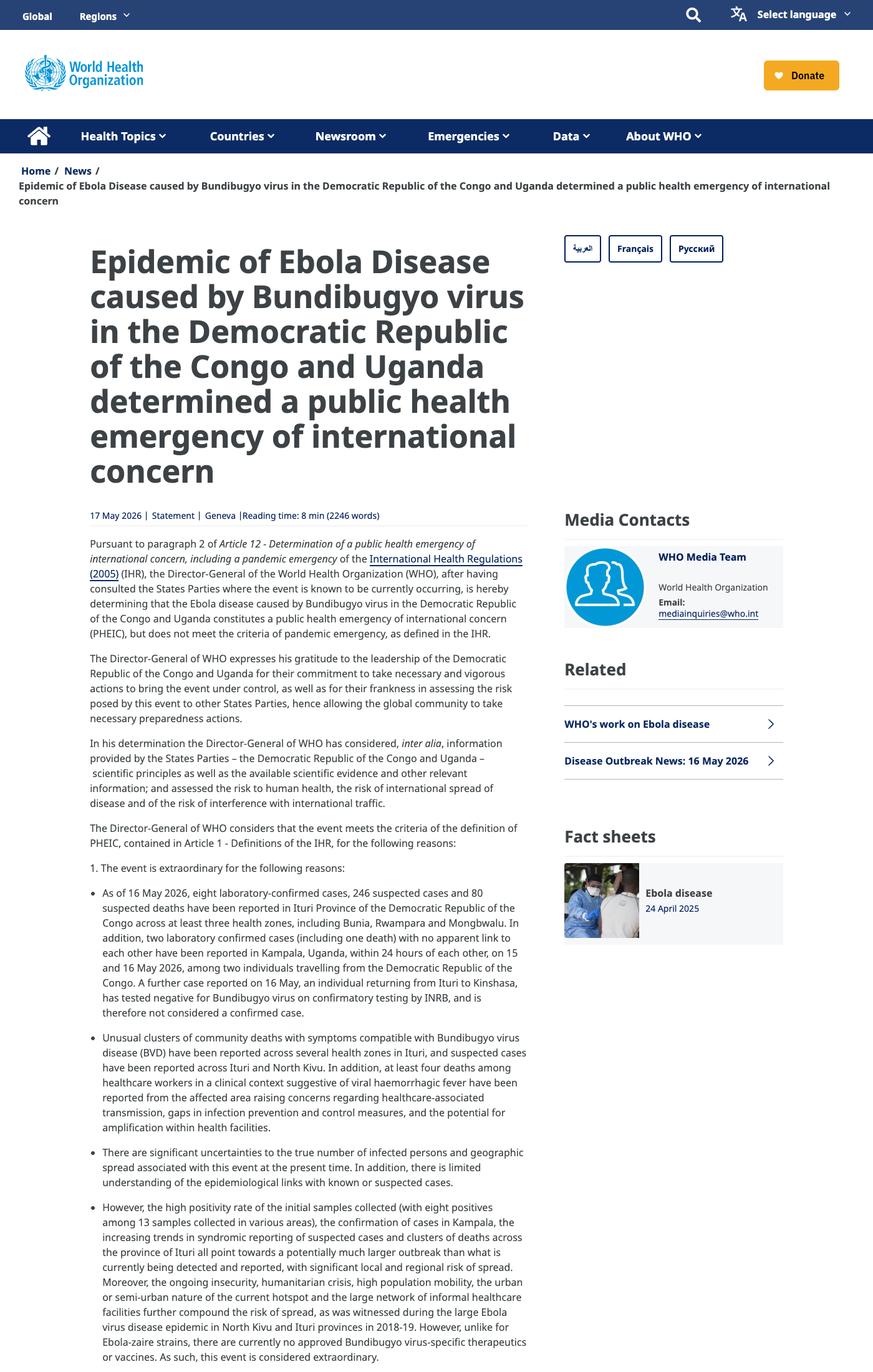
On May 17, WHO Director-General Tedros Adhanom Ghebreyesus determined that the Bundibugyo virus outbreak across the Democratic Republic of the Congo and Uganda meets the criteria for a Public Health Emergency of International Concern — the 9th PHEIC ever declared. As of May 16, DRC reports 246 suspected cases and 80 suspected deaths in Ituri Province; Uganda has confirmed two imported cases in Kampala, with one death. No licensed vaccine or therapeutic exists for the Bundibugyo strain.

The World Health Organization on May 17 declared the ongoing outbreak of Ebola disease caused by Bundibugyo virus in the Democratic Republic of the Congo and Uganda a Public Health Emergency of International Concern — the highest alarm level under the International Health Regulations and only the 9th such declaration since the framework took effect in 2005.
WHO Director-General Tedros Adhanom Ghebreyesus issued the determination under Article 12 of the IHR after consulting affected states, finding that the outbreak meets the three statutory criteria: it is "extraordinary," it poses a public health risk to other States Parties through international spread, and it requires coordinated international response. The Director-General committed to convene the IHR Emergency Committee "as soon as possible" to recommend temporary measures for States Parties.
The numbers as of May 16
Per WHO's Disease Outbreak News 602, published May 16:
- DRC: 8 laboratory-confirmed cases, 246 suspected cases, 80 suspected deaths across three health zones in Ituri Province — Rwampara, Mongbwalu, and Bunia. Four deaths among confirmed cases. The presumed index case, a health worker in Mongbwalu, developed symptoms on April 24; WHO was alerted on May 5 to an unknown high-mortality illness after at least four health workers died within four days of each other.
- Uganda: 2 confirmed imported cases in Kampala, with 1 death. The first case, a 59-year-old Congolese man, was admitted to Kibuli Muslim Hospital on May 11 and died on May 14; a second imported case, with no apparent epidemiological link to the first, was confirmed on May 16 and is being treated in Mulago Hospital's isolation unit, per Uganda's Ministry of Health press statement.
- Cross-border exposure: Ituri borders Uganda and South Sudan. WHO notes the cluster includes "frequent cross-border travel, all of which may increase the risk of further transmission."
DRC's Ministry of Public Health, Hygiene and Social Welfare formally declared the country's 17th Ebola outbreak on May 15. Uganda's Ministry of Health confirmed its first imported case the same day.
Why this PHEIC is different: no licensed vaccine for this strain
The most consequential operational fact about this outbreak is one that other Ebola emergencies have not faced. Merck's Ervebo — the only WHO-prequalified Ebola vaccine, used in ring vaccination during the 2018-2020 Kivu outbreak and DRC's 2025 Equateur outbreak — is approved only against Zaire ebolavirus. It does not have a licensed indication for the Bundibugyo species (Orthoebolavirus bundibugyoense).
There is no approved monoclonal-antibody therapeutic for Bundibugyo either. Inmazeb and Ebanga, the two licensed Ebola treatments, target the Zaire-strain glycoprotein.
Bundibugyo is one of the four Ebola species known to cause human disease and one of the rarest. It has been recorded in only two prior outbreaks: a 2007 event in western Uganda (131 cases, 42 deaths, case-fatality ratio roughly 32%) and a 2012 outbreak in Orientale Province, DRC (57 cases, 29 deaths, case-fatality ratio approximately 51%). WHO cites a historical Bundibugyo case-fatality range of "approximately 30% to 50%" — lower than Zaire-strain Ebola's typical 50-90% mortality, but with no licensed countermeasures to apply.
Cross-protection against Bundibugyo from Ervebo has been shown only in small non-human primate studies; it is not the basis for a licensed indication, and WHO has not endorsed using Ervebo as a Bundibugyo countermeasure. Candidate vaccines and therapeutics targeting Bundibugyo specifically — including Mapp Biopharmaceutical's MBP-134 and Auro Vaccines' VesiculoVax-vectored construct — remain in pre-licensure development. The PHEIC declaration is in part a vehicle for accelerating clinical trial protocols for these candidates inside an active outbreak, an arrangement the WHO Director-General's statement explicitly contemplates.
Africa CDC and US CDC response
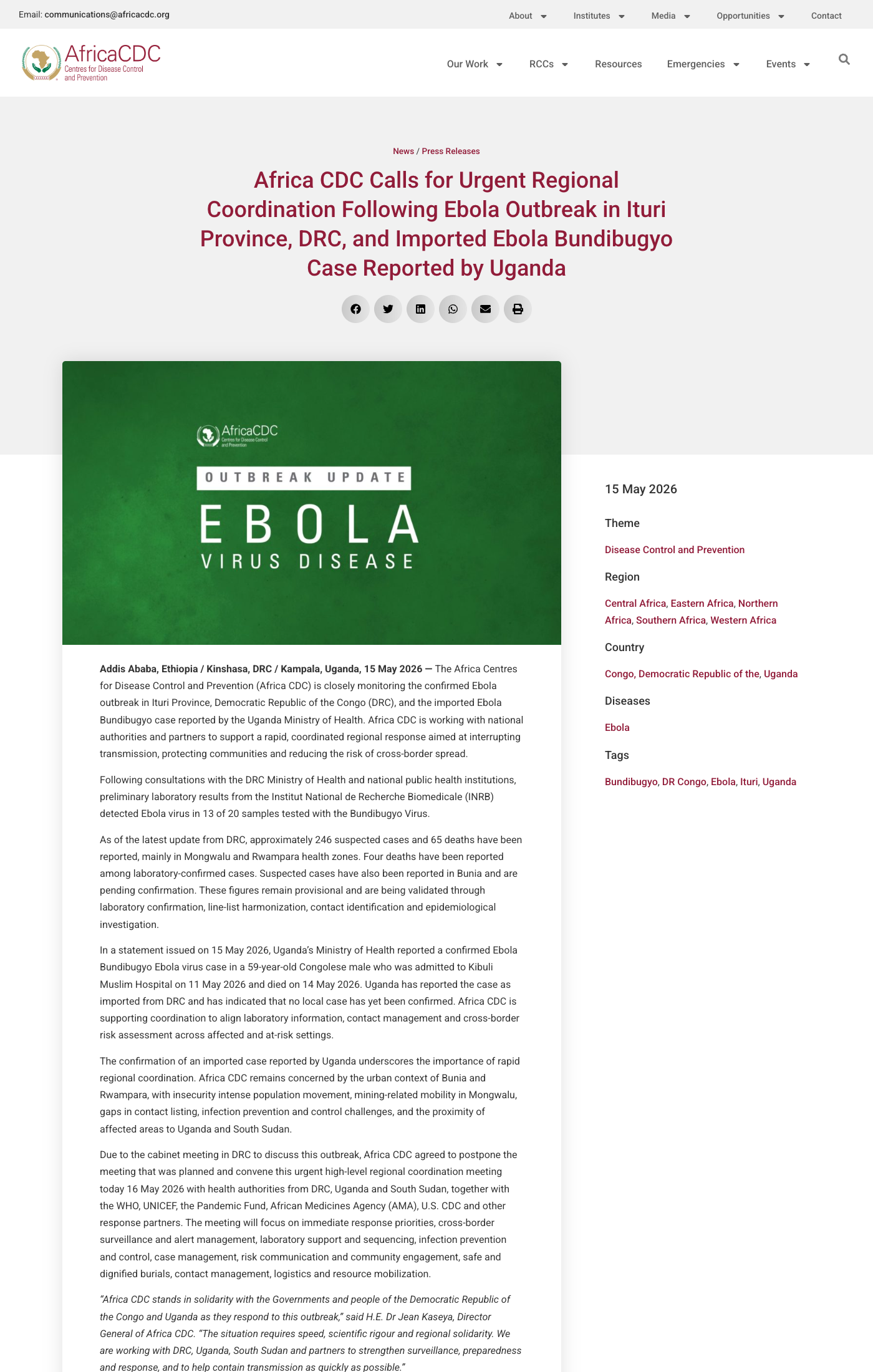
The Africa CDC activated an Incident Management Support Team on May 15 and convened a high-level coordination meeting with DRC, Uganda, South Sudan, WHO, and partner organizations. Director-General Jean Kaseya said the response "requires speed, scientific rigour and regional solidarity." Surge teams have been deployed to both affected countries; a medical countermeasures workstream has been established.
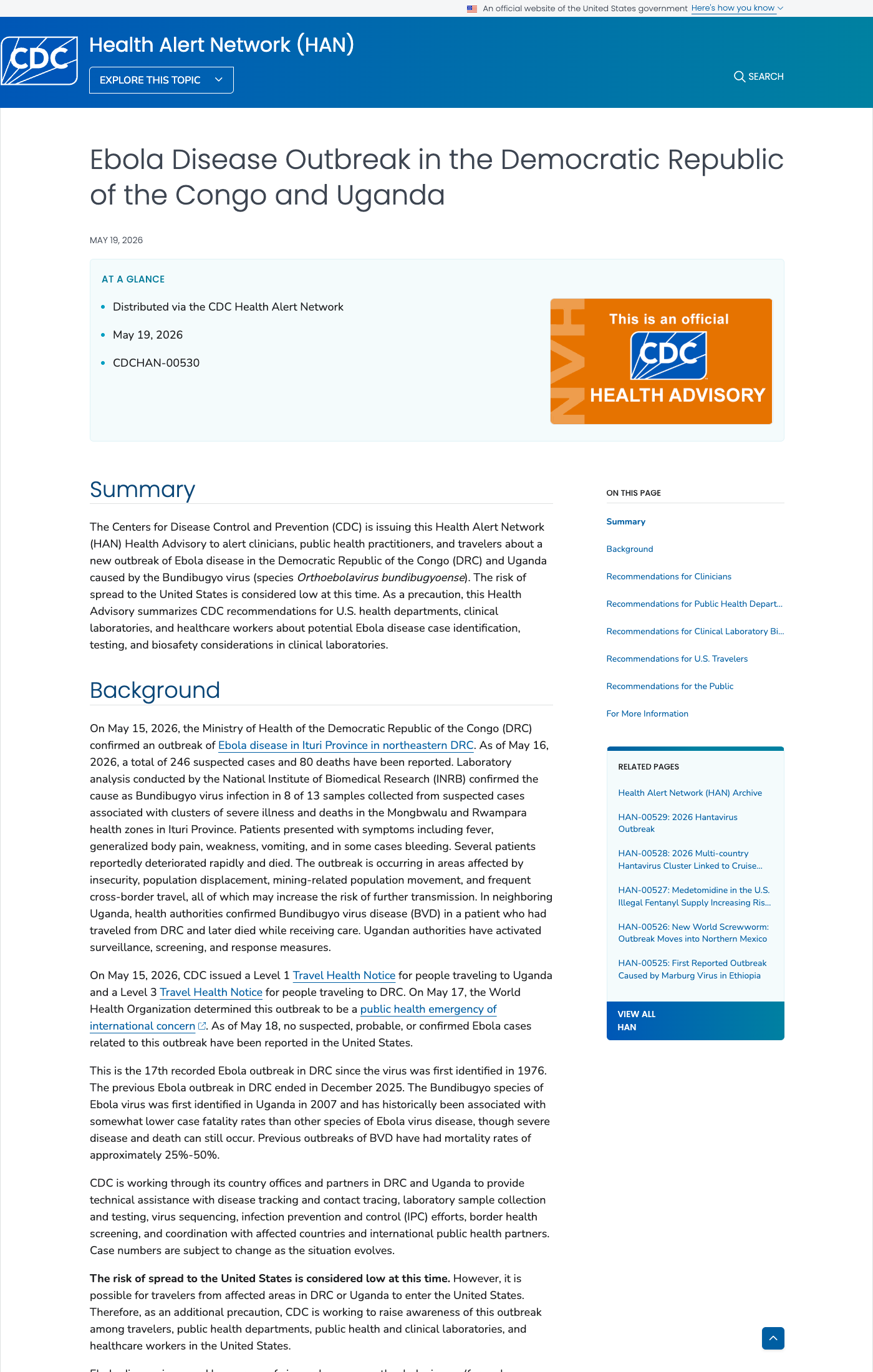
The U.S. Centers for Disease Control and Prevention issued Health Alert Network notice CDCHAN-00530 on May 18, instructing U.S. clinicians, public health practitioners, and laboratories to obtain travel history and consider Bundibugyo virus disease as a differential diagnosis for any person with compatible symptoms who has been in DRC or Uganda in the prior 21 days. CDC assessed the risk to the U.S. public as low but issued the alert to ensure detection in returning travelers. A Level 3 travel health notice is in force for DRC; Uganda carries a Level 1 notice.
The PHEIC framework, by the numbers
A PHEIC is the highest alarm under the 2005 International Health Regulations. WHO has declared one nine times since the mechanism became operational:
- 2009 — H1N1 influenza A pandemic
- 2014 — Wild poliovirus international spread (ongoing)
- 2014 — Ebola virus disease in West Africa
- 2016 — Zika virus and clusters of microcephaly
- 2019 — Ebola virus disease in eastern DRC (Kivu)
- 2020 — COVID-19
- 2022 — Mpox, multi-country clade IIb outbreak
- 2024 — Mpox, upsurge driven by clade I
- 2026 — Bundibugyo Ebola in DRC and Uganda
Three of the nine have been Ebola outbreaks. The 2014 West Africa epidemic killed more than 11,000 people. The 2019 Kivu PHEIC ended in June 2020 after over 2,200 deaths and the first deployment of Ervebo at scale. The current PHEIC opens a third Ebola chapter — this one without a licensed vaccine.
Operational context
The outbreak is unfolding in Ituri Province, a part of eastern DRC under significant active conflict. WHO's situation summary notes the outbreak occurs "in a complex humanitarian setting, with limited access in certain locations, weak surveillance, and population movement." The 2018-2020 Kivu Ebola outbreak — adjacent to Ituri — was extended and amplified by attacks on Ebola treatment centers and vaccination teams.
The next dated operational milestones are the IHR Emergency Committee meeting (TBD; WHO committed to "as soon as possible"), the Africa CDC regional coordination meeting outputs, and DRC/Uganda's daily case reporting. WHO will issue updated DONs at minimum weekly per its outbreak reporting cadence; the next is due on or before May 23.