Emperor Penguin Declared Endangered as Antarctic Sea Ice Hits Record Lows
The IUCN moved the emperor penguin from Near Threatened to Endangered, projecting the population will halve by the 2080s as sea-ice break-up accelerates. The Antarctic fur seal was also reclassified to Endangered after a 57% population crash since 1999.
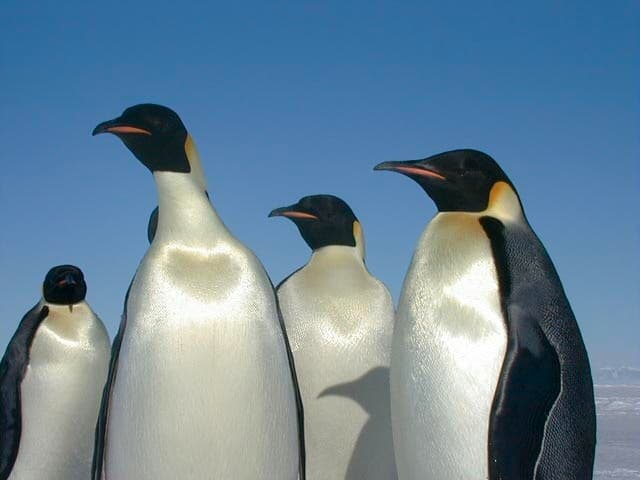
The emperor penguin -- the tallest and heaviest of all living penguin species and the most iconic animal in Antarctica -- has been declared Endangered on the IUCN Red List of Threatened Species, the international body announced on April 9.
The species was previously classified as Near Threatened. It is now two steps from extinction on the IUCN scale.
Satellite imagery shows the emperor penguin population declined by approximately 10% between 2009 and 2018, a loss of more than 20,000 adult birds. Under current climate projections, the IUCN expects the population to halve by the 2080s.
What's Killing Them
Emperor penguins depend on fast ice -- sea ice attached to the Antarctic continent -- for breeding, moulting, and resting. They are the only penguin species that breeds during the Antarctic winter, and their chicks need stable ice platforms from April through December to survive.
Antarctic sea ice has reached record lows since 2016, and early spring break-up has already disrupted colonies around the continent. When the ice breaks up before chicks have developed their waterproof adult feathers, they drown. In several recent seasons, entire colonies have suffered complete breeding failure.
The IUCN assessment, coordinated by BirdLife International through the IUCN Penguin Specialist Group, identifies greenhouse gas emissions as the primary driver.
Not Just Penguins
The same Red List update reclassified two other Antarctic species:
| Species | Old Status | New Status | Key Metric |
|---|---|---|---|
| Emperor penguin | Near Threatened | Endangered | Population to halve by 2080s |
| Antarctic fur seal | Least Concern | Endangered | 57% decline: 2.19M (1999) to 944K (2025) |
| Southern elephant seal | Least Concern | Vulnerable | 90%+ pup mortality in some colonies from avian flu |
The Antarctic fur seal's collapse is driven by rising ocean temperatures pushing krill -- their primary food -- to greater depths, combined with increased predation from killer whales and leopard seals, and competition from recovering baleen whale populations.
The southern elephant seal's reclassification is linked to Highly Pathogenic Avian Influenza (HPAI), which has spread through Antarctic wildlife since 2020 and now affects four of the species' five major subpopulations.
Why It Matters
The emperor penguin is the first Antarctic species to be declared Endangered primarily due to climate change rather than direct human exploitation like hunting or fishing. It functions as a sentinel species -- a biological early warning system for the health of the entire Antarctic ecosystem.
"These important findings should spur us into action across all sectors and levels of society to decisively address climate change," said IUCN Director General Dr. Grethel Aguilar.
The reclassification carries no binding legal force -- the IUCN Red List is an assessment tool, not a regulatory framework. But it influences conservation funding, research priorities, and international negotiations. The emperor penguin's status will be a reference point in upcoming discussions under the Antarctic Treaty System and the UN Framework Convention on Climate Change.