Nigeria Convicts 386 Boko Haram and ISWAP Suspects in Four-Day Mass Trial at Federal High Court Abuja
Attorney-General Lateef Fagbemi says Phase 9 of Nigeria's mass terrorism trials produced 386 convictions out of 508 defendants over four days at the Federal High Court in Abuja. Sentences range from eight years to life imprisonment; the next phase is scheduled for 15-18 June.
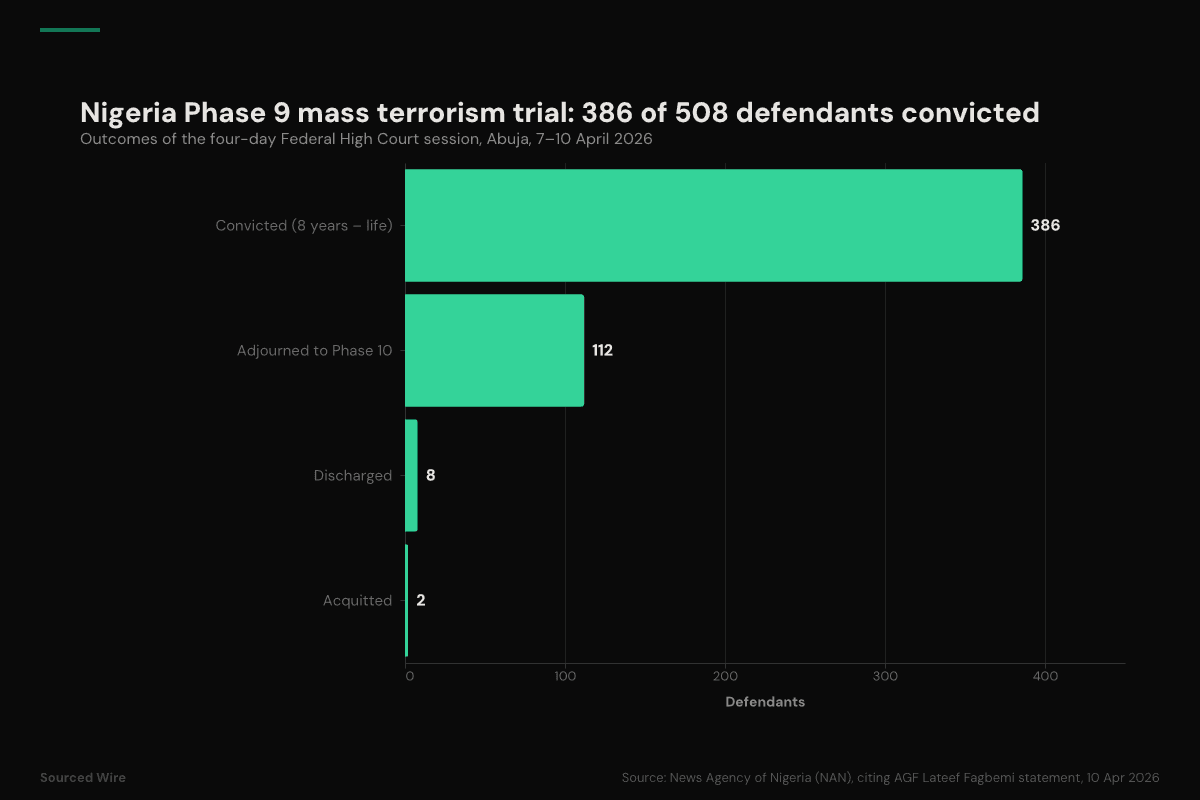
Nigeria's Attorney-General of the Federation and Minister of Justice, Lateef Fagbemi SAN, told reporters on Friday, April 10 that the federal government had secured 386 convictions in the Phase 9 sitting of its mass terrorism trials at the Federal High Court in Abuja. According to the official statement released by the News Agency of Nigeria — Nigeria's state-owned news service — the four-day session began on Tuesday, April 7 and processed 508 defendants before ten specially constituted courts.
The outcomes, as disclosed by Fagbemi, break down as follows:
| Outcome | Number of defendants |
|---|---|
| Convicted | 386 |
| Adjourned to Phase 10 (15–18 June) | 112 |
| Discharged | 8 |
| Acquitted | 2 |
| Total arraigned | 508 |
Convicted defendants received jail terms "ranging from eight years to life imprisonment depending on the gravity of the charges against them," Fagbemi told NAN. The AGF said the sentences were intended "to send a clear signal to people involved in terrorism and terrorism-financing that there is no space for them here in Nigeria."
What Phase 9 actually is
The Kainji terrorism trials — so named because many of the defendants were held at military detention facilities in Kainji, Niger State, and in Maiduguri, Borno State — are a multi-year program of mass prosecutions the Federal Ministry of Justice began in 2017 to clear a backlog of Boko Haram and Islamic State West Africa Province (ISWAP) suspects who had been held in military custody for years without charge. The ninth phase is the first major sitting under the current AGF to clear hundreds of cases in a single block.
To make that possible, Fagbemi said the Chief Judge assigned ten judges to sit as special courts and work through the Easter weekend. "I commend the 10 judges of the court for sacrificing their Easter holiday to sit as special courts to handle the cases," the minister said, according to NAN's dispatch.
The proceedings were observed, per the NAN account, by the UN Office on Drugs and Crime, Amnesty International, the Nigerian Bar Association, the National Human Rights Commission and civil-society organizations. Those observers are a fixture of the Kainji trials because earlier phases drew criticism from human-rights bodies over the use of plea bargains, the length of pre-trial detention (some suspects had been held for more than a decade without charge), and the limited disclosure of evidence against individual defendants.
What comes next
Fagbemi said the 112 defendants whose cases could not be heard in Phase 9 will be arraigned in the next phase, scheduled for 15 to 18 June 2026, along with an as-yet-unspecified number of additional suspects. A separate announcement from the Ministry, reported by PR Nigeria, also said prosecutors have identified 48 suspected terrorism financiers for investigation in a parallel track.
The Phase 9 convictions take the total number of terrorism-related judgments handed down by the Federal High Court's special sittings past the 1,000 mark, according to Ministry figures cited in earlier phases — though the Federal Ministry of Justice has not yet published an updated cumulative tally for Phase 9 on its website.