State Department Says 'America First Global Health Strategy' Has Put $20.6 Billion Into 30 Bilateral Health MOUs
Friday's press statement announcing a health cooperation framework with the Philippines also disclosed the running total for the Trump administration's PEPFAR successor: 30 bilateral MOUs signed, $12.8 billion in U.S. assistance matched by $7.8 billion in recipient-country co-investment, and a geographic footprint that remains concentrated in sub-Saharan Africa.
A U.S. State Department press statement released April 9, 2026 by Principal Deputy Spokesperson Thomas "Tommy" Pigott provides the clearest cumulative accounting yet of where the Trump administration's America First Global Health Strategy (AFGHS) now stands, seven months after its launch in September 2025.
The nominal subject of the statement is a Joint Declaration of Intent signed on April 7 between the United States and the Republic of the Philippines. Under the declaration, the two governments will negotiate a five-year Strategic Objective Agreement covering tuberculosis, HIV, maternal health, disease surveillance, and outbreak response. It is pitched as a framework "to transition the Philippines to greater autonomy and self-reliance in its health systems."
But the release's final paragraph is where the actual news sits. As of April 7, according to the State Department:
- 30 bilateral global health MOUs have been signed under AFGHS.
- $20.6 billion in total new health funding is committed across those MOUs.
- $12.8 billion is direct U.S. assistance.
- $7.8 billion is "co-investment from recipient countries."
The 30 countries
The press statement lists the full set of signatories. They are, alphabetically: Angola, Botswana, Burkina Faso, Burundi, Cambodia, Cameroon, Côte d'Ivoire, the Democratic Republic of the Congo, the Dominican Republic, El Salvador, Eswatini, Ethiopia, Guatemala, Guinea, Honduras, Kenya, Lesotho, Liberia, Madagascar, Malawi, Mozambique, Niger, Nigeria, Panama, the Philippines, Rwanda, Senegal, Sierra Leone, Tajikistan, and Uganda.
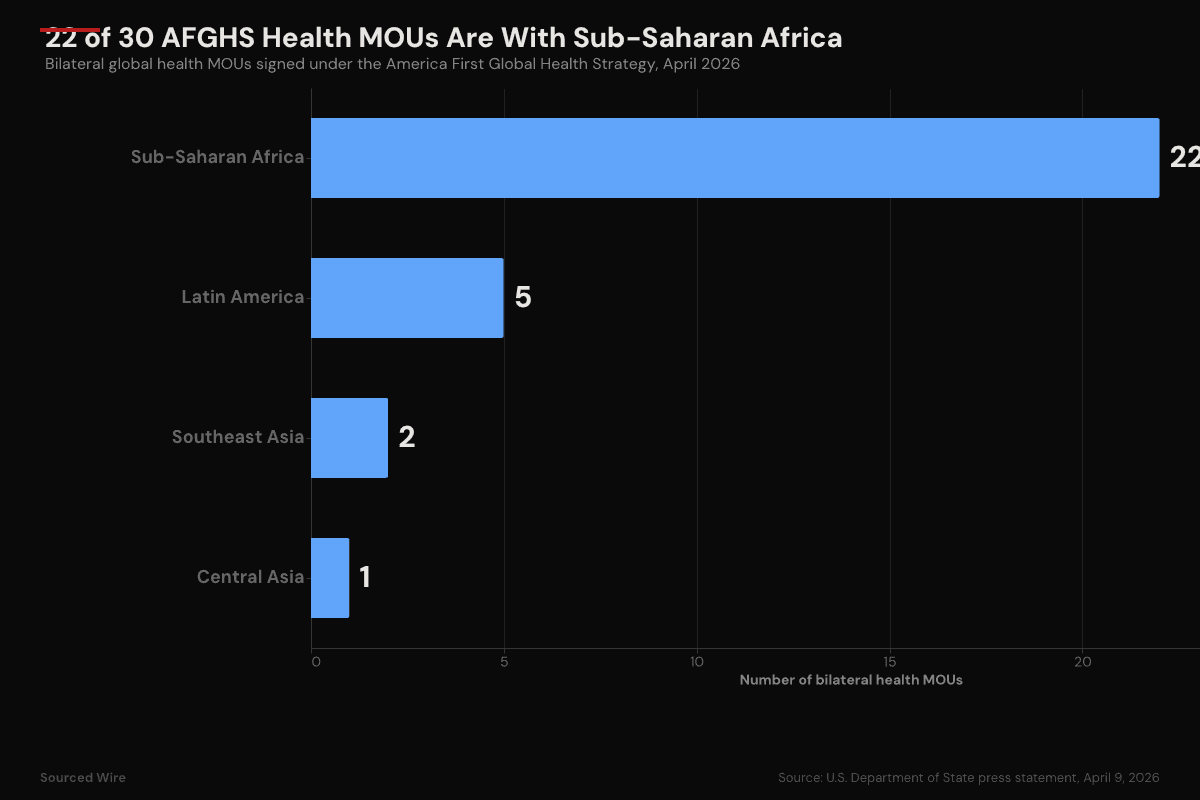
Twenty-two of the 30 — more than two-thirds — are in sub-Saharan Africa. Five are in Latin America and the Caribbean (Dominican Republic, El Salvador, Guatemala, Honduras, Panama), two are in Southeast Asia (Cambodia and the new Philippines signatory), and one is in Central Asia (Tajikistan).
That footprint is important context for how AFGHS relates to its predecessor. The President's Emergency Plan for AIDS Relief (PEPFAR), launched in 2003 under President George W. Bush, has always been heavily concentrated on sub-Saharan Africa. The operational geography of AFGHS — the set of countries where the State Department is willing to commit multi-year funding — is a direct continuation of the PEPFAR map. The terminology is different, but the counterparties are the same institutions, ministries, and programs.
What has changed is the burden-sharing mechanism. AFGHS is built around bilateral MOUs in which recipient countries co-fund a share of the program. The $7.8 billion of recipient-country co-investment in the April 7 total represents roughly 38% of the total commitment — a meaningful shift from PEPFAR's traditional grant-based structure, in which U.S. taxpayer dollars carried essentially the entire funding load. The strategy's launch documents frame this shift as ending "open-ended dependency on U.S. taxpayers."
What the Philippines agreement does specifically
The Philippines Joint Declaration explicitly names TB, HIV, and "other infectious diseases" as priorities, and commits the two governments to co-funding "mutually agreed upon global health objectives in the near future." It builds on a prior U.S. health assistance package for the Philippines announced in September 2025 that focused on tuberculosis, maternal health, and disease surveillance. The new Joint Declaration is a framework step — the actual five-year Strategic Objective Agreement has not yet been negotiated.
The State Department describes the AFGHS approach as advancing "all three pillars" of the strategy, though the April 9 release does not enumerate the pillars in detail. The September 2025 strategy document is available on the State Department's website.
Context for the numbers
The $20.6 billion figure is the cumulative commitment value across all 30 signed MOUs over the life of their respective agreements (typically 5 years). It is not an annual figure, and it is not equivalent to the roughly $6 billion per year that PEPFAR historically received in congressional appropriations. The $12.8 billion U.S. portion is spread across the same multi-year horizon and across 30 countries, which works out to roughly $85 million per country per year on average — substantially lower than the per-country flows under the pre-AFGHS model in the top PEPFAR recipients.
The State Department has not published a country-by-country breakdown of the MOU amounts, and the April 9 release does not include one. Questions about whether specific countries have received larger or smaller allocations, or whether the co-investment share varies by country, are not answered in the publicly available primary source.