SPR Drawdown Accelerates: 6.3 Million Barrels Drained in Three Weeks as Iran War Reverses Year-Long Refill
The Strategic Petroleum Reserve dropped to 409.2 million barrels -- its lowest since October 2025 -- as the government tapped reserves at an accelerating rate to offset the Iran war's impact on oil markets. Gas prices remain at $4.25 per gallon, up 38% since February.
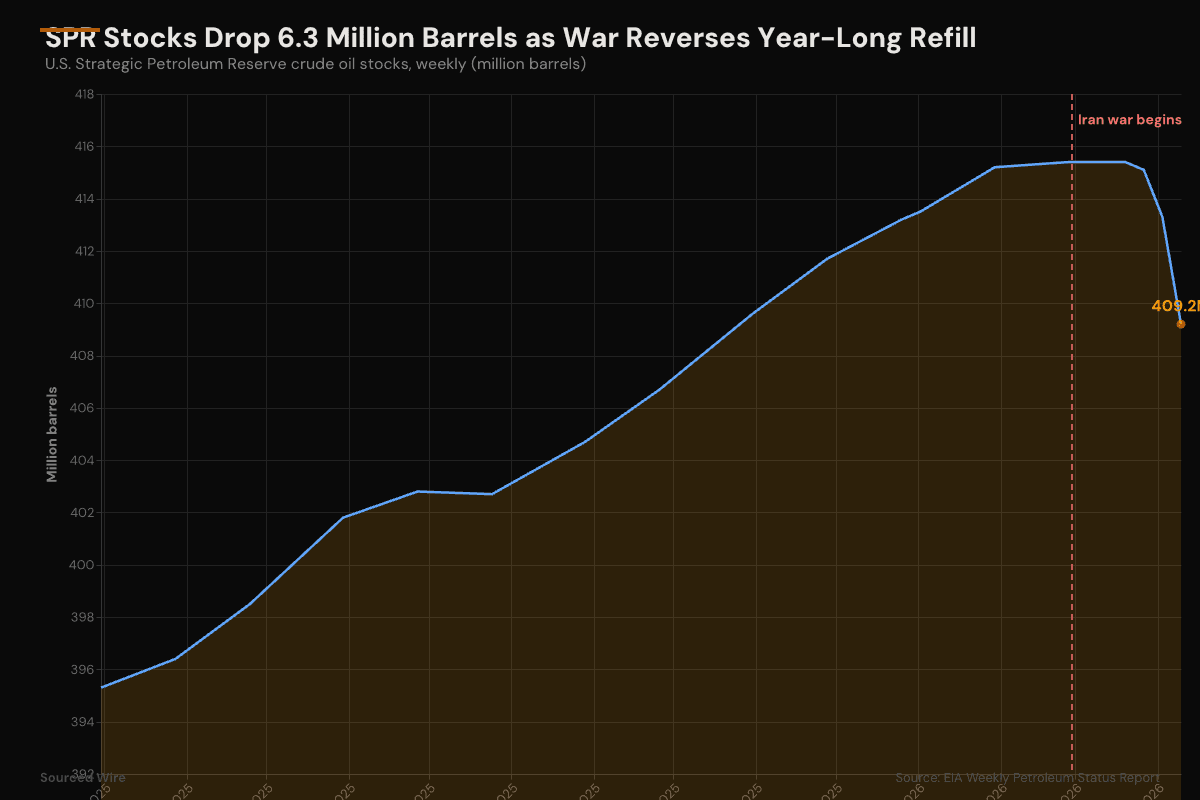
The U.S. Strategic Petroleum Reserve fell by 4.1 million barrels in the week ending April 10, according to data published Wednesday by the Energy Information Administration. That brings the three-week total drawdown to 6.3 million barrels -- erasing six months of refilling in less than a month.
The SPR now holds 409.2 million barrels, its lowest level since October 2025. The draws are accelerating: 0.4 million in the week ending March 27, then 1.7 million, then 4.1 million. The latest single-week draw is the largest since the Biden-era emergency release ended in late 2023.
The refill that got reversed
The administration had been steadily rebuilding the SPR since early 2025, adding roughly 20 million barrels over a year. The reserve climbed from 395.3 million barrels in February 2025 to 415.4 million by late February 2026 -- a slow, deliberate refill after the 2022 emergency release brought the reserve to its lowest level since 1984.
Then the war started. Operation Epic Fury launched on February 28. By March 20, the SPR had been flat for two weeks as the administration weighed its options. By March 27, the first draw appeared. Each week since has been larger than the last.
| Week ending | SPR level (M bbl) | Weekly change |
|---|---|---|
| Feb 27 | 415.4 | -- |
| Mar 6 | 415.4 | 0.0 |
| Mar 13 | 415.4 | 0.0 |
| Mar 20 | 415.4 | 0.0 |
| Mar 27 | 415.1 | -0.4 |
| Apr 3 | 413.3 | -1.7 |
| Apr 10 | 409.2 | -4.1 |
What it hasn't fixed
Regular gasoline averaged $4.254 per gallon nationally for the week of April 13 -- unchanged from the prior week and 38.5% above the $3.072 average on February 23, the last full week before the war. Gas prices have plateaued but not retreated, even after the April 8 ceasefire.
WTI crude fell from $114.58 to $96.17 on the ceasefire day, then bounced back to $100.72 by April 13. The war premium has partially unwound, but oil remains well above pre-war levels.
Meanwhile, commercial crude stocks (excluding the SPR) sit at 463.8 million barrels -- up 44.5 million since mid-February as refineries pulled back operations during the conflict. That commercial build is a separate dynamic: refineries reduced throughput as war risk spiked, causing crude to pile up in storage rather than being processed into gasoline and diesel.
The math going forward
At the current pace of 4.1 million barrels per week, the SPR would drop below 400 million barrels within three weeks -- returning to pre-refill levels. At the 2022 emergency release rate of roughly 5-7 million barrels per week, it would take about six months to reach the Biden-era low of 347 million barrels.
The ceasefire may slow the draws. But the Strait of Hormuz remains a contested chokepoint, Iranian oil infrastructure has sustained damage, and the global supply disruption that justified tapping reserves has not fully resolved. The SPR is a buffer, not a fix -- and the buffer is getting thinner.