Commerce Department Strips Disparate-Impact Protections from All Its Grant Programs, Effective Immediately
A final rule published today rescinds the portions of Commerce's Title VI regulations that prohibited federally funded programs from having discriminatory effects -- not just discriminatory intent. The change covers NTIA broadband grants, NOAA, NIST, EDA, and every other Commerce-funded program.
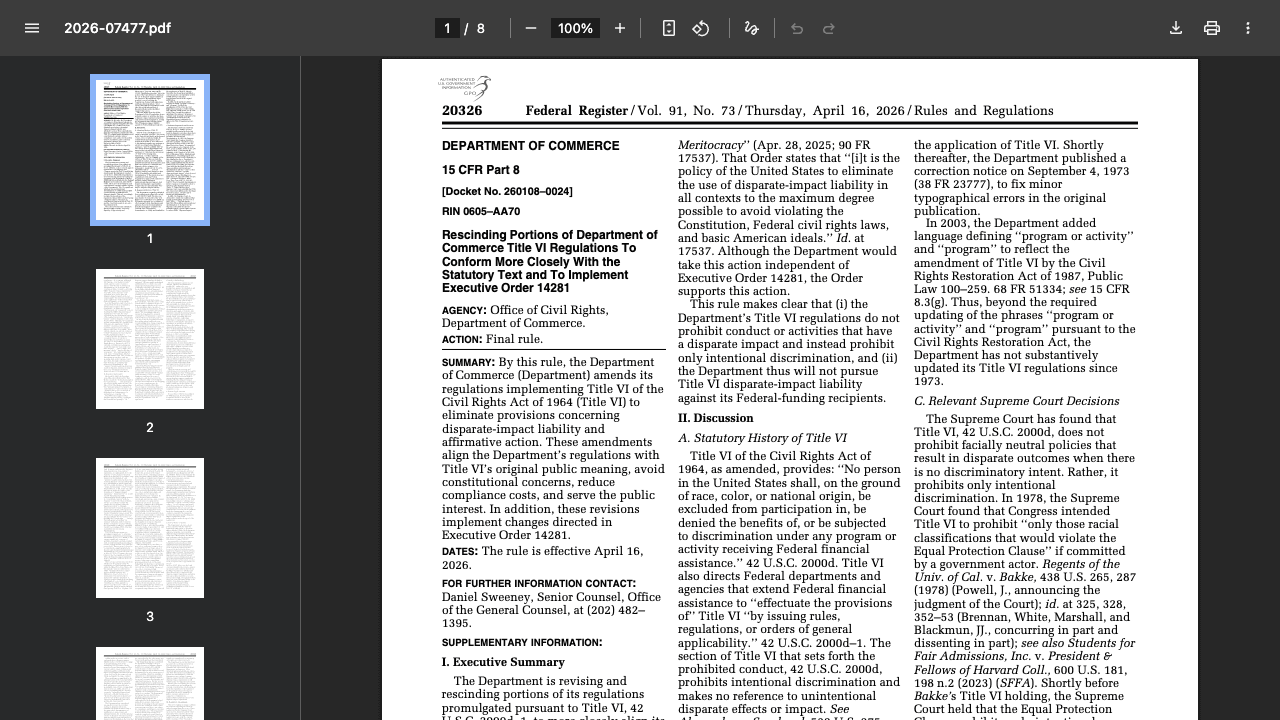
The Department of Commerce published a final rule today stripping disparate-impact protections from its Title VI civil rights regulations. The rule, effective immediately, means Commerce will no longer investigate or enforce claims that its federally funded programs discriminate in their effects -- only intentional discrimination remains prohibited.
The change applies to every recipient of Commerce Department financial assistance: NTIA broadband infrastructure grants, NOAA research funding, NIST laboratory grants, Economic Development Administration aid to distressed communities, Census Bureau agreements, and Minority Business Development Agency programs. Commerce administers hundreds of billions of dollars in federal assistance, including roughly $42 billion in broadband grants from the Infrastructure Investment and Jobs Act.
What the rule removes
The eight-page rule, published in the Federal Register as FR Doc. 2026-07477, amends 15 CFR 8.4 ("Discrimination prohibited") in five specific ways:
| Section | What was removed | Effect |
|---|---|---|
| 8.4(b)(2) | The general prohibition on "criteria or methods of administration which have the effect of subjecting individuals to discrimination" | Replaced with "[Removed and Reserved]" -- the core disparate-impact ban is gone |
| 8.4(b)(3) | The phrase "or effect" from rules on facility site selection | Only intentionally discriminatory site choices are now prohibited |
| 8.4(b)(6) | The entire affirmative action provision, both subparts | No obligation to remedy past discrimination or address historical barriers |
| 8.4(c)(1) | Affirmative action requirements in employment | Removed from employment practices of grant recipients |
| 8.4(c)(2) | Extension of employment discrimination protections | Employment practices that "tend to" exclude people by race are no longer covered |
The practical meaning: a federally funded program can now produce racially disparate outcomes without triggering Commerce Department enforcement, so long as no one can prove the disparity was intentional. Grant recipients no longer need to conduct impact analyses, and entities with documented histories of discrimination no longer have any regulatory obligation to remediate it under Commerce oversight.
No public comment
Commerce bypassed the standard notice-and-comment rulemaking process, invoking the Administrative Procedure Act's exception for rules relating to "agency management or personnel or to public property, loans, grants, benefits, or contracts." The same procedural shortcut the Department of Justice used when it rescinded its own Title VI disparate-impact regulations on December 10, 2025.
The rule took effect on the day of publication -- April 16, 2026. No draft was circulated. No public input was solicited. No transition period was provided.
The legal argument
Commerce's rule leans heavily on three Supreme Court decisions:
Alexander v. Sandoval (2001): The Court held that private plaintiffs cannot sue to enforce disparate-impact regulations under Title VI. Commerce argues this casts "serious doubt" on the regulations' validity.
Students for Fair Admissions v. Harvard (2023): The Court's ruling against race-conscious admissions. Commerce cites it for the principle that the Equal Protection Clause "applies without regard to any differences of race, color, or of nationality."
Loper Bright v. Raimondo (2024): The overturning of Chevron deference. Commerce argues that without judicial deference, the regulations cannot be sustained because Title VI's "single, best meaning" prohibits only intentional discrimination.
The rule states that even without Executive Order 14281, "the Department would have taken steps to adopt the policy to eliminate the use of disparate-impact liability under Title VI."
The executive order
The rule implements Executive Order 14281, "Restoring Equality of Opportunity and Meritocracy," signed April 23, 2025. The order declares disparate-impact liability "not only undermines our national values but also runs contrary to equal protection under the law and, therefore, violates our Constitution." It directed all federal agencies to repeal or amend Title VI regulations containing disparate-impact provisions.
The Department of Justice went first, publishing its final rule on December 10, 2025 (90 FR 57141). Commerce's rule today explicitly "cross-references and incorporates the reasoning" of DOJ's rule. The template is identical: cite the same cases, invoke the same APA exception, make it effective immediately.
Which agencies are next
Commerce is the second agency to complete the process. The Department of Energy has begun its own rescission. Education, HHS, HUD, EPA, and Transportation all maintain Title VI disparate-impact regulations that EO 14281 targets. Each administers programs where the distinction between intentional discrimination and discriminatory effect matters enormously -- school funding formulas, hospital reimbursements, housing vouchers, environmental permits, transit planning.
The Commerce rule acknowledges the dissenting view that "looking at disparate effects can sometimes be useful in uncovering or deterring subtle discrimination or indifference to unnecessary and arbitrary barriers" and that "placing a focus on disparate outcomes can help undo the impact of prior instances of intentional discrimination." It concludes these benefits "are outweighed by the other issues and factors the Department has considered."
The full rule is published in the Federal Register, Vol. 91, No. 73, pages 20326-20333. Contact: Daniel Sweeney, Senior Counsel, Office of the General Counsel, at (202) 482-1395.