Trump's May 29 Vaccine Executive Order Routes Kennedy's Schedule Cuts Through ACIP After Court Blocked the Bypass
The May 29 executive order directs the CDC and its Advisory Committee on Immunization Practices to "take any appropriate steps to update" the childhood and adolescent vaccine schedule -- the same substantive change a federal judge blocked on March 16 because Kennedy had bypassed ACIP. The mechanism, not the policy, has changed.
President Trump signed an executive order on May 29, 2026 titled "Realigning United States Core Childhood Vaccine Recommendations with Best Practices from Peer, Developed Countries." Section 2(b) directs that "the Centers for Disease Control and Prevention (CDC) and its Advisory Committee on Immunization Practices (ACIP) shall review the scientific assessment and the latest clinical data and, to the extent permitted by law, take any appropriate steps to update the United States childhood and adolescent vaccine schedule."
The order pushes the same substantive change that a federal judge blocked ten weeks earlier — but through a different procedural door.
What the court blocked
On March 16, 2026, U.S. District Judge Brian E. Murphy granted a preliminary injunction in American Academy of Pediatrics v. Kennedy, No. 1:25-cv-11916 (D. Mass.). The plaintiffs — led by the American Academy of Pediatrics and joined by the American College of Physicians, the American Public Health Association, the Infectious Diseases Society of America, the Society for Maternal-Fetal Medicine, and the Massachusetts Public Health Alliance — alleged that HHS Secretary Robert F. Kennedy Jr. had violated the Administrative Procedure Act on three grounds: arbitrary and capricious agency action, failure to observe required procedural requirements, and action contrary to law.
Two HHS actions were at the heart of the case. On January 5, 2026, Acting CDC Director Jim O'Neill — also serving as Deputy Secretary of HHS — signed a decision memorandum cutting the routine childhood and adolescent immunization schedule from 17 diseases to 11. Recommendations for rotavirus, COVID-19, influenza, hepatitis A, hepatitis B, and meningococcal disease were removed from the routine schedule. The change was announced "without much internal or external consultation, and without prior public notice," and the new schedule "was not reviewed by CDC experts nor given a public hearing through ACIP," according to the Kaiser Family Foundation's analysis of the memo. Separately, Kennedy had replaced 13 ACIP members between June 2025 and January 2026.
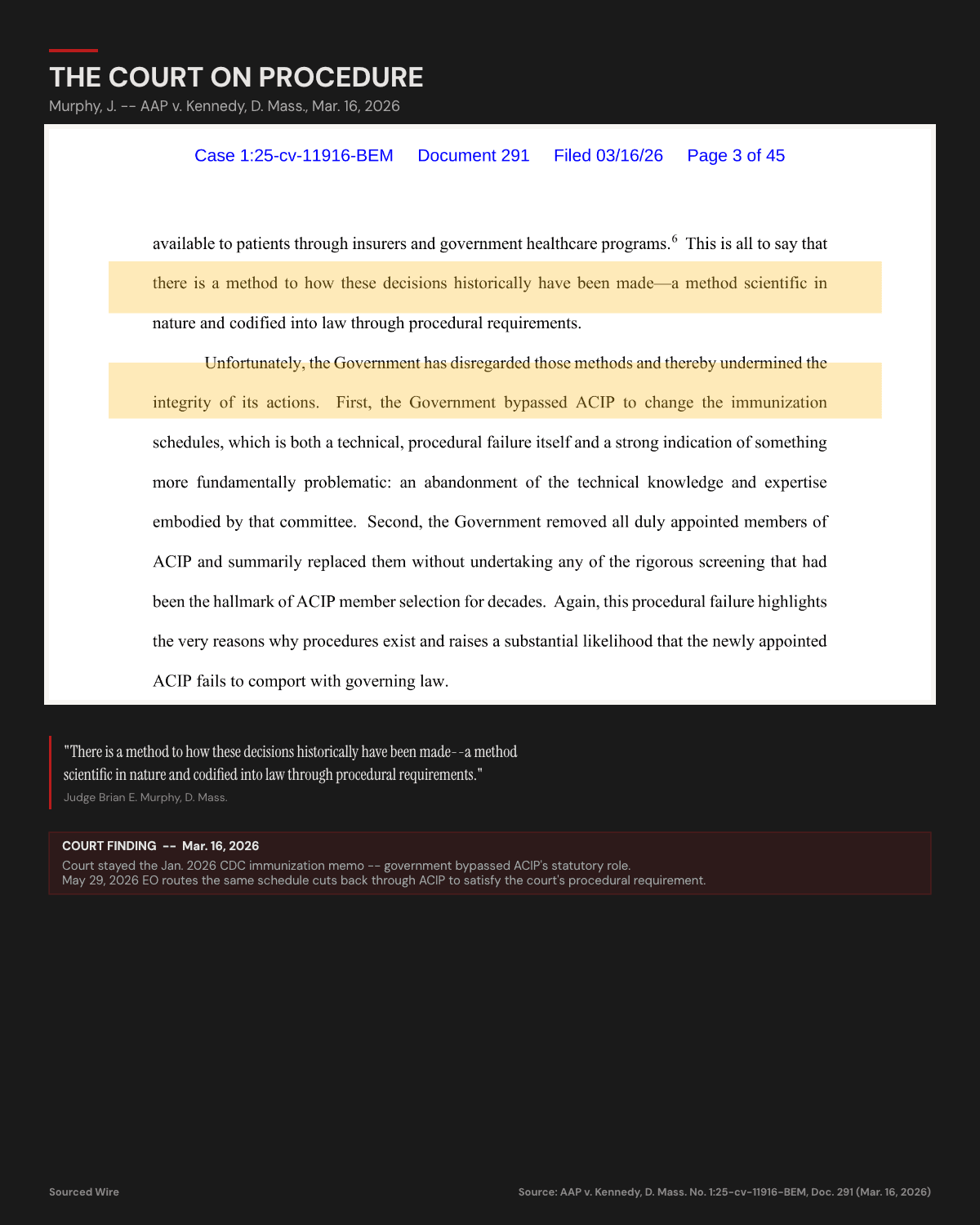
Murphy stayed the January 5 schedule memo, stayed the 13 ACIP appointments, and voided votes the reconstituted panel had taken. The procedural ground was explicit:
"[T]here is a method to how these decisions historically have been made — a method scientific in nature and codified into law through procedural requirements. Unfortunately, the Government has disregarded those methods and thereby undermined the integrity of its actions. First, the Government bypassed ACIP to change the immunization schedules, which is both a technical, procedural failure itself and a strong indication of something" deeper, Murphy wrote. The Trump administration filed a notice of appeal later that spring.
What the executive order changes
Section 2(b) of the May 29 order does not name a new schedule, override Murphy's injunction, or remove vaccines. It instructs ACIP to do the work. The order tells ACIP to "consider ways to provide maximum flexibility to parents and doctors through recommendations for timing and sequencing of the administration of routine immunizations."
Section 2(c) extends the directive across the executive branch: "Each executive department and agency shall ensure all actions, regulations, funding, and coverage related to child and adolescent immunizations align with the schedule recommended by the ACIP and adopted by the CDC, including fulfilling all legal obligations with respect to parental authority, religious freedom, disability accommodations, and equal protection under the law."
The White House fact sheet accompanying the order asserts the U.S. childhood schedule "expanded from 23 doses (1980) to 84+ doses (2024)" and that "most peer nations maintain high vaccination rates through education rather than mandates." Neither the order nor the fact sheet names a specific peer country, identifies a comparison schedule, or lists which vaccines would be removed. The fact sheet does reference prioritizing "11 routine childhood vaccines" — the same count produced by the enjoined January 5 memo.
The procedural posture
Murphy's order did not rule on the merits of the schedule changes themselves. It ruled that Kennedy had to use the established process — ACIP review under the Federal Advisory Committee Act and notice-and-comment under the APA — to make them. The April 3 CDC charter renewal, which extended ACIP through April 2028 and added toxicology to its required specialty balance (Wire coverage), positioned the panel to operate going forward. The May 29 order now formally tasks that panel with producing the schedule change.
If ACIP proceeds through full notice-and-comment review and produces a recommendation that cuts the schedule from 17 diseases to 11, the procedural objection that supported Murphy's injunction would no longer apply to the new recommendation. The substantive challenge — whether the science supports the cuts — has not yet been litigated.
The order takes effect against a backdrop of active disease pressure. The U.S. recorded 1,714 measles cases in the first 100 days of 2026, the most in any comparable window since elimination was declared in 2000, putting that status at risk (Wire coverage). The CDC has been without a permanent director for over eight months; Trump's third nominee, former Deputy Surgeon General Erica Schwartz, was named April 17 (Wire coverage).
ACIP has not announced a public meeting date as of June 3. The committee's next session is the procedural event that determines whether the executive order produces a schedule change in the near term.