U.S. Orders Anthropic to Disable Fable 5 and Mythos 5 Worldwide Under an Export Rule Never Before Applied to an AI Model
A Commerce Department directive invoking the deemed-export rule at 15 CFR 734.13 bars all foreign nationals from Anthropic's two most capable models -- forcing the company to disable them for every customer. No record of the order appears in the Federal Register.

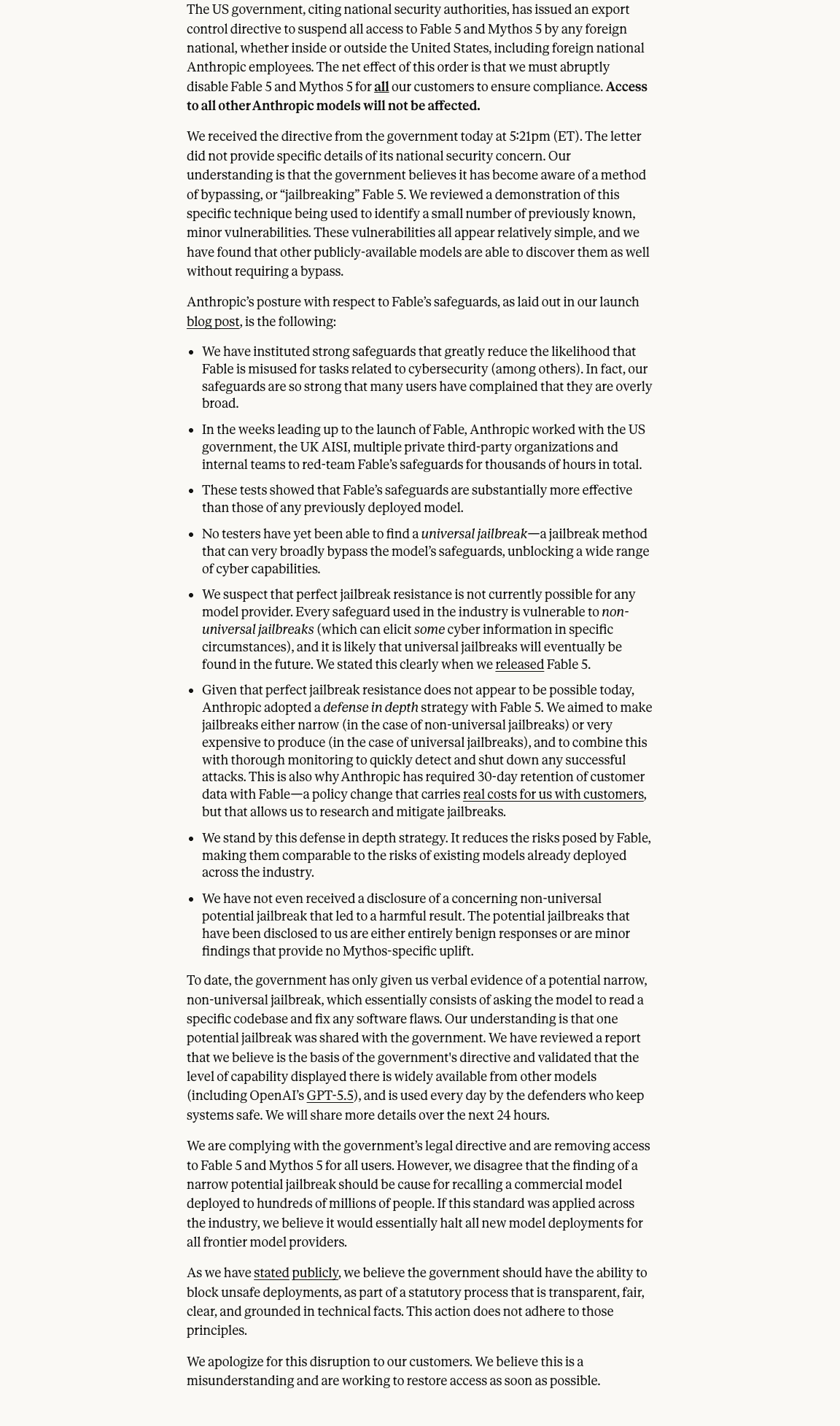
The U.S. government has ordered Anthropic to suspend all access to Fable 5 and Mythos 5, its two most capable AI models, for any foreign national -- inside or outside the United States, including the company's own foreign-national employees. Because Anthropic cannot wall off foreign users without taking the systems down, the order forces it to disable both models for every customer. Access to the company's other models is unaffected.
Anthropic disclosed the order in a statement published June 12. "We received the directive from the government today at 5:21pm (ET)," the company wrote. "The letter did not provide specific details of its national security concern."
The mechanism: a deemed export
The order is an export-control directive. According to the company and to subsequent reporting, it rests on the "deemed export" doctrine in the Export Administration Regulations -- the rule that treats handing controlled technology or source code to a foreign person already inside the country as an export to that person's home country. The governing text, 15 CFR 734.13(b), reads:
Any release in the United States of “technology” or source code to a foreign person is a deemed export to the foreign person’s most recent country of citizenship or permanent residency.
The doctrine was built for tangible dual-use technology -- semiconductors, encryption, biotech -- and turns on licensing the transfer of that technology to specific foreign nationals. Applying it to a hosted, general-purpose AI model accessible through an API is, by all available accounts, the first time it has been used this way. It is what produces the order's unusual reach: a control framed around foreign persons, but executed as a global shutoff.
What the government says -- and what it hasn't shown
The stated concern is a security one. Anthropic's understanding is that officials "become aware of a method of bypassing, or 'jailbreaking' Fable 5." The company says it reviewed a demonstration of the technique and found it surfaced "a small number of previously known, minor vulnerabilities" -- flaws it says "other publicly-available models are able to discover… as well without requiring a bypass."
By Anthropic's account, the evidence remained thin: "To date, the government has only given us verbal evidence of a potential narrow, non-universal jailbreak."
The government has not published its own account. The directive is a private letter to Anthropic; its text has not been released. The only attributed rationale in circulation comes from an unnamed administration official who told Axios that Commerce acted after another company claimed it had jailbroken Mythos. There is no signed government statement on the record.
No public record of the order
Actions of this weight usually leave a paper trail in the government's own journal. This one does not. A search of the Federal Register -- the official daily publication of every federal rule, notice, and presidential document -- returns no rule, notice, or presidential document mentioning Anthropic, Fable, or Mythos published in June 2026. A full-text query for "Anthropic" across the Register's entire history returns four documents, all unrelated (data-broker and nondiscrimination rules from 2024-2026).
A deemed-export determination delivered by letter does not require a published rule, so the absence is procedurally consistent. But it means the most aggressive export action ever taken against a U.S. AI company exists, publicly, only as the target company's description of a letter the public cannot read.
Anthropic's response
Anthropic complied while openly disputing the order. It argued its Fable 5 safeguards were red-teamed "for thousands of hours" with the U.S. government, the UK AI Safety Institute, and outside groups, and were "substantially more effective than those of any previously deployed model." It said no tester has found a universal jailbreak, and that narrow, non-universal jailbreaks affect every model provider.
The company's central objection is about precedent: it disagrees "that the finding of a narrow potential jailbreak should be cause for recalling a commercial model deployed to hundreds of millions of people," warning that such a standard "would essentially halt all new model deployments for all frontier model providers." Anthropic said it believes there has been a misunderstanding and is "working to restore access… as soon as possible."
The backdrop
The directive lands on top of an already-public conflict between Anthropic and the government. In April, co-founder Jack Clark confirmed Anthropic had briefed the White House on Mythos Preview -- a model that autonomously found exploitable vulnerabilities in every major operating system and browser -- even as the company was suing the Department of Defense. That fight began when contract negotiations collapsed over Anthropic's refusal to permit its models to be used for mass surveillance of Americans or for fully autonomous weapons; the Pentagon then designated Anthropic a supply-chain risk, a label historically reserved for foreign adversaries. In a February CBS interview, CEO Dario Amodei called that designation "retaliatory and punitive."
The export directive is a different instrument than the Pentagon dispute -- Commerce authority rather than a defense contract -- but it points the same direction: the government reaching for tools built for hardware and adversary states, and applying them, for the first time, to a commercial American AI model.