Nobody Knows How Much Electricity Data Centers Use. The Federal Government Is Finally Asking.
The EIA is surveying 196 companies across three states in the first federal attempt to directly measure data center electricity consumption. Bipartisan Senate pressure is pushing to make the surveys mandatory nationwide.
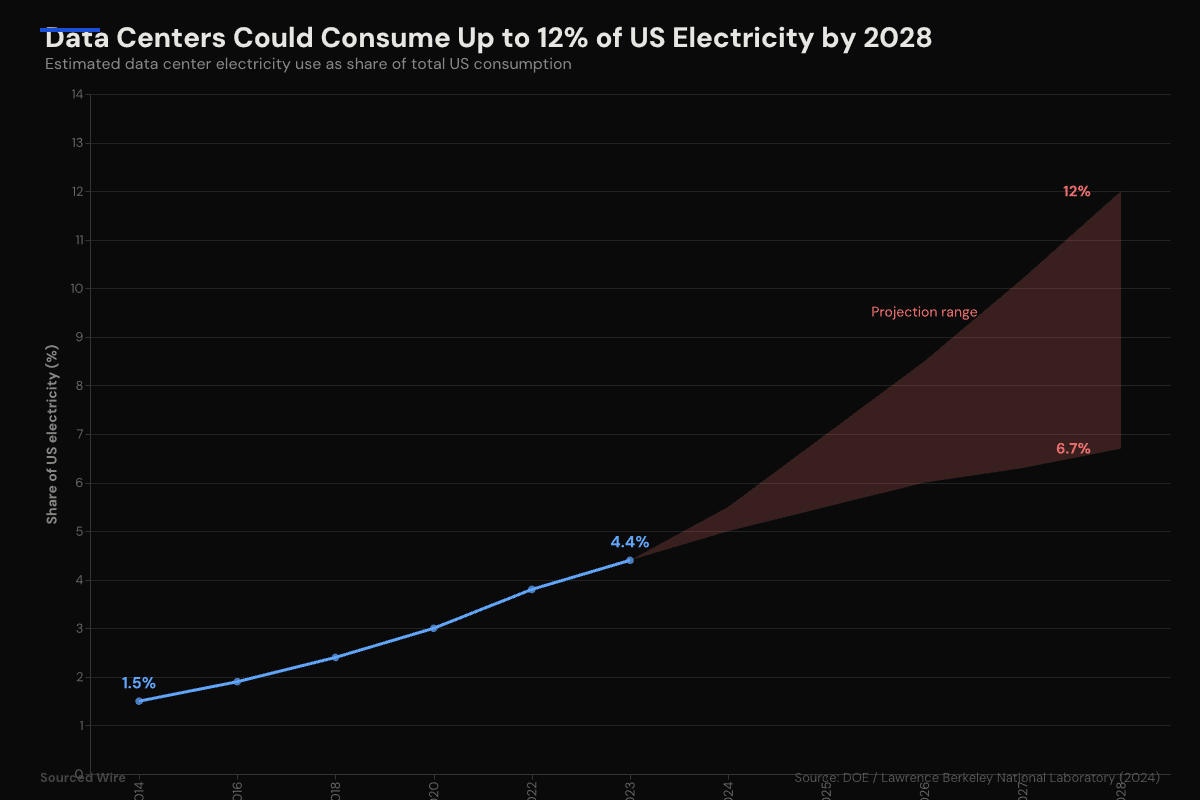
Every estimate of how much electricity American data centers consume is a guess. The Department of Energy's best figure -- 176 terawatt-hours in 2023, roughly 4.4% of all US electricity -- comes from models and industry surveys, not from any direct federal measurement. The projections for where that number is headed range from 325 to 580 TWh by 2028, a gap of 255 TWh that exceeds the total electricity consumption of most countries.
Now, for the first time, the federal government is trying to count.
The first federal survey
On March 25, the Energy Information Administration announced it would conduct pilot field studies of data center energy use in three regions: Texas, Washington state, and the Northern Virginia-Washington, D.C. corridor. The agency identified 196 companies operating data centers in those areas and is asking each to report on at least one facility.
The surveys cover energy sources, electricity consumption, site characteristics, server metrics, and cooling systems. In Texas and Washington, the surveys are web-based; in Northern Virginia and D.C., EIA staff are conducting in-person interviews.
EIA Administrator Tristan Abbey framed the effort as part of a broader modernization: "Going forward, that excellent work will be geared toward faster cycles and finer detail."
The three pilot regions were chosen for obvious reasons. Northern Virginia is the largest data center market in the world -- Virginia's commercial electricity sales hit 83.6 TWh in 2025, up 13% from 73.8 TWh just two years earlier. Texas, the state with the highest total electricity consumption, saw commercial sales jump to 173.8 TWh. Washington state, home to major Microsoft and Amazon facilities, reached 33.6 TWh.
Bipartisan push for mandatory reporting
The EIA surveys are voluntary. Senators Elizabeth Warren (D-Mass.) and Josh Hawley (R-Mo.) want to change that.
In a March 26 letter to Administrator Abbey, the senators called for mandatory annual reporting requirements for data centers and other large energy consumers. They want granular data: hourly, annual, and peak energy loads; the electricity rates companies pay; costs of required grid upgrades and who bears them; whether data centers participate in demand response programs; and critically, a breakdown of energy consumed by AI servers versus general cloud computing.
"Comprehensive information regarding the operations of data centers and other large loads is essential for accurate grid planning and will support policymaking to prevent large companies from increasing electricity costs for American families," the senators wrote.
The letter referenced the Administration's "Ratepayer Protection Pledge," signed by seven technology companies on March 4, in which they committed to build, bring, or buy the new generation resources needed for their energy demands. Without mandatory disclosure, the senators argued, neither Congress nor the public can hold these companies to that promise.
The senators gave Abbey until April 9 to respond with the EIA's survey plans. The EIA has since confirmed that its pilot surveys are expected to conclude by September, with plans for a mandatory nationwide survey to follow.
The measurement gap
The core issue is straightforward: the United States is building massive energy infrastructure to serve data centers, but no federal agency has ever directly measured how much power those facilities consume.
The most authoritative estimate comes from a December 2024 report by Lawrence Berkeley National Laboratory, funded by the DOE. It found that data center electricity tripled over the past decade, from 58 TWh in 2014 to 176 TWh in 2023. The report projected consumption could reach 325 to 580 TWh by 2028 -- meaning data centers could account for anywhere from 6.7% to 12% of total US electricity.
That projection range -- 255 TWh of uncertainty -- is itself the problem. It is roughly equivalent to the total electricity consumption of 24 million American homes. Grid planners, utility companies, and state regulators are making investment decisions worth tens of billions of dollars based on estimates with that kind of spread.
Total US electricity sales hit 4,058 TWh in 2025, up from 3,874 TWh in 2023, according to EIA data. Some portion of that 184 TWh increase is attributable to data centers, but exactly how much is unknown.
The Congressional Research Service noted in its report on data center energy that AI consumed an estimated 10-20% of data center energy in 2024. Roughly half of a data center's electricity goes to IT equipment; much of the rest goes to cooling.
What happens next
The EIA's pilot surveys will test the agency's ability to collect standardized energy data from data centers -- a category it has never surveyed before. If the pilots succeed, a mandatory nationwide survey would give the federal government its first direct measurement of data center electricity consumption.
The bipartisan nature of the push -- Warren from the left, Hawley from the right -- reflects the breadth of concern. Data centers are being built in rural districts and suburban counties across the country, and local ratepayers are increasingly asking whether their electricity bills are subsidizing Big Tech's AI ambitions.
The answer, for now, is that nobody actually knows.