The Pentagon's $185 Billion Missile Shield Has $398 Million in the Actual Budget
The FY2027 request for Golden Dome totals $17.5 billion, but 97% depends on a second reconciliation bill. There is no funding plan for FY2028.
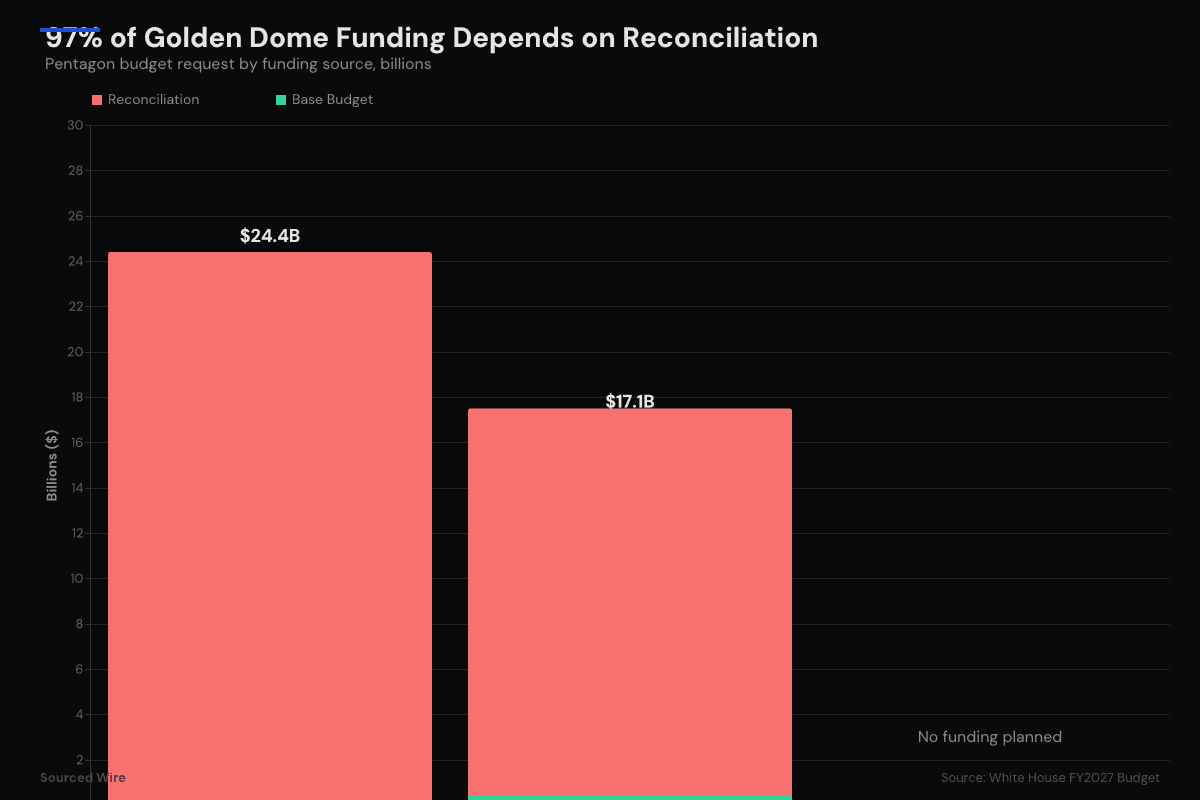
The Pentagon's fiscal 2027 budget asks for $17.5 billion to build Golden Dome, the missile defense shield President Trump says will protect the homeland from "all aerial threats." But only $398 million of that request sits in the defense base budget -- the money Congress appropriates through the normal process.
The other $17.1 billion depends on Congress passing a second reconciliation bill. That's 97.7% of the program's funding routed through a legislative mechanism that typically gets one shot per budget resolution.
There is no plan for fiscal 2028.
The Most Expensive Defense Program Since Star Wars
Trump signed an executive order in January 2025 directing the Pentagon to design a next-generation shield against ballistic, hypersonic, and cruise missiles. He announced the program in May 2025, saying it would cost $175 billion and be complete within three years.
Fifteen months later, the cost estimate has risen to $185 billion after the Pentagon added space-based capabilities. That's the White House's own number. Independent estimates run far higher:
| Source | Estimate |
|---|---|
| White House | $185 billion |
| Congressional Budget Office (20-year) | $161–542 billion |
| CBO lifecycle | $831 billion |
| American Enterprise Institute | $252 billion–$3.6 trillion |
The range depends on how much of the architecture actually gets built -- and that question is increasingly open.
How the Money Flows
Golden Dome's first $24.4 billion came through the "One Big Beautiful Bill" reconciliation act signed last summer. The FY2026 defense appropriations bill, passed February 3, included $13.4 billion for space and missile defense systems. But the base budget -- the annual defense spending that Congress debates and renews through regular order -- has carried almost none of it.
The FY2027 request continues this pattern:
| Fiscal Year | Reconciliation | Base Budget | Total |
|---|---|---|---|
| FY2026 | $24.4B | — | $24.4B |
| FY2027 (request) | $17.1B | $398M | $17.5B |
| FY2028–2036 | None planned | TBD | — |
"The whole program is on unstable footing," Todd Harrison of the American Enterprise Institute told Defense One. "If they have not been able to move the main funding lines into the base budget, because reconciliation is highly unlikely to continue beyond FY27, then where does all the Golden Dome funding go in FY28?"
Space Force Gen. Michael Guetlein, the program's leader, says all reconciliation funds have flowed and execution is on track. "We've got a very close partnership with OMB and the National Security Council on execution of those funds," he said.
What $185 Billion Is Supposed to Buy
Guetlein describes a layered architecture: a sensor layer to track threats, an ICBM defeat layer built on existing ground-based interceptors, and an air layer to handle cruise missiles and drones. The most ambitious and expensive component is space-based interceptors that could destroy missiles during their boost phase -- seconds after launch, before warheads separate and decoys deploy.
SpaceX holds a $2 billion contract for a 600-satellite constellation. Anduril Industries, Lockheed Martin, Northrop Grumman, and True Anomaly -- a startup backed by a venture capital firm associated with Vice President JD Vance -- have received contracts. Over 1,000 companies have been deemed eligible for future awards.
But Guetlein has signaled that space-based interceptors are not guaranteed. "If boost-phase intercept from space is not affordable and scalable, we will not produce it, because we have other options to get after it," he said in April. "We are so focused on affordability. If we cannot do it affordably, we will not go into production."
The Physics Problem
No missile defense system has proven capable of consistently intercepting advanced ICBM threats under realistic conditions. The existing Ground-Based Midcourse Defense system, which cost $67 billion, has what the American Physical Society calls serious limitations against warheads accompanied by decoys.
MIT physicists Lisbeth Gronlund and David Wright calculated that defending against a salvo of just 10 missiles would require a space-based constellation tens of thousands of satellites large -- far beyond the 600 currently contracted.
Trump frequently compares Golden Dome to Israel's Iron Dome. But Iron Dome defends a country the size of New Jersey against short-range rockets traveling tens of miles. Intercepting ICBMs crossing oceans at 15,000 mph is a problem of fundamentally different scale. The Congressional Research Service primer on the program notes that no peer adversary's arsenal has ever been tested against.
China has called the system a violation of the Outer Space Treaty's peaceful use provisions. Russia has called it destabilizing. Arms control analysts warn it could incentivize both countries to expand their nuclear arsenals -- the logic being that if the shield might work, you need more missiles to overwhelm it.