Education Secretary McMahon Makes AI a Formal Grant-Selection Priority Across Department Discretionary Programs
A 33-page final rule scheduled for Monday publication establishes "Advancing Artificial Intelligence in Education" as a Secretary's Supplemental Priority for every discretionary grant the Department of Education runs. Grant competitions can now designate AI literacy or AI-integration work as an absolute, competitive-preference, or invitational priority — steering federal education dollars toward AI training, tools, and teacher-prep programs.
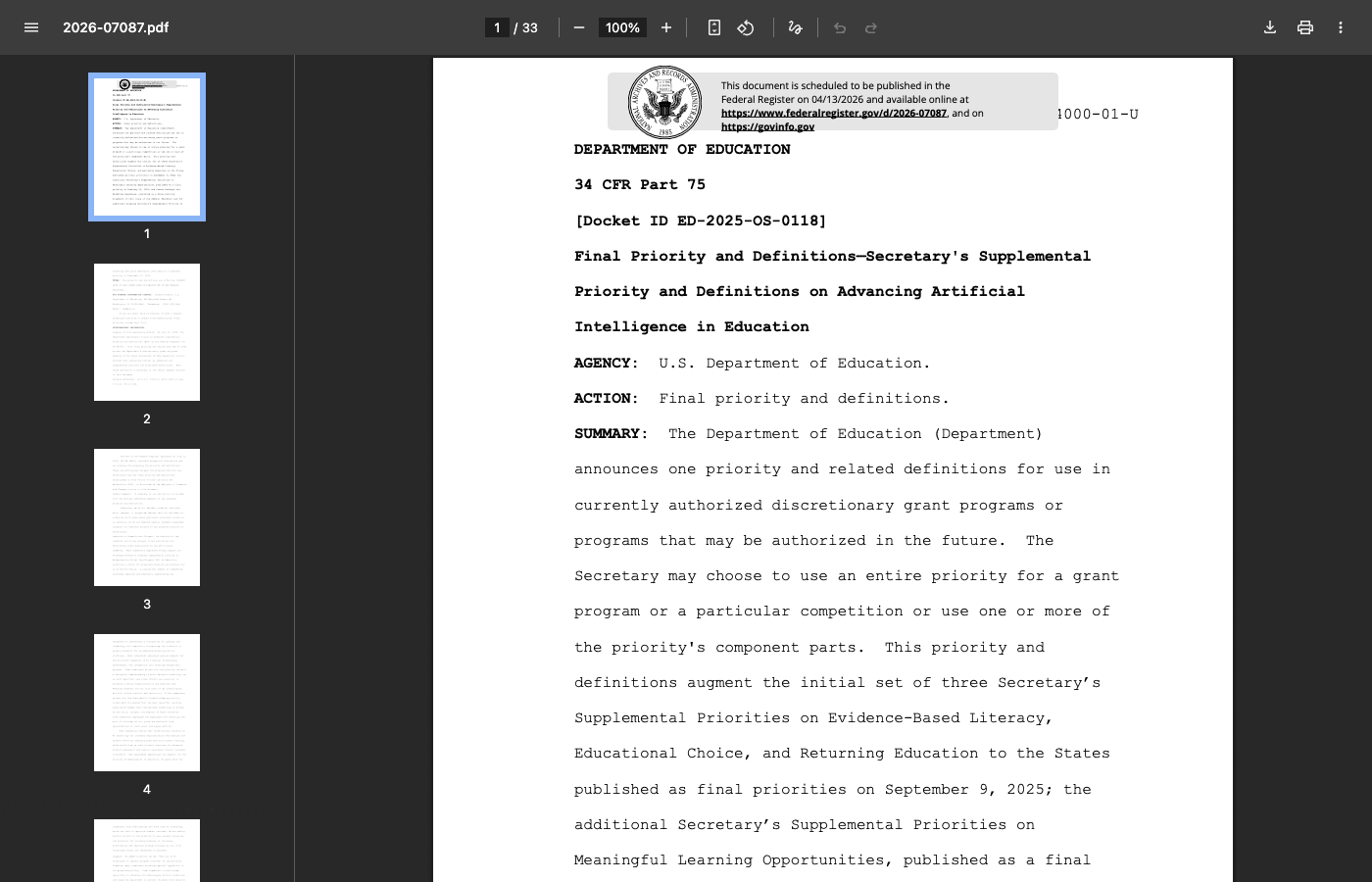
The U.S. Department of Education has finalized a Secretary's Supplemental Priority on "Advancing Artificial Intelligence in Education" that will govern how the Department weighs grant applications across its discretionary programs. The 33-page final rule was filed with the Federal Register for public inspection on April 10 and is scheduled for formal publication on April 13. It takes effect 30 days after publication — approximately May 13, 2026.
The rule is codified under 34 CFR Part 75 and filed as Docket ED-2025-OS-0118. It follows a July 21, 2025 Notice of Proposed Priority that drew over 300 public comments. Related final and proposed priorities have been issued in sequence by Secretary Linda McMahon since September 2025.
What a Secretary's Supplemental Priority does
Under 34 CFR 75.105, the Department designates priorities for competitive grant programs as one of three types:
- Absolute priority: only applications that meet the priority are considered at all.
- Competitive preference priority: applications that meet the priority get awarded additional points or, between two applications of comparable merit, the priority-meeting one wins.
- Invitational priority: the Department signals interest but no scoring benefit.
The designation is made program-by-program in the Federal Register when the Department publishes a grant competition. Today's rule makes AI in Education available as an option the Department can invoke in any future discretionary competition. It does not automatically attach to every grant — but it functions as a standing menu item that the Department can now plug into any notice of funding availability.
What the priority actually covers
The rule divides "Advancing Artificial Intelligence in Education" into two parts. Applicants can meet the priority by proposing work in any one of the listed categories.
(a) Expanding understanding of AI, which includes:
- AI literacy skills in teaching and learning, including how to detect AI-generated disinformation or misinformation online
- Age-appropriate AI and computer-science education in K-12
- AI and CS courses in higher-education general education or core curriculum
- Embedding AI and CS into pre-service and in-service teacher preparation programs
- Professional development for educators on integrating AI into their subject areas
- Dual-enrollment programs for high-schoolers earning postsecondary AI credit or industry-recognized credentials
- Age-appropriate AI education methodologies emphasizing foundational concepts, critical thinking, and developmental readiness
(b) Expanding appropriate and ethical use of AI technology, which includes:
- AI-supported instruction for gifted and talented students
- AI-supported instruction for below-grade-level students and students needing remedial or developmental education
- AI for early-intervention, special-education, and related services for children with disabilities
- AI-driven tools for personalized learning — adaptive learning technologies, virtual teaching assistants, tutoring, and data-analytics tools
- AI in teacher training and evaluation
- AI to reduce administrative burden in classrooms and schools
- AI-driven college and career pathway exploration, advising, and navigation
- Incorporation of universal design for learning principles (as defined in 20 U.S.C. § 1003)
The rule specifies that priority-meeting projects must be consistent with the Department's existing regulations governing discretionary grants and cannot override statutory eligibility rules for the underlying programs.
This is the sixth in a series
The AI in Education priority is the sixth Secretary's Supplemental Priority the McMahon Department of Education has issued since September 2025:
| Priority | Status | Published |
|---|---|---|
| 1. Evidence-Based Literacy | Final | Sept 9, 2025 |
| 2. Educational Choice | Final | Sept 9, 2025 |
| 3. Returning Education to the States | Final | Sept 9, 2025 |
| 4. Promoting Patriotic Education | Proposed | Sept 17, 2025 |
| 5. Meaningful Learning Opportunities | Final | Feb 12, 2026 |
| 6. Advancing Artificial Intelligence in Education | Final | April 13, 2026 |
| 7. Career Pathways and Workforce Readiness | Final | April 13, 2026 (companion rule) |
The April 13 batch publishes two final priorities simultaneously — AI in Education and a separate Career Pathways and Workforce Readiness priority (FR Doc. 2026-07084, 36 pages). Promoting Patriotic Education remains proposed but has not been finalized since September 2025.
Each supplemental priority is added to the existing federal grant framework rather than replacing prior priorities; the Department can mix and match across competitions. By May 13, the Secretary will have seven priorities (six final plus Patriotic Education as proposed) available to designate in any discretionary grant program, from IDEA funding to Title I supplemental competitions to teacher preparation grants.
Procedural details
The Department notes that it received "over 300" public comments on the July 2025 proposed rule. The rule's Analysis of Comments and Changes section addresses comments received but does not report how many were supportive versus critical. The Department writes that "many commenters expressed strong support for Secretary McMahon's proposed supplemental priority" and notes that commenters appreciated "the Department's leadership to incorporate AI literacy and technology into education."
Authority for the priority comes from 20 U.S.C. 1221e-3, 3474, and 6301 et seq., plus 5 U.S.C. 311 et seq. Contact on the rule is Zachary Rogers at the Department of Education, (202) 260-1144, SSP@ed.gov.