EPA Pushes the PFAS TSCA 8(a)(7) Reporting Start From April 13 to January 31, 2027 — Third Delay to the Rule
A 40 CFR Part 705 final rule scheduled for Monday publication shifts the start of the PFAS manufacturer and importer reporting period out by roughly nine months. Reporting covers everyone who manufactured or imported PFAS since January 1, 2011, and the rule was slated to go live this coming Monday before EPA delayed it.
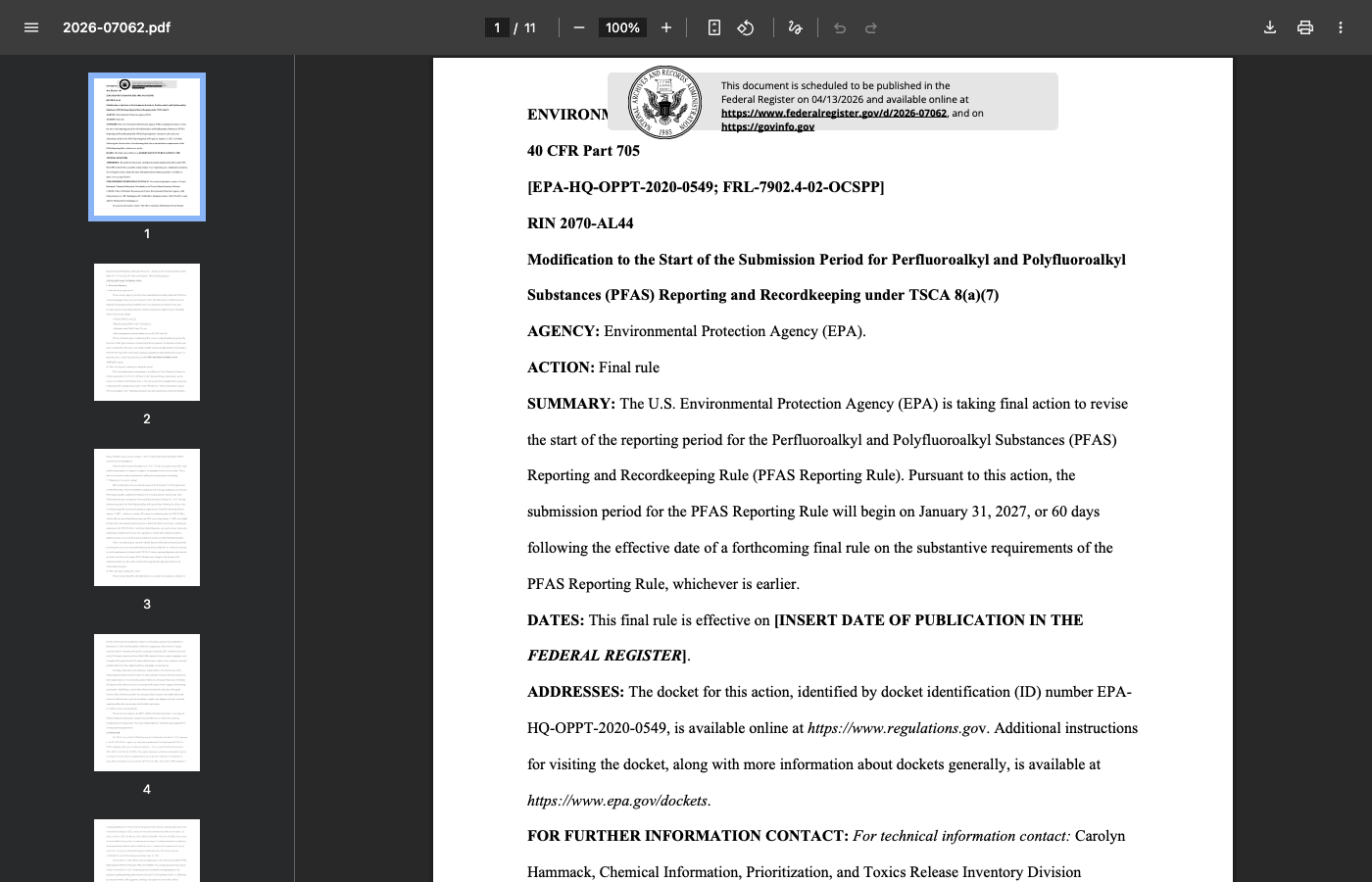
The Environmental Protection Agency has issued a final rule shifting the start of the mandatory PFAS (per- and polyfluoroalkyl substances) reporting period under the Toxic Substances Control Act. Under the rule previously in effect, manufacturers and importers of PFAS were required to begin submitting data to EPA on April 13, 2026 — this coming Monday. Under the new final rule, that start date moves to January 31, 2027, or 60 days after the effective date of a separate forthcoming substantive rule, whichever comes first.
The rule was filed with the Federal Register for public inspection at 08:45 a.m. EDT on April 10, 2026, is scheduled for formal publication on April 13, and takes effect immediately upon publication. This is the third delay to the PFAS reporting start since the original rule was finalized in October 2023.
The rule being delayed
The underlying reporting obligation comes from TSCA Section 8(a)(7), which was added to the Toxic Substances Control Act in December 2019 by Section 7351 of the FY2020 National Defense Authorization Act (Public Law 116-92). That statute required EPA to promulgate a rule requiring anyone who has manufactured a PFAS chemical "in any year since January 1, 2011" to report specific categories of information: production volumes, byproducts, disposal, exposure, and other TSCA 8(a)(2)(A)-(G) data.
EPA finalized the PFAS Reporting Rule at 40 CFR Part 705 on October 11, 2023. As written, the rule sweeps in every manufacturer or importer of PFAS — or articles containing PFAS — going back more than a decade. The scope was historic for TSCA: rather than a forward-looking reporting window, it pulled in 15 years of past production data from every affected company. NAICS sectors identified by EPA as potentially subject include utilities (NAICS 22), manufacturing (31–33), wholesale trade (42), and waste management and remediation services (562), and the final rule notes that other sectors could also be regulated.
The delay chronology
| Date | Action | Effective submission start |
|---|---|---|
| Oct 11, 2023 | Final rule published | November 12, 2024 (original) |
| Sept 5, 2024 | First delay (direct final rule) — IT development delays in EPA's Central Data Exchange | July 11, 2025 |
| May 13, 2025 | Second delay (interim final rule) — more IT delays and preparation for proposed modifications | April 13, 2026 |
| Nov 13, 2025 | Proposed substantive modifications to the reporting rule | — |
| Dec 29, 2025 | Comment period closes on proposed modifications | — |
| April 10/13, 2026 | Third delay (this final rule) | January 31, 2027 (or 60 days after forthcoming final substantive rule, whichever is earlier) |
What the agency says it's waiting on
The final rule does not substantively change what manufacturers have to report — that is still under development in the November 2025 proposed rule, which EPA has not yet finalized. Today's action only moves the start date. EPA's stated rationale is that it needs more time to work through public comment on both the May 2025 interim final rule and the November 2025 proposal. The rule document reports the comment volumes received:
- May 2025 interim final rule: 27 unique comments and 639 additional comments from a mail-in campaign.
- November 2025 proposed rule: approximately 600 unique comments and more than 8,500 additional comments from two mail-in campaigns.
EPA says it "needs additional time to address these comments, write and publish a final rule, release updated guidance, and update its reporting tool." The forthcoming substantive rule is expected to modify both the scope of covered chemicals and the duration of the reporting window. EPA explicitly states today's action "does not address the end of the submission period," meaning the currently codified six-month submission window (plus the extended 12-month window for small article-importer manufacturers) is preserved and will be revisited in the separate substantive rulemaking.
The two-date structure and severability
The rule ties the new start date to the effective date of a forthcoming substantive final rule, with a January 31, 2027 backstop in case that future rule is delayed. EPA writes that the two commencement triggers are "intended to be severable" — meaning if judicial review vacates one, the other remains in force. If the 60-day-after-future-rule trigger were struck down, the January 31, 2027 backstop would stand; if the backstop were struck down, the 60-day trigger would stand.
That dual-date structure, and the emphasis on severability, reads like EPA anticipating legal challenges from environmental groups or state attorneys general who may argue the delay itself is unlawful. The comment record summarized in the rule includes over 9,000 comments on the underlying proposal, most of them mail-in campaigns — a volume consistent with organized public pressure on both sides of the reporting rule.
Legal basis for immediate effectiveness
The final rule takes effect immediately upon publication rather than after the usual 30-day waiting period required under the Administrative Procedure Act. EPA's cited justification is 5 U.S.C. 553(d)(1), which allows an immediately-effective rule when it "grants or recognizes an exemption or relieves a restriction." EPA characterizes the delay as a restriction-relieving action because it postpones a compliance obligation that would otherwise have taken force on Monday.
The final rule is docketed as EPA-HQ-OPPT-2020-0549 (FRL-7902.4-02-OCSPP, RIN 2070-AL44). Technical inquiries are directed to Carolyn Hammack of EPA's Chemical Information, Prioritization, and Toxics Release Inventory Division at (202) 566-0521.