Senate Bill Extends Section 702 to June 12 in Single Day; House Approves 261-111 With 85 Democrats Opposed
S. 4465 — three operative lines, no privacy reforms — was introduced, passed both chambers, and signed by President Trump on April 30, 2026, hours before Section 702 was set to expire. It is the second short bridge in two weeks and pushes the new sunset to June 12. House Democrats split 94-85 in opposition; 26 Republicans joined them; Rep. Andy Biggs, the warrant-amendment author at the center of the prior fight, did not vote.
On April 30, 2026, the same day the most recent extension of Section 702 of the Foreign Intelligence Surveillance Act was set to expire, Congress passed and President Trump signed a 43-day reauthorization introduced that morning by Sen. Tom Cotton (R-AR) and Sen. Mark Warner (D-VA), respectively the chairman and vice chairman of the Senate Select Committee on Intelligence. The bill, S. 4465, is now Public Law No. 119-87. It moves the Title VII sunset from April 30 to June 12, 2026.
It is the second short bridge in two weeks. The 10-day extension that became Public Law 119-84 on April 18 expired the day S. 4465 took effect. The full 18-month clean extension that the administration originally sought, H.R. 8035, never reached a floor vote: the House killed its own rule of consideration on April 17 in a revolt against a closed rule that had blocked an amendment requiring a warrant for U.S.-person queries of the 702 database.
What S. 4465 does
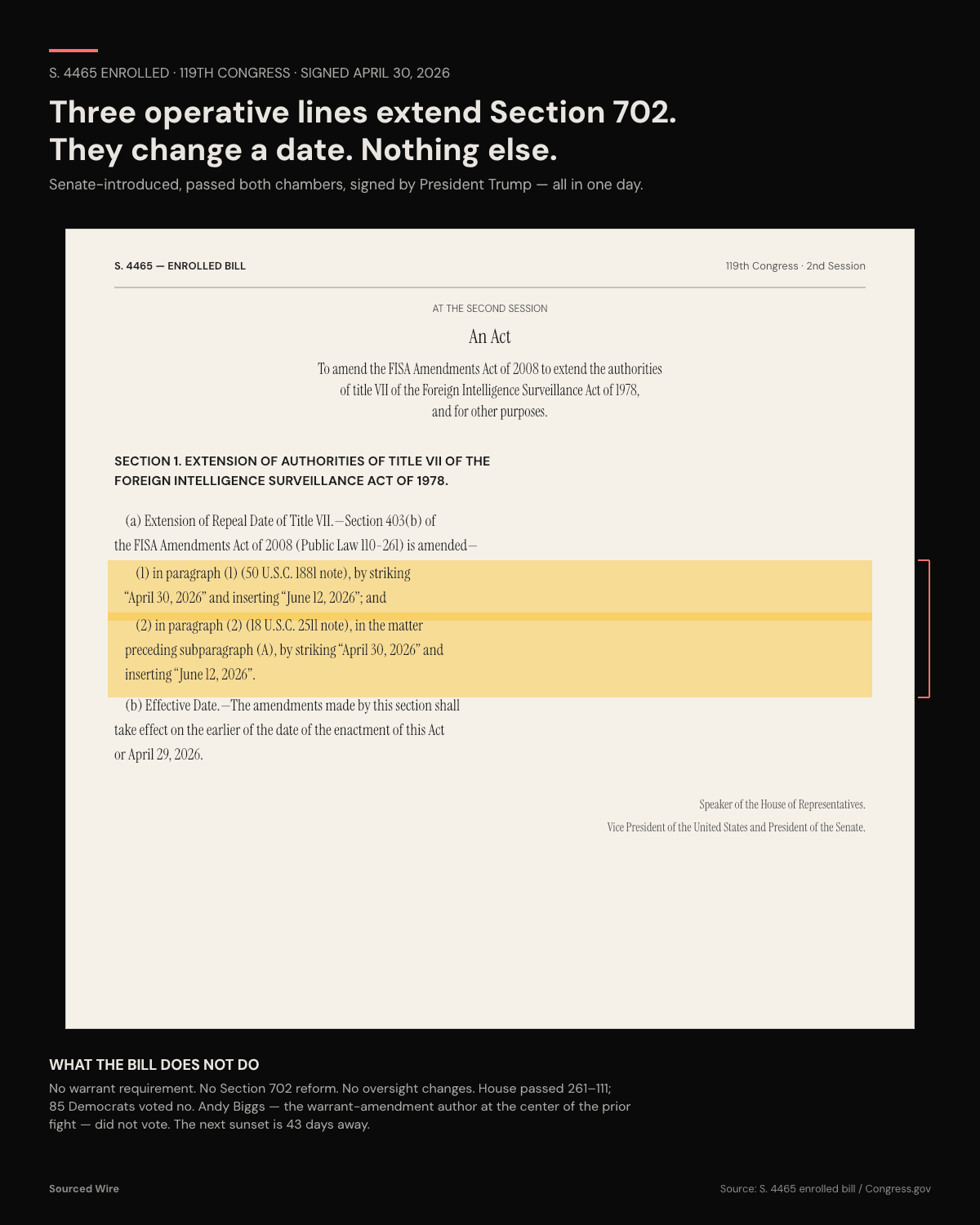
The enrolled bill, like the 10-day bridge it replaces, is a date change. Its entire operative text:
SEC. 1. EXTENSION OF AUTHORITIES OF TITLE VII OF THE FOREIGN INTELLIGENCE
        SURVEILLANCE ACT OF 1978.

  (a) Extension of Repeal Date of Title VII.--Section 403(b) of the FISA
      Amendments Act of 2008 (Public Law 110-261) is amended--
        (1) in paragraph (1) (50 U.S.C. 1881 note), by striking
            ``April 30, 2026'' and inserting ``June 12, 2026''; and
        (2) in paragraph (2) (18 U.S.C. 2511 note), in the matter
            preceding subparagraph (A), by striking ``April 30, 2026''
            and inserting ``June 12, 2026''.
  (b) Effective Date.--The amendments made by this section shall take
      effect on the earlier of the date of the enactment of this Act or
      April 29, 2026.
The bill contains no warrant requirement, no reforms to U.S.-person query procedures, and no changes to FBI compliance training or penalties added by the 2024 Reforming Intelligence and Securing America Act. The effective-date clause sets the new sunset retroactively to April 29 — one day before enactment — to ensure no even-momentary gap in authority.
The single-day legislative path
Cotton introduced S. 4465 in the Senate on the morning of April 30, with Warner as the sole cosponsor. The Senate read it twice, considered it, read it a third time, and passed it without amendment by voice vote — meaning no senator stood to demand a recorded vote despite the substantive opposition that would surface in the House hours later.
The bill arrived in the House the same day. Rep. Jim Jordan (R-OH), chair of the House Judiciary Committee, moved to suspend the rules and pass the bill — a procedural path that bars amendments and requires a two-thirds majority. The chamber agreed to forty minutes of debate. The motion carried 261 to 111, with 58 members not voting. Two-thirds of the 372 voting members is 248; the motion cleared by 13 votes. Trump signed the bill the same afternoon.
The Senate gave the bill no recorded vote. The House made it the second-narrowest 702 reauthorization vote in the program's history.
The dissent: 85 Democrats and 26 Republicans
Roll Call No. 155 on April 30 broke as follows:
| Party | Yea | Nay | Not Voting |
|---|---|---|---|
| Republican | 166 | 26 | 25 |
| Democratic | 94 | 85 | 33 |
| Independent | 1 | 0 | 0 |
| Total | 261 | 111 | 58 |
The 85 Democratic no votes are the largest Democratic defection on a Section 702 reauthorization since the program's reauthorization fights began. They included Reps. Pramila Jayapal (WA), Alexandria Ocasio-Cortez (NY), Ro Khanna (CA), Ilhan Omar (MN), Jasmine Crockett (TX), Greg Casar (TX), Maxwell Frost (FL), Jared Huffman (CA), Becca Balint (VT), and Adelita Grijalva (AZ). The 10-day bridge two weeks earlier had cleared both chambers by voice vote and unanimous consent, with no recorded Democratic opposition.
The 26 Republican no votes were drawn from the same civil-libertarian coalition that killed the rule on H.R. 8035: Reps. Thomas Massie (KY), Chip Roy (TX), Warren Davidson (OH), Lauren Boebert (CO), Paul Gosar (AZ), Mary Miller (IL), Scott Perry (PA), Clay Higgins (LA), and Harriet Hageman (WY), among others.
Rep. Andy Biggs (R-AZ) — the author of the warrant amendment whose exclusion from the H.R. 8035 closed rule precipitated the April 17 rule defeat — did not vote.
What comes next
Section 702 now sunsets on June 12, 2026 — 43 days after the latest extension was signed, 32 days from publication of this article. No longer-term reauthorization has been formally noticed for floor action. Sen. Cotton's office and Sen. Warner's office have not stated whether the 43-day timeline reflects an agreement to negotiate substantive reforms before the new deadline or, as with the 10-day bridge it replaced, a continuation of the pattern of serial date-change extensions.
The only bill since April 18 that addresses Section 702 substantively — S. 4402, requiring a report on the use of artificial intelligence in querying 702-collected data — was referred to the Senate Judiciary Committee on April 27 and has had no further action.