Trump Invokes Defense Production Act Across Oil, Gas, Coal, LNG, and the Grid in Five Simultaneous Determinations
President Trump signed five Section 303 Defense Production Act determinations on April 20, each directing the Secretary of Energy to use federal purchases, loans, and commitments to expand a different piece of the US fossil-fuel and electric-grid supply chain. All five waive the statute's standard review-and-approval gates, citing the national energy emergency Trump declared on his first day in office.
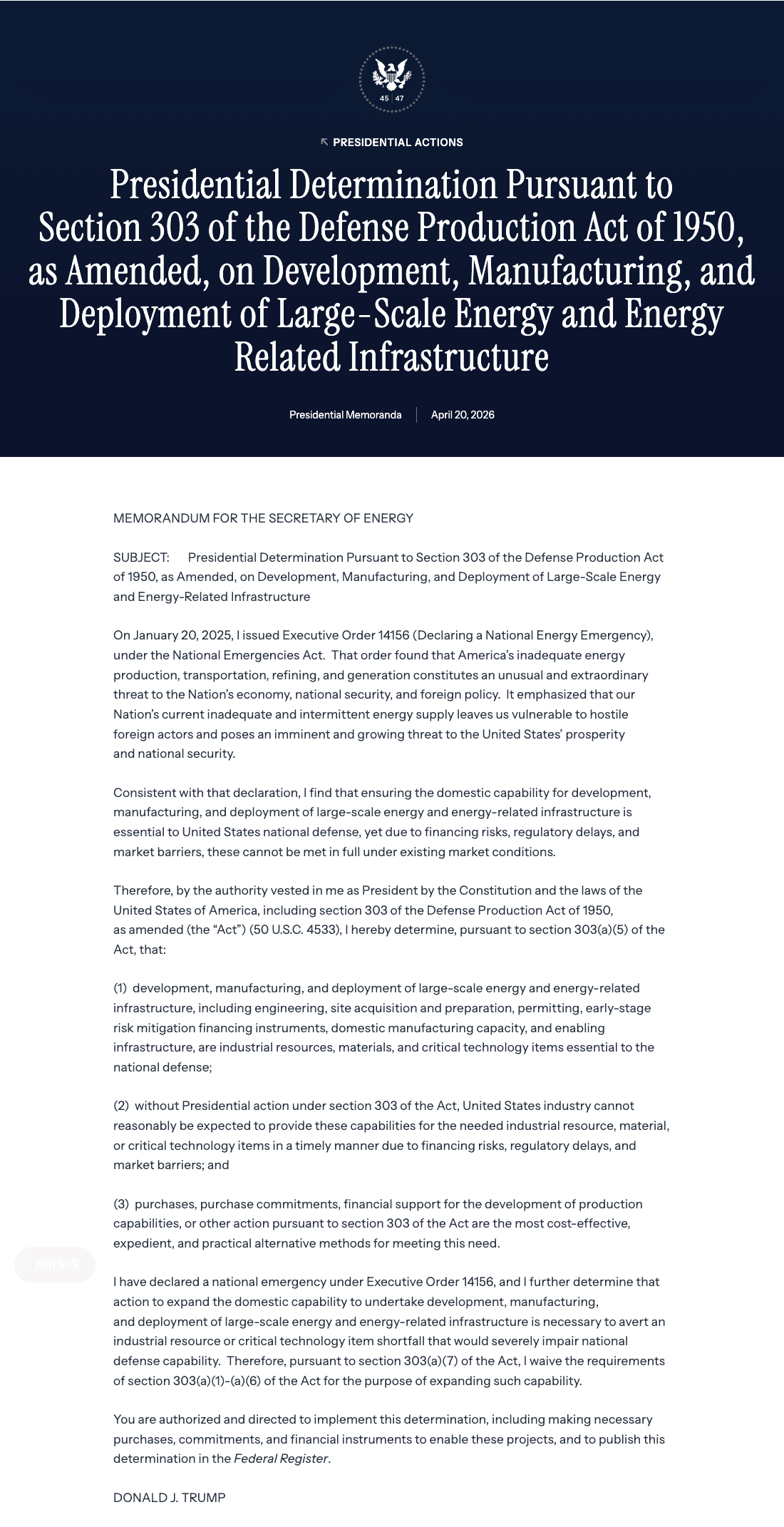
President Donald Trump signed five simultaneous presidential determinations on April 20 invoking Section 303 of the Defense Production Act of 1950 — the Cold War industrial-mobilization law that lets the president direct federal loans, loan guarantees, purchase commitments, and financial instruments to expand domestic production of anything deemed "essential to the national defense." Each determination is a memorandum to the Secretary of Energy, and each one waives the statute's standard review-and-approval gates under Section 303(a)(7).
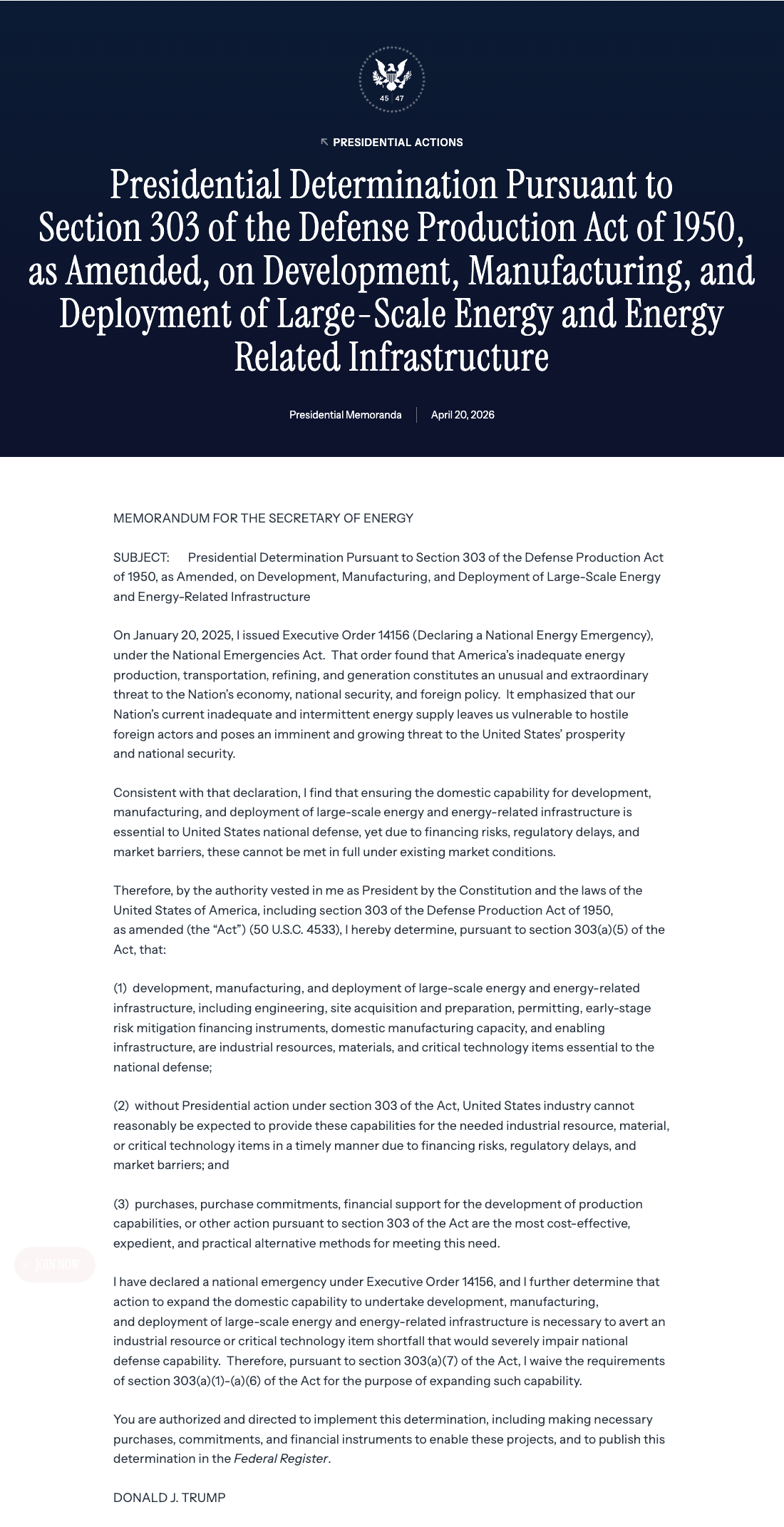
The five determinations, taken together, are a single industrial-policy action delivered under emergency-powers law. They cover, in the words of the memos themselves:
| Determination | What it covers |
|---|---|
| Large-scale energy and energy-related infrastructure | The umbrella: "engineering, site acquisition and preparation, permitting, early-stage risk mitigation financing instruments, domestic manufacturing capacity, and enabling infrastructure." |
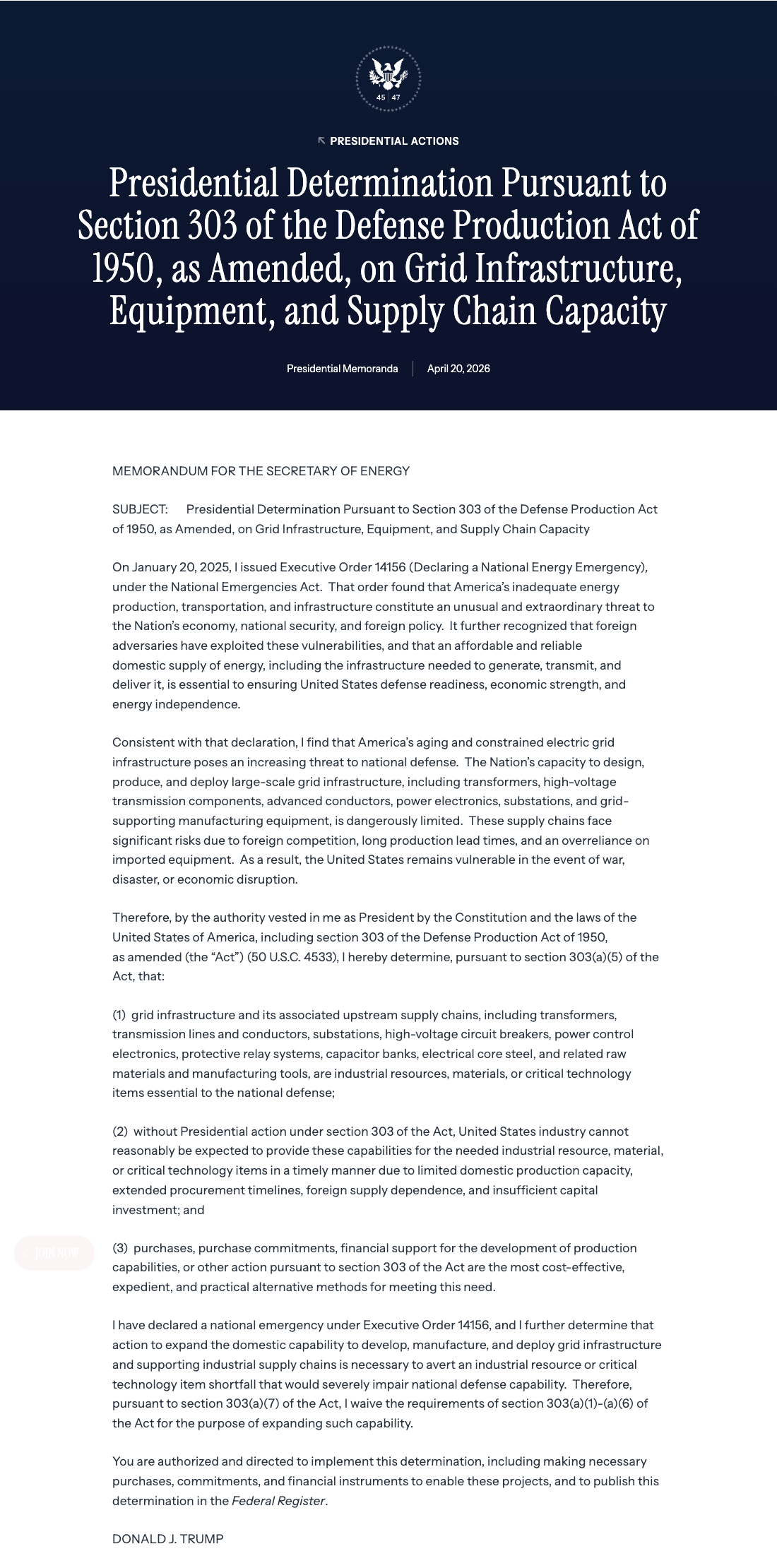
| Grid infrastructure, equipment, and supply chain capacity | "Transformers, transmission lines and conductors, substations, high-voltage circuit breakers, power control electronics, protective relay systems, capacitor banks, electrical core steel, and related raw materials and manufacturing tools." |
| Coal supply chains and baseload power generation capacity | "Coal mining, rail and barge logistics, export and domestic terminals, generating unit availability and life-extension work, on-site stockpiles, and associated reliability updates." |
| Domestic petroleum production, refining, and logistics capacity | "Exploration and production, gathering and transmission pipelines, storage, and marine terminals." |
| Natural gas transmission, processing, storage, and LNG capacity | "Gathering and transmission pipelines, compression, processing plants, underground storage, LNG liquefaction, storage and marine load, export facilities, and critical distribution infrastructure." |
The legal hook is a national emergency Trump himself declared on January 20, 2025, his first day in office. Executive Order 14156 — "Declaring a National Energy Emergency" — found that the country's energy supply "poses an imminent and growing threat to the United States' prosperity and national security." Each of the five determinations cites EO 14156 by number and builds on its finding.
What the waiver actually does
Section 303(a) of the DPA normally imposes statutory gates on the President's 303 authority. The Secretary of Energy would ordinarily have to determine that there is no reasonable alternative, that the acquisition is essential to defense, and that action under 303 is the most cost-effective path; 303(a)(5) caps any single acquisition above statutory thresholds without Congressional authorization, and 303(a)(6) adds further Congressional notification requirements.
Under Section 303(a)(7), the President can waive those gates when a "domestic industrial base shortfall... would severely impair national defense capability." Trump made that finding in each of the five determinations and waived 303(a)(1)–(a)(6) across the board. Each memo then "authorized and directed" the Secretary of Energy to "implement this determination, including making necessary purchases, commitments, and financial instruments."
The practical effect is that the Department of Energy now has blanket authority under DPA 303 to offer federal loans, loan guarantees, direct purchases, and purchase commitments to companies building anything on those five lists — without the usual per-acquisition gates. The determinations don't appropriate money; Congress still controls the underlying DPA budget line. But they remove the statutory review triggers that would otherwise apply each time DOE wants to commit federal funds to a specific project.
Precedent
The last time a president invoked DPA Section 303 at this scale was June 2022, when the Biden administration used it for a different set of technologies: solar panel parts, heat pumps, insulation, electrolyzers for hydrogen production, and grid transformers. Grid transformers now appear on both administrations' DPA Section 303 lists — the only item of overlap.
What the determinations do not contain
None of the five memos names a dollar amount, a specific company, a specific project, or a geographic region. None identifies individual recipients of loans or purchase commitments. None sets a sunset date or review period. None names the foreign adversaries the grid determination references as having "exploited these vulnerabilities."
None of the five determinations mentions nuclear power, solar, wind, battery storage, or geothermal.