Humanoid Robot 'Lightning' Runs Beijing Half-Marathon in 50:26, Beating the Human World Record
At the 2026 Beijing E-Town Humanoid Robot Half-Marathon on April 19, a bipedal robot named Lightning (闪电) by Shenzhen-based Honor finished the 21.0975 km course in 50 minutes 26 seconds — faster than the men's human half-marathon world record of 57:20, per the event's organizer and Xinhua. Last year's winner needed 2 hours 40 minutes.
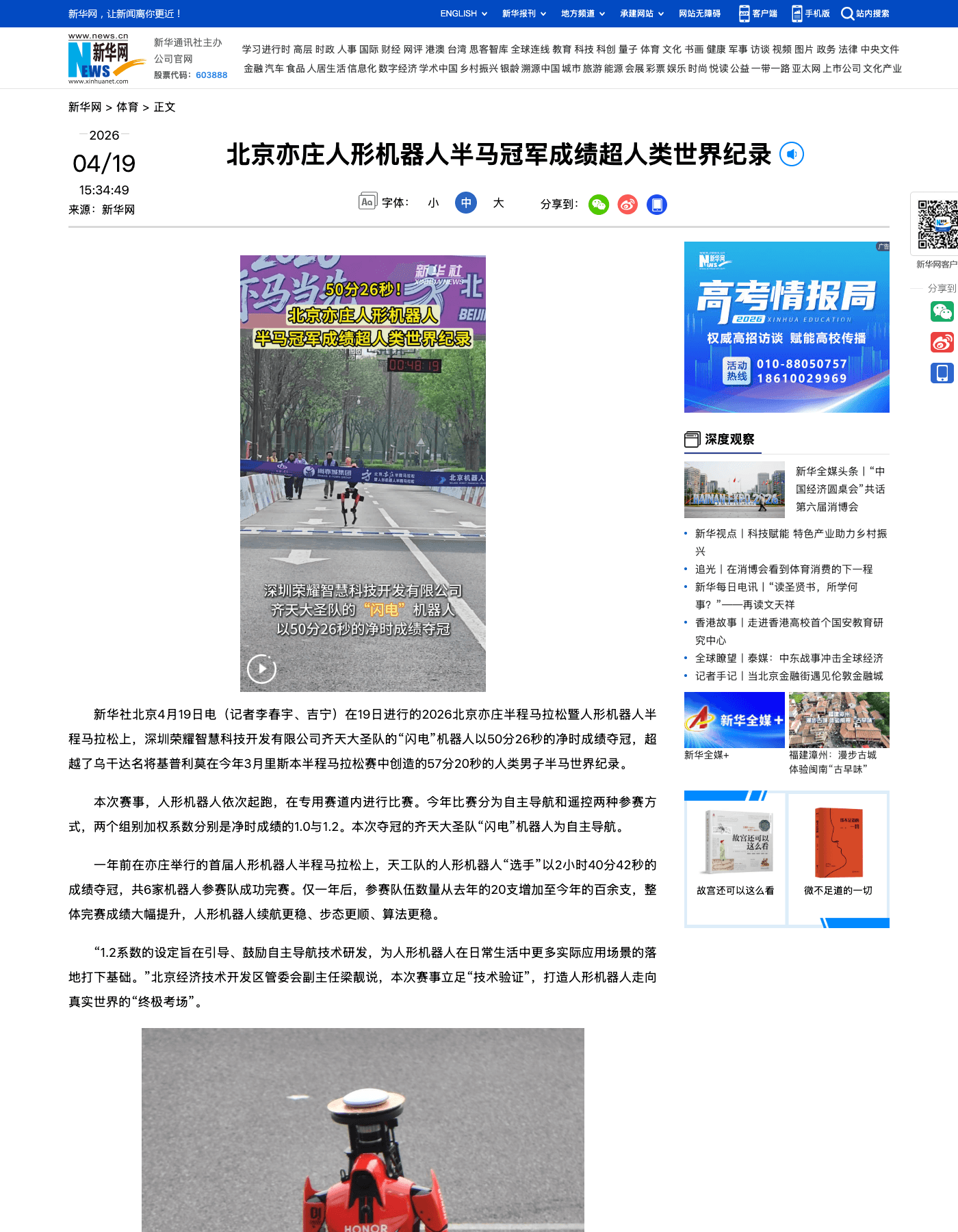
A humanoid robot from Honor's Qitian Dasheng ("Monkey King") team crossed the finish line of the 2026 Beijing E-Town Humanoid Robot Half-Marathon in 50 minutes 26 seconds on Sunday, according to the Beijing Economic-Technological Development Area (Beijing E-Town), the event's organizer. Xinhua reported the time was under the men's human half-marathon world record of 57:20 set in Lisbon last month.
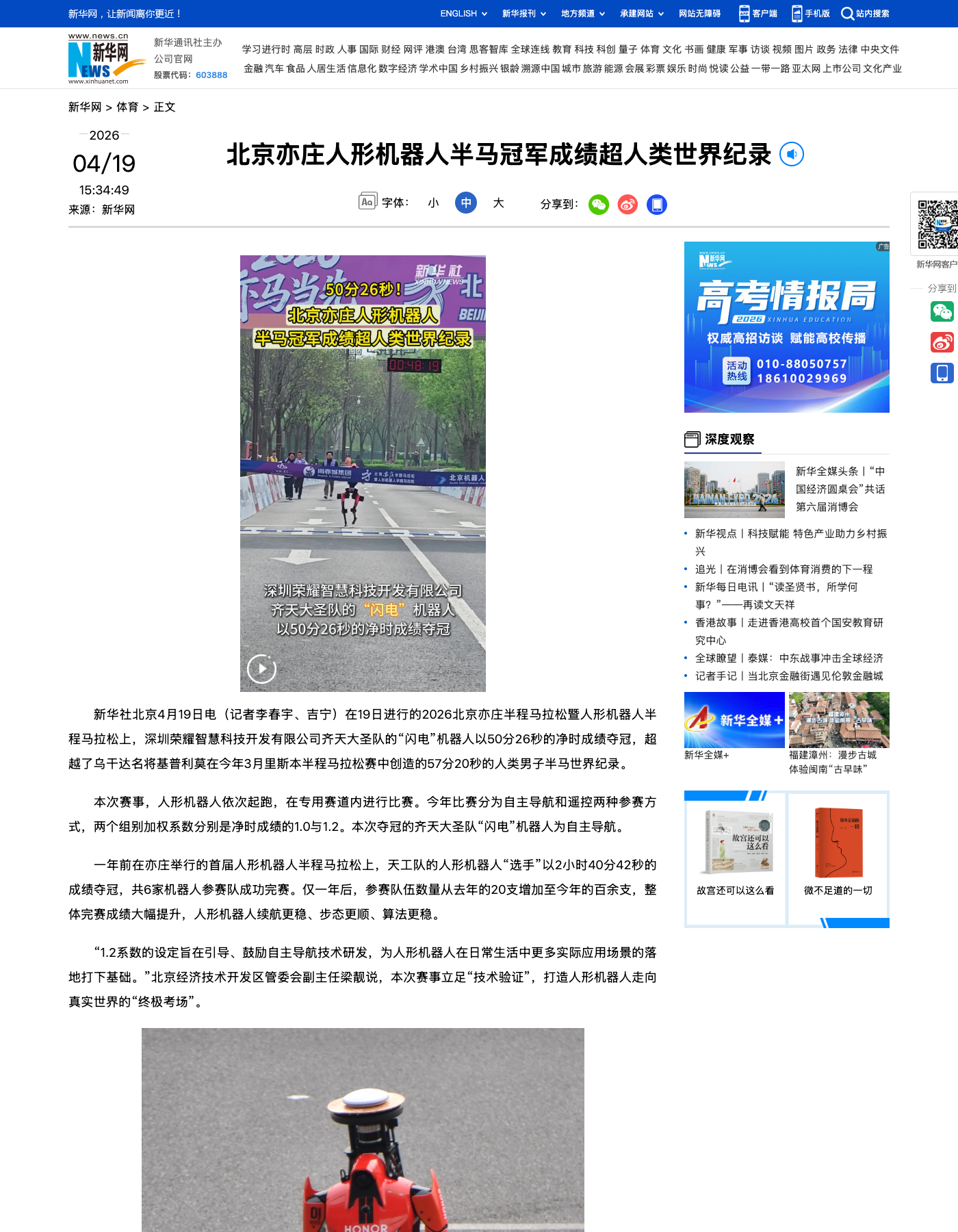
The 169-cm-tall robot, named 闪电 (Lightning), ran the 21.0975 km course through the industrial-park streets of Beijing's E-Town district on the city's southeastern outskirts. It was built by Shenzhen Rongyao Intelligent Technology Development, a subsidiary of Chinese smartphone maker Honor. All three podium places — Lightning, "Thunder Lightning" (silver), and "Spark Prairie" (bronze) — were Honor robots.
A 2-hour 40-minute gap in one year
Last year's inaugural humanoid robot half-marathon in Beijing E-Town was won by Tiangong Ultra in 2 hours 40 minutes 42 seconds. Lightning's 50:26 is roughly 1 hour 50 minutes faster. The scale also jumped: six teams completed the 2025 race; more than 100 humanoid robot teams entered this year, running alongside 12,000 human runners on the same course (the top human finisher, Zhao Haijie, ran 1:07:47 — more than 17 minutes slower than Lightning).
Organizers split the field into two categories. Autonomous-navigation robots — roughly 40% of entries this year, up from essentially none last year — got a 1.0 scoring coefficient. Remote-controlled robots received a 1.2 coefficient, penalizing them to incentivize self-directed systems. Lightning won under the autonomous-navigation rules.
"Competition to drive research, production, and application"
Liang Jing, deputy director of the Beijing Economic-Technological Development Area, framed the race as part of the city's push to turn humanoid robotics from demos into shipping products. The official slogan of the event — 以赛促研、以赛促产、以赛促用 — translates roughly as "using competition to drive research, production, and application."
Chinese humanoid-robot firms including Unitree, Pinecone Technologies (Xiaomi), and Honor treat public running events as a benchmark: walking on flat stage demos is one thing; surviving 21 km of potholes, curbs, turns, and battery drain is another. Lightning's run puts a time on the board that U.S. and European humanoid programs will be measured against.
What the 50:26 does and doesn't mean
Lightning's time is a race result on a specific course with its own rules, not a ratified athletics record — no global governing body certifies robot times, and the Beijing E-Town event applies its own scoring coefficient to autonomous entries. Lightning is also a purpose-built machine optimized for controlled running on a known course, not a general-purpose humanoid.
Still, the year-over-year delta — 2:40:42 to 50:26 — is the more useful number than the comparison to Jacob Kiplimo or Eliud Kipchoge. Twelve months ago, the question was whether a humanoid could finish a half-marathon upright. On Sunday, a hundred of them tried, and the winner finished ahead of more than 11,000 human runners.