Japan Deploys 1,400 Troops and Live-Fire Units to Balikatan 2026 — First Weapons on Philippine Soil Since WWII
Invoking the new Japan–Philippines Reciprocal Access Agreement, Japan's Ministry of Defense is sending approximately 1,400 JSDF personnel, a helicopter destroyer, a tank-landing ship, and Type 88 surface-to-ship missile systems to Balikatan 41-2026. China's foreign ministry warned that external military cooperation 'may very well backfire.'
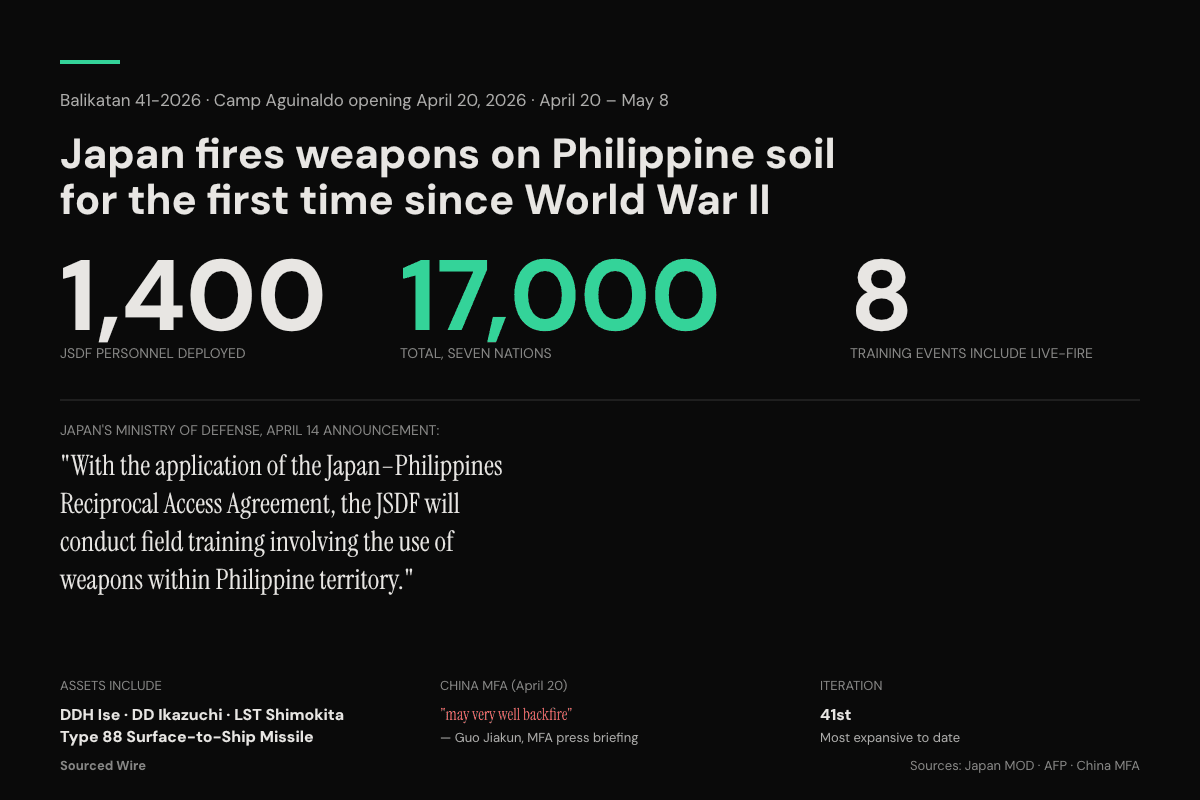
Exercise Balikatan 41-2026 opened on April 20 with a ceremony at Camp Aguinaldo in Quezon City, the Armed Forces of the Philippines said in a press release announcing "the most expansive iteration in history" of the annual U.S.–Philippine drill. The exercise runs through May 8 and involves approximately 17,000 troops from the Philippines, United States, Australia, Canada, France, Japan, and New Zealand, with 13 additional nations observing under the International Observers Program.
The iteration is the 41st and coincides with the 75th anniversary of the U.S.–Philippines Mutual Defense Treaty.
Japan's first field deployment with weapons since WWII
The headline change this year is Japan's.
In an April 14 announcement, the Joint Staff Office of Japan's Ministry of Defense disclosed that Japan will send approximately 1,400 JSDF personnel to Balikatan 26 — and, crucially, that this year's deployment will be the first in which Japan conducts field training involving the use of weapons inside a foreign country since World War II. Japan has participated in Balikatan continuously since joining as an observer in 2012, but previous years were limited to observation or humanitarian and disaster-relief scenarios.
The MOD statement specifies:
"With the application of the Japan–Philippines Reciprocal Access Agreement, the JSDF will conduct field training involving the use of weapons within Philippine territory."
The Reciprocal Access Agreement (RAA) is Tokyo's second such agreement — after its 2022 RAA with Australia — and is the legal instrument under which weapons-carrying JSDF units can operate on Philippine soil.
What Japan is bringing
According to Japan's Joint Staff Office, the 1,400 personnel are drawn from the Joint Staff Office, Ground Staff Office, Ground Component Command, Northern Army, JGSDF Fuji School, JGSDF Anti-Aircraft Artillery School, JGSDF Logistics Command, Self-Defense Fleet, Information Warfare Command, Air Staff Office, Air Defense Command, Air Support Command, Air Training Command, Air Communication System & Wing, Iruma Hospital, JSDF Joint Operations Command, and JSDF Cyber Defense Command. Assets include:
- DDH Ise, a helicopter destroyer
- DD Ikazuchi, a destroyer
- LST Shimokita, a tank-landing ship
- C-130H transport aircraft
- US-2 amphibious search-and-rescue aircraft
- Type 88 surface-to-ship missile systems
Japan's planned training events are: Multinational Maritime Exercise, Amphibious Operations Exercise, Counter-Landing Live-Fire Exercise, Maritime Strike Exercise, Integrated Air and Missile Defense Exercise, Cyber Attack Response Exercise, Joint Medical Operations Exercise, and Airfield Damage Repair Exercise.
The Philippine framing
The AFP's own release described the exercise as the 41st and framed it as a demonstration of alliance depth. AFP Chief of Staff General Romeo S. Brawner Jr. said at the opening ceremony:
"Balikatan is readiness made real, cooperation put into action, and peace preserved through strength. Let this exercise not only demonstrate our readiness, but affirm our commitment to stand together and to act together."
Major General Francisco F. Lorenzo is the Philippine Exercise Director for Balikatan 41-2026.
China's response
At his April 20 regular press briefing in Beijing, Foreign Ministry spokesperson Guo Jiakun was asked directly by an AFP correspondent about the Balikatan drills. Guo responded that "the Asia-Pacific needs peace and tranquility" and warned against "division and confrontation as a result of the introduction of external forces," adding that "military cooperation among countries should not target any third party" and that binding oneself together for security "may very well backfire."
A Reuters follow-up asked about a Japanese destroyer that transited the Taiwan Strait en route to the drills. Guo reaffirmed China's "solemn position" on such passages and urged Japan to "exercise prudence" in military matters rather than "flexing muscles around" the region.
What the exercise covers
Balikatan 41-2026 runs April 20 to May 8 across the Philippine archipelago. Reported elements include multinational maritime logistics, distributed maritime operations, amphibious operations, counter-landing live-fire, maritime strike, integrated air and missile defense, cyber defense, and airfield damage repair. The U.S. contributes approximately 10,000 personnel; the Philippines, Japan, and the remaining partner nations account for roughly 7,000.