FDA Codifies Class II Rule for Gene Tests That Identify Patients Eligible for Rhythm's Setmelanotide
Published April 22 in the Federal Register, the final order creates 21 CFR § 862.1164 — a permanent regulatory slot for in vitro diagnostic systems that screen for germline variants in obesity patients who may benefit from setmelanotide. Future test sponsors can pursue 510(k) clearance instead of filing fresh De Novo requests.
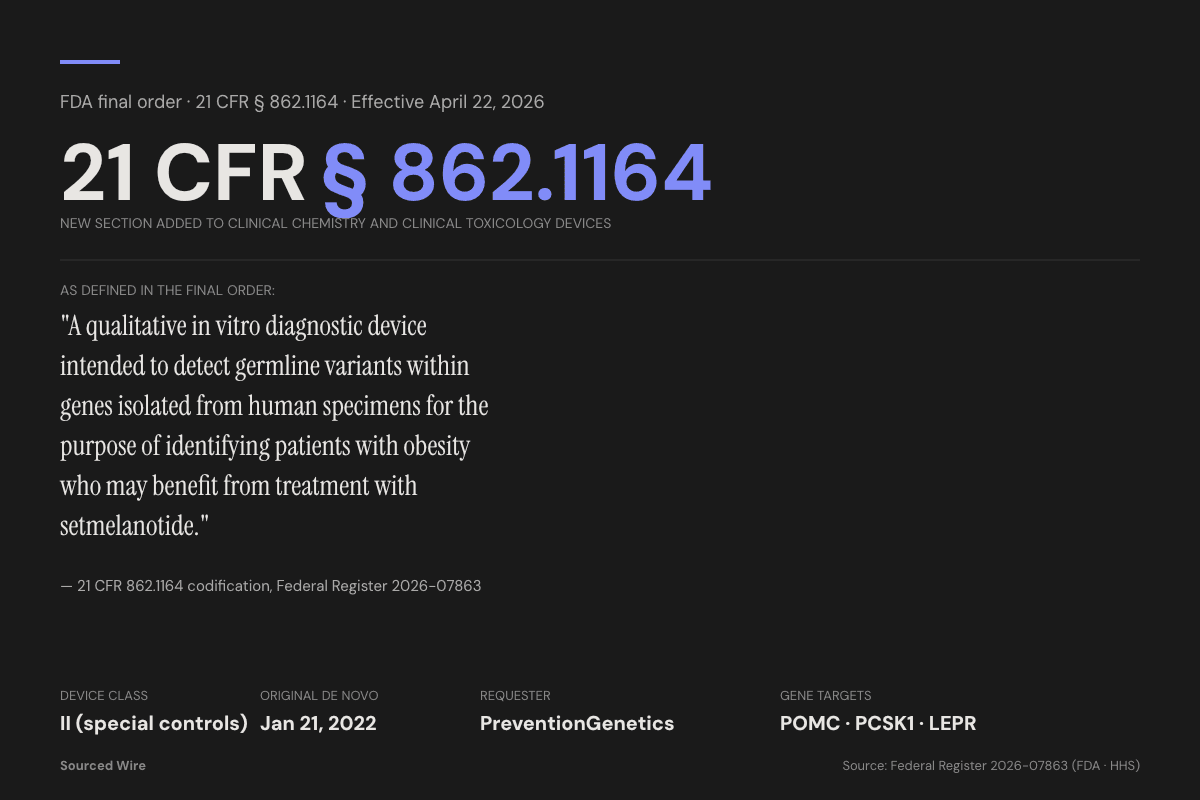
The Food and Drug Administration on April 22 issued a final order codifying Class II classification for a new generic device type: the "setmelanotide eligibility gene variant detection system." The order adds 21 CFR § 862.1164 to the clinical chemistry and clinical toxicology devices subchapter and completes a process that began when PreventionGenetics, LLC filed a De Novo request on September 7, 2021 for its POMC/PCSK1/LEPR CDx Panel. FDA granted the original classification on January 21, 2022; Wednesday's order writes that classification into the Code of Federal Regulations as a generic device category.
The codified definition reads:
"A qualitative in vitro diagnostic device intended to detect germline variants within genes isolated from human specimens for the purpose of identifying patients with obesity who may benefit from treatment with setmelanotide in accordance with the approved therapeutic product labeling."
Setmelanotide is the generic name for Rhythm Pharmaceuticals' IMCIVREE — a melanocortin-4 receptor (MC4R) agonist cleared to treat rare genetic forms of obesity driven by variants in MC4R-pathway genes including POMC, PCSK1, LEPR, Bardet-Biedl syndrome, and, as of March 19, 2026, acquired hypothalamic obesity.
Why codification matters for companion diagnostics
The practical effect of this final order is that future gene-test developers can pursue 510(k) clearance instead of filing a new De Novo request. FDA wrote that a class II designation with special controls "will enhance patients' access to beneficial innovation, in part by reducing regulatory burdens" compared with the automatic class III assignment that any post-1976 device receives by default. Once a classification exists as a generic type, new entrants can be cleared as substantially equivalent to the predicate.
What the rule requires
FDA identified two risks specific to the device type in Table 1 of the final order:
- Incorrect performance of the test producing false positives (inappropriate drug treatment) or false negatives (patients missing a treatment opportunity).
- Incorrect interpretation of genetic data producing the same two failure modes.
Both risks are addressed through the special controls named in § 862.1164: documented design verification and validation studies; documented variant-interpretation and classification procedures; and labeling that discloses performance information and limiting statements. FDA declined to exempt the device type from 510(k) premarket notification, so each new setmelanotide-eligibility detection system remains subject to premarket clearance.
The rule is housed under the FDA's Office of Management and Budget paperwork-reduction review authorities cited in § 862.1164 (OMB control numbers 0910-0844 for De Novo, 0910-0120 for 510(k), 0910-0073 for quality management, 0910-0485 for labeling).
Context
The setmelanotide companion diagnostic sits in a narrow but expanding corner of FDA regulatory policy. Drug-specific genetic tests are typically cleared alongside the drug itself through the companion-diagnostic (CDx) pathway. Codifying the device as a generic type tied to one drug's labeling — rather than classifying it by analyte (a POMC/PCSK1/LEPR panel could be used for many purposes) — signals that FDA is willing to structure its diagnostic classifications around the therapeutic use case when a drug has a narrow, genetically-defined patient population. Setmelanotide's approved indications include variants in POMC, PCSK1, LEPR, and Bardet-Biedl syndrome-related genes.
Rhythm Pharmaceuticals, which markets IMCIVREE, is not itself the requester of the classification; PreventionGenetics originated the De Novo submission with its CDx Panel. Today's codification makes that panel's approval the platform on which future sponsors can stack — including laboratories that want to offer reimbursable germline testing as the patient population eligible for setmelanotide expands.