Germany's Headline Crime Count Fell 5.6% in 2025. Rape, Gun Violence, and Youth Pornography Did Not.
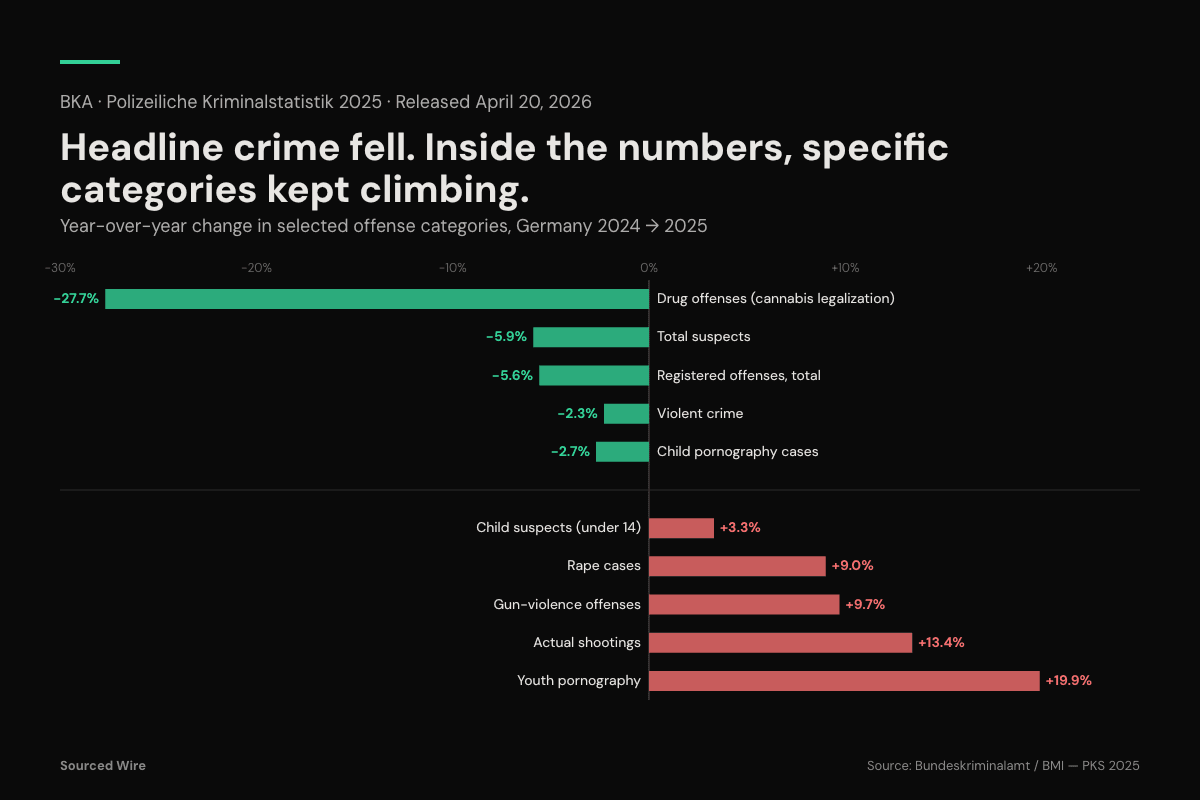
The Bundeskriminalamt's Police Crime Statistics for 2025, released April 20, show 5.5 million total offenses — the lowest since 2021 — with violent crime down 2.3% for the first time since then. Inside that headline, rape rose 9%, gun-violence offenses rose 9.7%, actual shootings rose 13.4%, and youth pornography cases rose 19.9%.
Germany's federal police-crime statistics for 2025 (Polizeiliche Kriminalstatistik, or PKS), presented in Berlin on April 20 by Federal Interior Minister Alexander Dobrindt, Hamburg Interior Senator and Interior Ministers' Conference chair Andy Grote, and Bundeskriminalamt (BKA) President Holger Münch, recorded about 5.5 million offenses — a 5.6% decline from 2024 and the lowest total since 2021. The clearance rate rose to 57.9%.
The top-line declines continued across most categories the PKS tracks:
- Total registered offenses: −5.6%
- Total suspects: −5.9% (roughly 2.05 million)
- Violent crime: −2.3% (the first decline since 2021)
- Juvenile suspects in violent crime: −7.4%
- Migrant suspects in violent crime: −7.2%
- Drug offenses: −27.7%, driven largely by the 2024 cannabis legalization (consumption cannabis offenses fell out of the statistics)
- Domestic cybercrime: −4.1%; domestic fraud: −8.4%
- Child pornography cases: −2.7% (41,677 cases)
Münch framed this at the Berlin press conference:
"Crime overall is declining, violence is declining, the number of suspects is declining. At the same time, crime is changing — more digital, more international, and in places more brutal."
Where the numbers went the other way
Several categories rose against the falling headline:
- Rape: +9.0% year-over-year; the case count is up roughly 72% since 2018
- Knife attacks: +0.8% (29,243 cases); specifically threats with knives +9.5%
- Gun-violence offenses: +9.7% (3,166 cases)
- Actual shootings (a subset of the above): +13.4%
- Youth pornography (production, distribution, possession of material showing 14-to-17-year-olds): +19.9%
- Cocaine-related offenses: +1.9%; methamphetamine: +3.0%
- Child suspects (under 14): +3.3%
- Internationally-perpetrated cybercrime: +3.0%; internationally-perpetrated fraud: +7.0%
Grote called the women's-safety numbers — particularly rising sexual offenses — the item he was most concerned by, telling reporters the figures underscored a need for "better protection."
Non-German nationals remained over-represented in violent-crime suspect counts at 42.9%, though that share fell alongside the overall drop. Dobrindt cited the figure in calling for a "tough action plan against organized crime" and "consistent deportation of repeat offenders":
"The decline is a beginning, but no reason for the all-clear."
The dark-field data
The BKA and BMI released the PKS alongside preliminary findings from the 2024 wave of the Sicherheit und Kriminalität in Deutschland (SKiD) dark-field study, a household survey designed to estimate how many crimes victims experience but never report. Selected results:
- 8.5% of 16–17-year-olds reported experiencing a physical assault in the preceding year — roughly double the 2020 reading
- Reporting rate for sexual offenses: 6.2%
- About 1 in 5 respondents reported being the target of internet fraud
- 74.0% said they felt safe walking alone at night, a 2.0-point improvement year-over-year
- Roughly 45% reported safety concerns on public transport (ÖPNV)
The SKiD gap — between what shows up in police statistics and what respondents report experiencing — is substantial for sexual offenses in particular. A reporting rate of 6.2% implies the 9.0% PKS increase in rape cases understates the underlying incidence.
What this is, and isn't
The PKS is a flow measure of police-registered crimes in the calendar year they are recorded; it does not track court outcomes or clearances by time-of-offense. Category definitions, recording practices, and legal changes all shift the counts. The 2024 partial cannabis legalization is the clearest example this year: the −27.7% decline in drug offenses is largely a definitional shift rather than a behavioral one. Read alongside SKiD, the picture the BKA sketched was what Münch called "differentiated" — headline volumes down, specific violent and digital categories continuing to climb.