FAA Carves Six New Restricted Airspace Blocks From Surface to FL 290 Over Camp Lejeune and Cherry Point for Marine Corps Training
The April 21 final rule establishes R-5305A/B/C over Camp Lejeune and R-5307A/B/C over Cherry Point, stitching them into the existing R-5003, R-5004, and R-5306 complexes to contain Small Diameter Bomb II laser targeting, surface-to-surface artillery, combat UAS operations, and low-altitude air defense drills. Effective July 9, 2026.
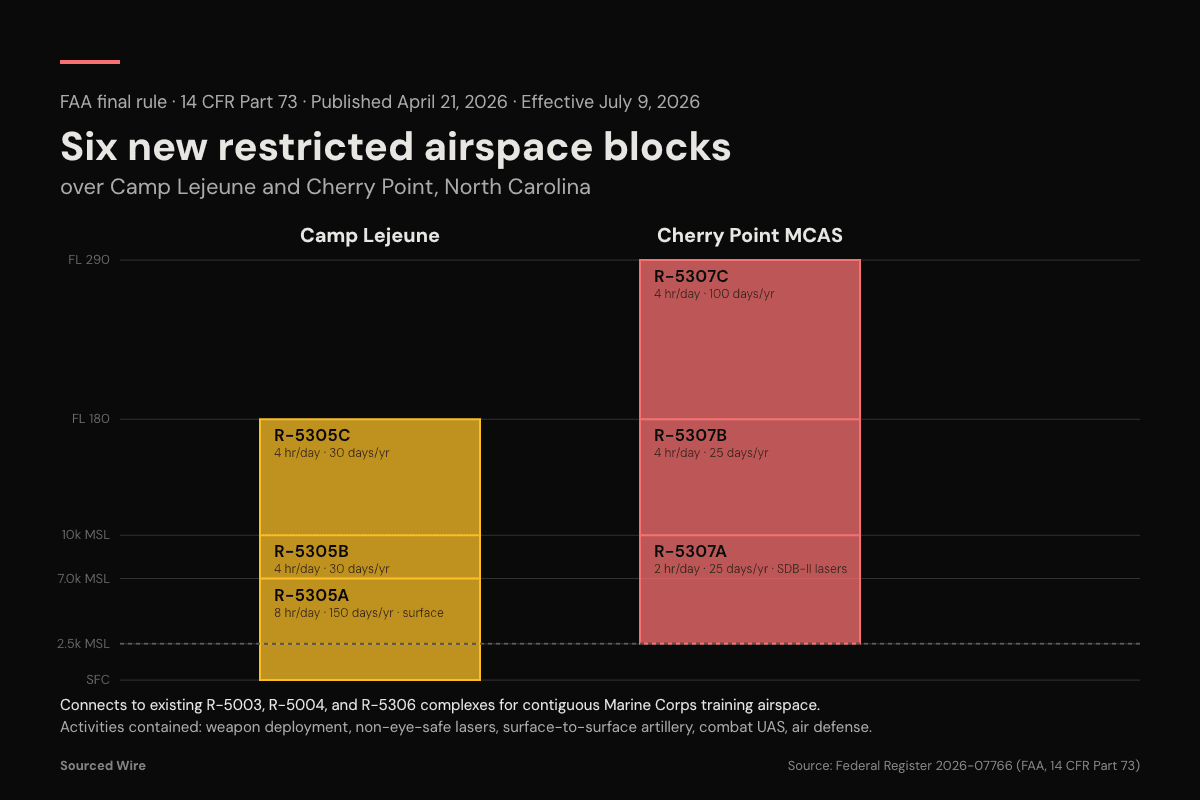
The Federal Aviation Administration published a final rule on April 21 creating six new restricted airspace blocks — three over Camp Lejeune (R-5305A, R-5305B, R-5305C) and three over Cherry Point Marine Corps Air Station (R-5307A, R-5307B, R-5307C) in eastern North Carolina. Together, the new blocks stack from the surface up to Flight Level 290 and connect the existing R-5003, R-5004, and R-5306 restricted area complexes into one contiguous tract of special use airspace sized to contain U.S. Marine Corps training that the agency describes as "hazardous activities such as weapon deployment and use of non-eye safe lasers and artillery."
The rule amends 14 CFR Part 73 and takes effect at 0901 UTC on July 9, 2026. The action carries FAA docket number FAA-2025-0273 and Federal Register document 2026-07766.
What each block covers
The Camp Lejeune blocks (R-5305A/B/C) share lateral boundaries and stack vertically:
- R-5305A — surface up to but not including 7,000 feet MSL. Published times of use: Monday through Friday, 0600–2359 local; other times by NOTAM with 24-hour advance notice. Expected activation: 8 hours per day, 150 days per year. A narrow corridor along U.S. Highway 17 — 200 feet either side of the road, from the surface to 200 feet AGL — is excluded.
- R-5305B — 7,000 to 10,000 feet MSL. NOTAM required at least 4 hours before activation. Expected: 4 hours per day, 30 days per year.
- R-5305C — 10,000 feet MSL to but not including FL 180. NOTAM required at least 4 hours before activation. Expected: 4 hours per day, 30 days per year.
The Cherry Point blocks (R-5307A/B/C) overlay each other. R-5307A replaces existing alert area A-530, which the FAA plans to cancel through a separate non-rulemaking process:
- R-5307A — 2,500 feet MSL to but not including 10,000 feet MSL. NOTAM required at least 12 hours before activation. Expected: 2 hours per day, 25 days per year. The 2,500-foot floor is specifically sized to contain Small Diameter Bomb II laser-targeting activity angled downward from above.
- R-5307B — 10,000 feet MSL to but not including FL 180. NOTAM required at least 4 hours before activation. Expected: 4 hours per day, 25 days per year.
- R-5307C — FL 180 to FL 290. Published times of use: Monday through Friday, 0800–2359 local; other times by NOTAM. Expected: 4 hours per day, 100 days per year.
Controlling agency for R-5305A, R-5305B, R-5307A, and R-5307B is Cherry Point Combined Center Radar Approach Control Facility (CERAP). Washington ARTCC controls R-5305C and R-5307C.
What the Marines will do in it
The Marine Corps Environmental Assessment on which FAA adopted its finding of no significant impact listed the activities that will occur inside the new airspace: fixed-wing use of existing targets, long-range lasers, threat emitters, low-altitude air defense training, surface-to-surface artillery, small arms ranges, and training with combat-capable Unmanned Aircraft Systems. Roughly 25 percent of activation time across the blocks is expected to occur during hours of darkness.
The pilot fight
The FAA received 49 comments on the NPRM. Twenty-four of those came from individuals worried about impacts to nearby general aviation — particularly Michael J. Smith Field (KMRH) in Beaufort, NC, which sits close to the R-5305 and R-5307 complexes. Commenters asked the agency to:
- Move the hazardous activities offshore into warning area airspace;
- Require NOTAMs at least four hours before activation;
- Provide real-time status for each block; and
- Raise the floor of R-5305A, R-5307A, and R-5307B, or carve a VFR corridor from KMRH toward the northwest.
The FAA declined suggestions 1 and 4. On the offshore-relocation idea, the agency said warning areas do not provide the "varied terrain" required for land and amphibious training. On the floor question, it cited the targeting geometry of SDB-II: because the laser and bomb trajectories are angled downward through R-5307A and R-5307B into adjacent R-5306A, raising the floor — even in a partial VFR corridor — "would degrade training by limiting the angles that could be used to fire ordnance."
The FAA agreed in part with the NOTAM-advance-notice request. In the final rule, R-5305B, R-5305C, and R-5307B all require a NOTAM at least four hours before activation. R-5307A was upgraded to a 12-hour NOTAM requirement. R-5305A retains its originally-proposed 24-hour requirement. R-5307C was left without an advance-NOTAM requirement on the ground that it is entirely inside Class A airspace, where pilots are already in two-way communication with air traffic control.
On real-time status, the FAA pointed commenters to its existing SUA status site at sua.faa.gov and listed the VHF/UHF frequencies for Cherry Point CERAP and Washington ARTCC that controllers will publish in the chart tabulation section of aeronautical charts.
How it fits together
Together with the preexisting R-5003, R-5004, and R-5306 complexes, the new blocks create what the rule calls "one large contiguous tract of SUA that is better suited to contain the hazardous activities associated with U.S. Marine Corps training requirements." The FAA justified adopting the rule under 49 U.S.C. § 40103, which directs the agency to "prescribe regulations to assign the use of the airspace necessary to ensure the safety of aircraft and the efficient use of airspace."