FAO and WMO: Extreme Heat Costs 500 Billion Work Hours a Year as Crop Thresholds Crack Above 30°C
A joint FAO-WMO report released on Earth Day 2026 finds that extreme heat now erases roughly half a trillion labor hours annually, threatens more than a billion livelihoods, and is pushing staple-crop yields past known temperature breakpoints in Brazil, Kyrgyzstan, and beyond.
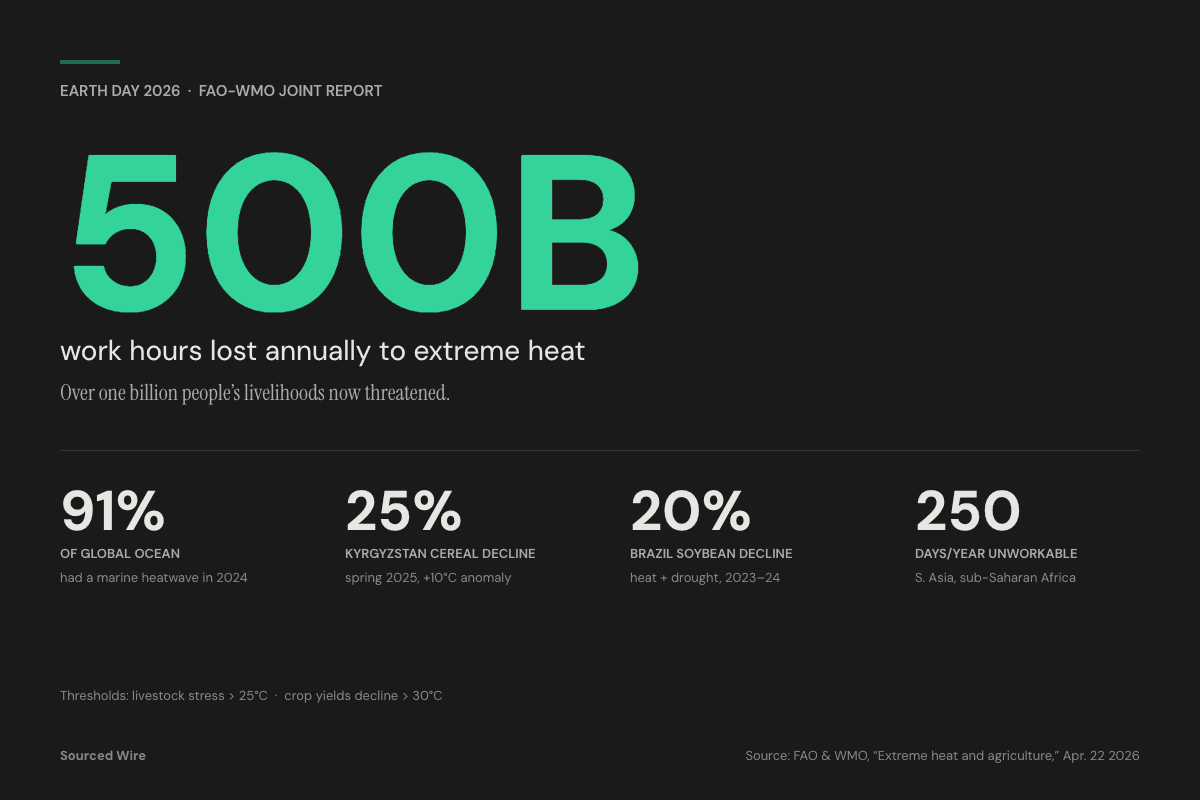
The UN's Food and Agriculture Organization and the World Meteorological Organization released a joint assessment titled Extreme heat and agriculture on April 22, 2026, quantifying a set of thresholds at which the global food system begins to fail. Their headline figure: roughly 500 billion work hours are lost each year to heat that is already too intense for outdoor labor, with more than one billion people's livelihoods now threatened. The losses fall disproportionately on agricultural workers in the tropics and on the crops, livestock, fisheries, and forests they tend.
The report frames heat as a "risk multiplier" — a variable that doesn't just damage systems directly, but amplifies every other stress they face: drought, pests, wildfire, disease. "Extreme heat is a major risk multiplier, exerting mounting pressure on crops, livestock, fisheries and forests," FAO Director-General Qu Dongyu said. WMO Secretary-General Celeste Saulo added that "extreme heat is increasingly defining the conditions under which agrifood systems operate."
The biological thresholds
Much of the report is devoted to physiological breakpoints. Livestock stress begins above 25°C. Major crop yields begin declining above 30°C. These are not projections — they are the conditions under which industrial-scale agriculture in much of the world is already operating for weeks or months each year.
In parts of South Asia, tropical sub-Saharan Africa, and Central and South America, the report finds up to 250 days a year are now too hot for safe outdoor work by international occupational-health standards. That is not a future scenario; it is the current baseline.
The recent case studies
The authors work through a short, documented list of recent system failures:
- Kyrgyzstan, spring 2025. The Fergana mountain range endured a stretch where temperatures ran roughly 10°C above normal, peaking around 30.8°C. Thermal shock hit fruit and wheat crops, triggered a locust outbreak, and cut irrigation capacity as evaporation spiked. The net result was a 25% decline in cereal harvests.
- Brazil, 2023-24. Compound heat and drought cut soybean yields by as much as 20% across affected growing regions.
- North America, 2021. The Pacific Northwest heat dome covered roughly 3 million square kilometers with temperatures four standard deviations above normal — a statistical event that would be expected on the order of once in tens of thousands of years in a stable climate. Fruit crops, orchards, and Christmas tree plantations sustained significant losses; the fire season that followed was calamitous.
- Oceans, 2024. 91% of the global ocean experienced at least one marine heatwave. The report links these events to fish cardiac failure from oxygen depletion and to cascading losses across fisheries.
How the curve bends
The report ties these observations to the warming trajectory directly. Relative to a 1.5°C world, 2°C warming roughly doubles extreme-heat intensity; 3°C warming roughly quadruples it. The implication is that the work-hours and yield-loss numbers quoted above are a lower bound on what the food system will face in coming decades unless the underlying trajectory is bent.
FAO and WMO jointly call for expanded early-warning systems, seasonal outlooks adapted for farmers and fishers, selective breeding and adjusted planting windows, and shock-responsive financial protections like parametric insurance and cash transfers. But the report is explicit that adaptation alone is insufficient. "The only lasting solution," the authors write, is "ambitious, coordinated action to curb climate change."
Global hunger, by the UN's own count, already reached 720 million people last year. The FAO-WMO report is an argument that those numbers and the temperature record are no longer separable — that food security is now, in operational terms, a climate variable.