France's G7 Environment Agenda Lists Five Priorities. Climate Change Is Not One of Them.
Opening a two-day ministerial meeting in Paris on April 23, France's presidency of the G7 published an agenda built around biodiversity finance, desertification, the ocean, water, and real-estate resilience to disasters. Climate change is addressed only as one of three COPs to be discussed in a "political exchange" — a downgrade from its central billing at previous G7 Environment meetings.

The G7 Environment ministers' meeting opened in Paris on April 23, 2026, under the French presidency of the G7. The meeting runs two days and will conclude with a press conference from French Minister of Ecological Transition Monique Barbut on April 24 at the Hôtel de Roquelaure.
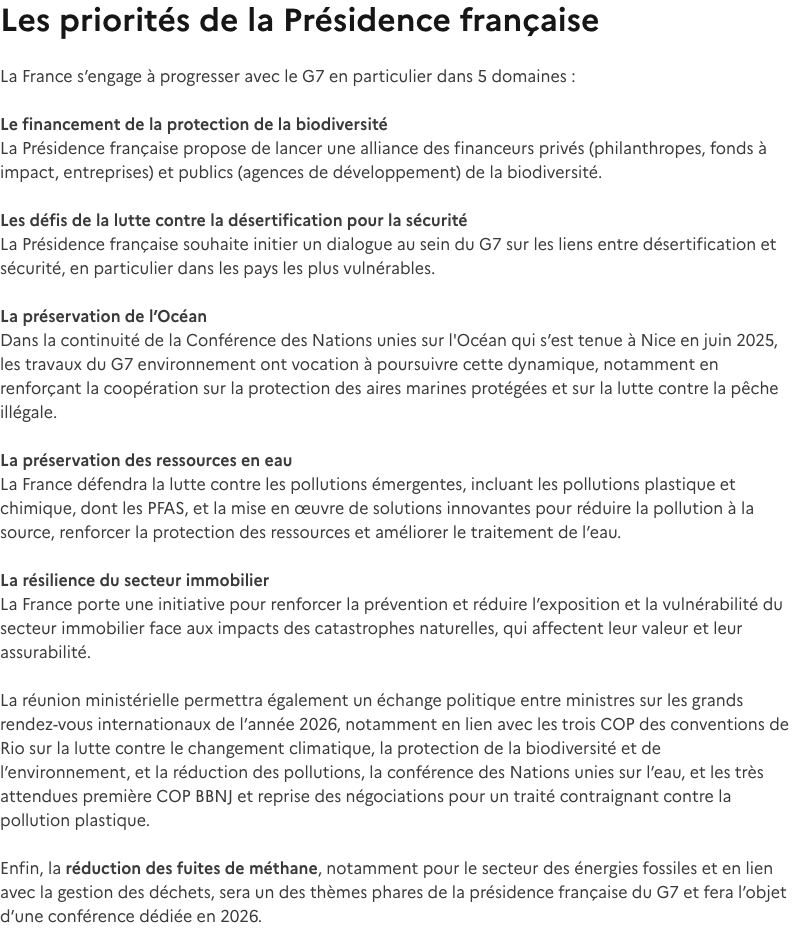
The agenda, published on the ministry's website ahead of the meeting, lists five priority domains for the French presidency — climate change is not among them:
The five priorities
As published by the Ministry of Ecological Transition:
- Biodiversity finance — "une alliance des financeurs privés et publics" (an alliance of private and public biodiversity funders, including philanthropies, impact funds, corporations, and development agencies).
- Desertification and security — a G7 dialogue on links between desertification and security risks "in the most vulnerable countries."
- Ocean preservation — a continuation of the UN Ocean Conference held in Nice in June 2025, focused on marine protected areas and illegal fishing.
- Water resources — emerging pollutants including PFAS, microplastics, and chemical pollution, with an emphasis on source reduction and treatment.
- Real-estate resilience — an initiative to reduce property-sector exposure to natural-disaster impacts on asset value and insurability.
A sixth theme — methane leak reduction from fossil fuels and waste — is flagged as "one of the flagship themes" of the French G7 presidency and will get a dedicated conference later in 2026.
Where climate sits on the agenda
Climate change appears in the agenda only as one item in a broader "political exchange" (échange politique) between ministers about upcoming international meetings in 2026: the three Rio-convention COPs (climate change, biodiversity, pollution reduction), the UN Water Conference, the first BBNJ COP on biodiversity in the high seas, and the resumption of negotiations on a binding plastic-pollution treaty.
The ministry's own framing characterizes the meeting's environmental ambition as advancing "a fairer growth" and "a new international order more balanced, more sustainable, and more inclusive." The published priorities list does not reference the Paris Agreement or a 1.5°C target.
Participation
Six G7 members — France, Italy, Canada, Japan, Germany, and the United Kingdom — are represented by environment ministers. The United States is represented by Usha-Maria Turner, assistant administrator for the Office of International and Tribal Affairs at the U.S. Environmental Protection Agency — a non-cabinet-level EPA official, rather than the EPA administrator.
Context: a downgrade from 2019
France last held the G7 presidency in 2019. That year's G7 Environment ministerial, held in Metz, was built around biodiversity and climate as joint priorities and produced the Metz Charter on Biodiversity. The 2019 communiqué explicitly reaffirmed the six non-U.S. G7 members' commitment to the Paris Agreement and recorded the United States' reiterated intent to withdraw.
The 2026 French agenda forgoes an equivalent climate-specific commitment. Climate appears in the agenda text only through its COP process, not as an action item with a G7 framing. The concluding ministerial declaration, typically released at the close of the two-day meeting, will indicate whether the full G7 — including the United States — signs on to any climate-specific language.
The Paris meeting is a preparatory milestone for the G7 leaders' summit, which France will host in Évian from June 15 to 17, 2026.