ILO Pegs 840,000 Annual Deaths to Workplace Stress, Long Hours and Harassment in First Global Estimate
The International Labour Organization, in its first global estimate, attributes more than 840,000 deaths a year to psychosocial risks at work. The report puts the combined annual loss from cardiovascular disease and mental disorders linked to those risks at 1.37% of global GDP.
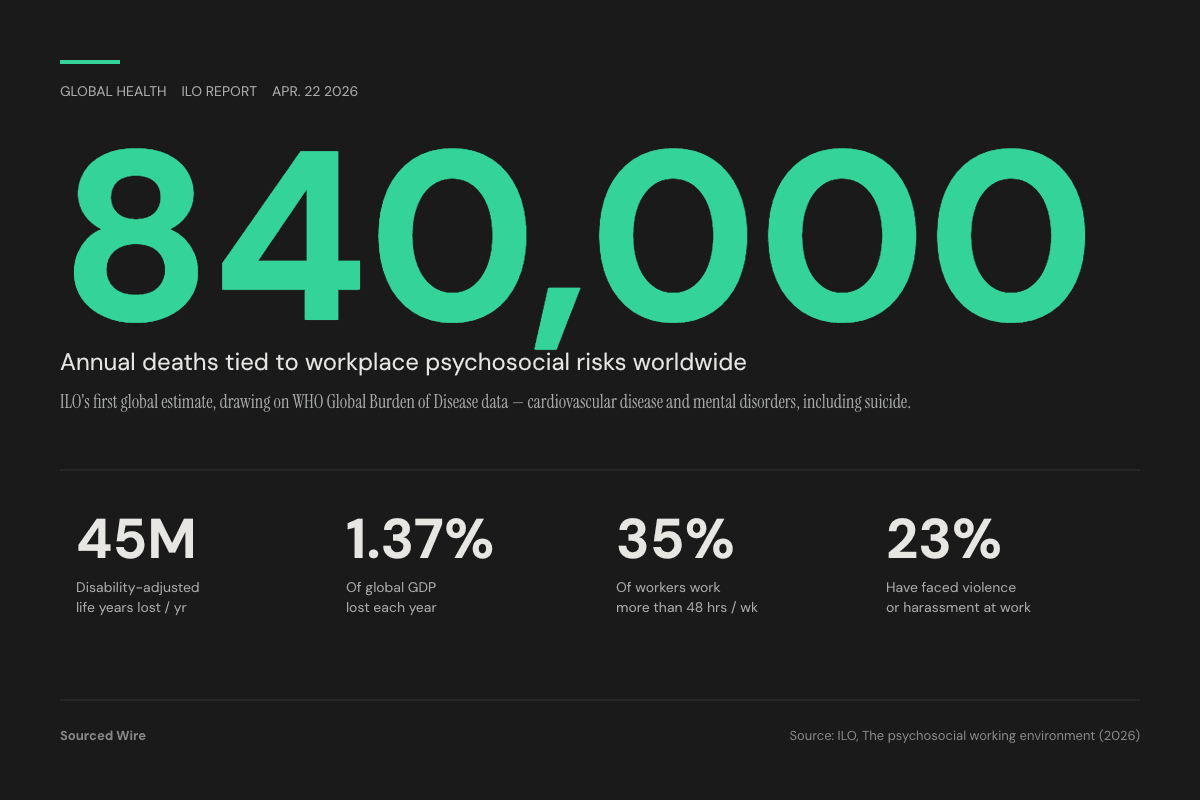
The International Labour Organization on Wednesday released the first-ever global estimate of how many people die each year from health conditions linked to the way work is designed, organized and managed: more than 840,000.
The deaths come almost entirely from two channels — cardiovascular disease and mental disorders, including suicide. The figure was generated by combining global exposure data on five workplace psychosocial risk factors with mortality data from the World Health Organization's Global Burden of Disease study.
The finding appears in The psychosocial working environment: Global developments and pathways for action, a 220-page report published under a Creative Commons BY 4.0 license and timed to the UN's April 28 World Day for Safety and Health at Work. Embargoed copies were released at 06:00 GMT on April 22.
What the ILO is counting
The ILO defines five psychosocial risk factors at work:
- Job strain — high demands paired with low control over how the work is done
- Effort-reward imbalance — the gap between what workers contribute and what they receive in pay, recognition, or job security
- Job insecurity — the threat of layoff, contract non-renewal, or loss of livelihood
- Long working hours — defined as more than 48 hours per week
- Bullying and harassment — including psychological violence, the most prevalent form
Each factor has, in epidemiological literature, been linked to elevated risk of heart disease, stroke, depression, anxiety and suicide. The ILO matched global prevalence data on each risk against WHO mortality estimates to produce the 840,000-deaths figure.
The supporting numbers
Beyond the headline death toll, the ILO documents four reinforcing figures:
- 45 million disability-adjusted life years lost each year — a measure that combines years of life cut short with years lived with disability
- 1.37 percent of global GDP lost annually to cardiovascular disease and mental disorders associated with workplace psychosocial risks
- 35 percent of workers globally work more than 48 hours per week, the threshold above which cardiovascular and stroke risk rises sharply
- 23 percent of workers worldwide have experienced violence or harassment in their working lives — with 18 percent reporting psychological violence specifically
The report says digitalization, AI, platform work, and the expansion of remote and hybrid arrangements may "intensify existing problems or create new ones" even as they offer scope to redesign work in ways that reduce psychosocial risk.
A regulatory and data gap
The ILO's foundational occupational safety and health (OSH) instruments do not explicitly mention psychosocial risks. The 2019 Violence and Harassment Convention (No. 190) is the first ILO instrument to do so. National frameworks vary widely; many laws still frame the issue as protecting "mental health" — an approach the report argues encourages individualized responses rather than redesigning the work itself.
The ILO surveyed national OSH statistics offices in 2025 and found that only 37 percent of responding institutions — 41 of 111 — have concrete plans to strengthen statistics on psychosocial risks within the next five years. Of 338 cross-border collective bargaining agreements recorded between 2000 and 2025 in the ILO Cross-Border Social Dialogue Repository, just 18 percent explicitly address mental health or psychosocial factors within OSH provisions.
"Psychosocial risks are becoming one of the most significant challenges for occupational safety and health in the modern world of work," said Manal Azzi, who leads OSH policy and systems at the ILO.
The full report carries DOI 10.54394/00033223 and ISBN 9789220432259. An executive summary runs five pages.