Trump Administration Nears $500M Spirit Airlines Rescue With Warrants for Up to 90% Equity, as His Transportation Secretary Resists
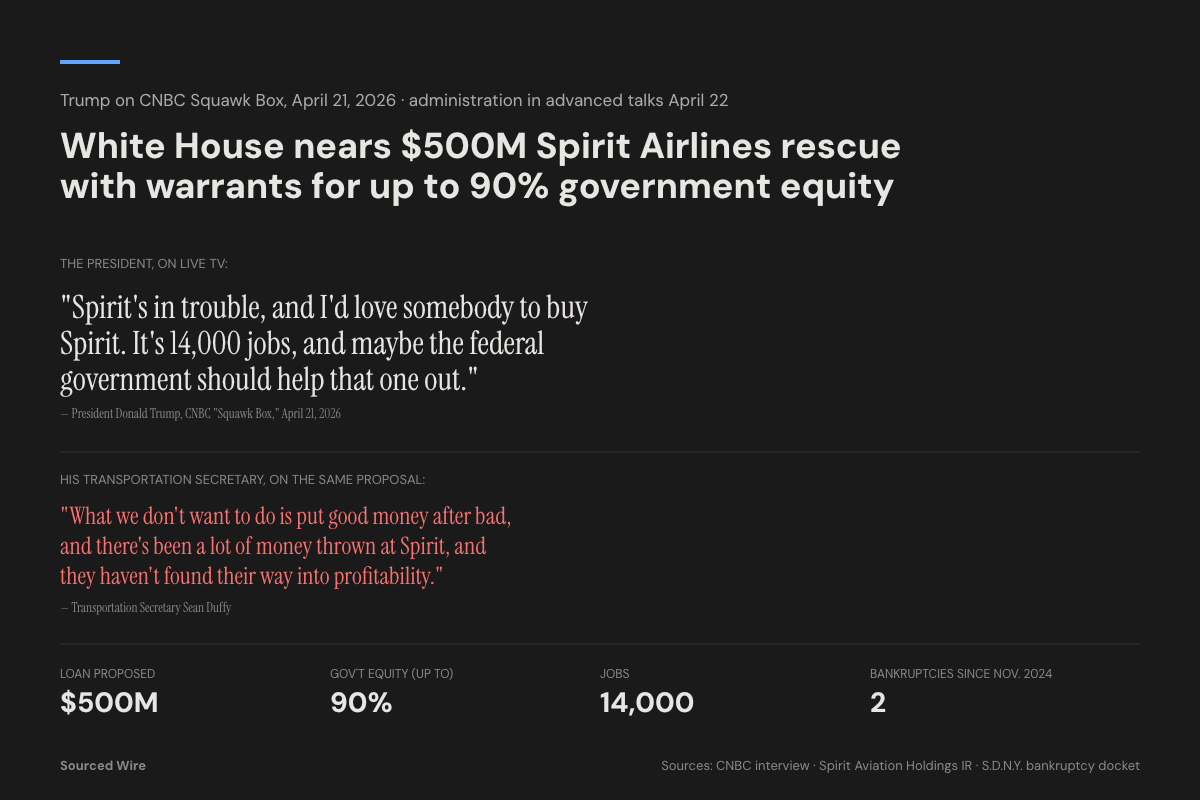
President Trump told CNBC on April 21 that the federal government should 'maybe' help Spirit Airlines, currently in its second bankruptcy in 14 months. By April 22 the administration was reportedly in advanced talks for a $500M financing package — with warrants that could leave the U.S. government owning up to 90% of the post-bankruptcy carrier. Transportation Secretary Sean Duffy has publicly opposed the deal.
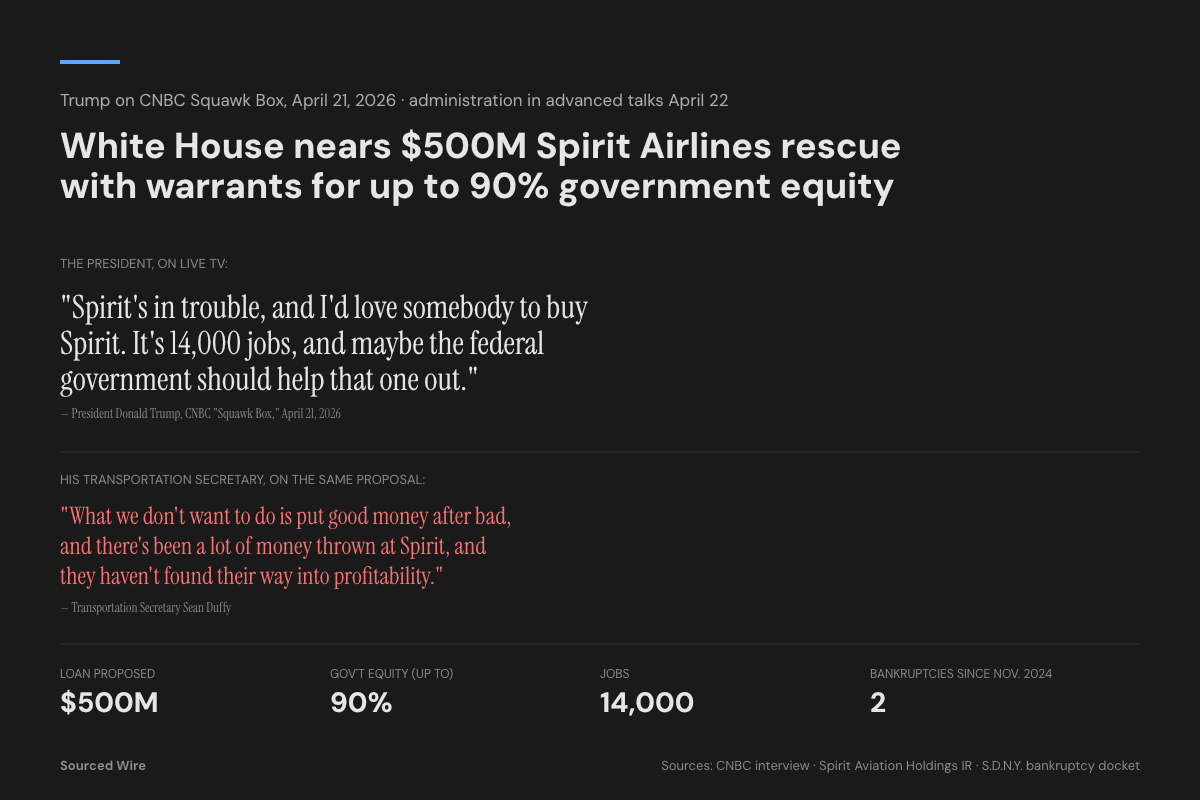
President Donald Trump on Tuesday morning floated the idea of federal aid for Spirit Airlines in a live CNBC interview; by Wednesday the administration was reportedly in advanced negotiations for a $500 million financing package whose warrants could leave the U.S. government owning as much as 90% of Spirit Aviation Holdings — the bankruptcy-restructured holding company for the discount carrier — when it exits Chapter 11. Spirit, which filed for bankruptcy protection for the second time in 14 months in August 2025, employs roughly 14,000 people and trades over the counter under the ticker FLYYQ.
What Trump said, on the record
In a sit-down on CNBC's Squawk Box on Tuesday, April 21, the president said: "Spirit's in trouble, and I'd love somebody to buy Spirit. It's 14,000 jobs, and maybe the federal government should help that one out." In the same interview Trump separately said he opposed a hypothetical United-American Airlines combination, telling the network the two carriers were already "doing very well. I don't like having them merge."
That order of preference — opposing combination among the largest U.S. carriers while inviting federal capital into the smallest of the major discount carriers — frames the rescue conversation underway in Washington this week.
What the deal would do
Reports of the negotiated terms describe a financing package of approximately $500 million paired with warrants that, if exercised, would convert into equity in the post-Chapter 11 reorganized Spirit Aviation Holdings entity. The cap on that potential equity position has been described as up to 90% of the new company. Were the deal closed and the warrants ultimately exercised at full conversion, the federal government would become the controlling shareholder of a publicly traded U.S. airline — an arrangement without a clean precedent in modern U.S. aviation policy outside of TARP-era and post-9/11 rescue programs, and one whose statutory authority would have to be specified in any final agreement.
The negotiations are described in news reporting as fluid and not yet finalized. Spirit Aviation Holdings has not made a Form 8-K disclosure of an executed financing agreement with the federal government as of this writing.
Internal administration disagreement
Transportation Secretary Sean Duffy, whose department oversees commercial aviation policy, has been publicly skeptical. "What we don't want to do is put good money after bad, and there's been a lot of money thrown at Spirit, and they haven't found their way into profitability," Duffy said this week. Asked about Trump's comments, Duffy said the administration would "take a look" at the proposal because, he said, "the president says take a look. And he is my boss."