House Kills Its Own Rule to Advance 18-Month FISA 702 Extension; 10-Day Bridge Becomes Public Law No. 119-84
H.R. 8035 — a three-paragraph bill that would have extended the warrantless-surveillance authority through October 20, 2027, with no privacy reforms — never reached a floor vote. The House rejected its rule of consideration on April 17 after the Rules Committee blocked an amendment to require a warrant for U.S.-person queries. Congress then passed a 10-day bridge, H.R. 8322, which President Trump signed the next day.
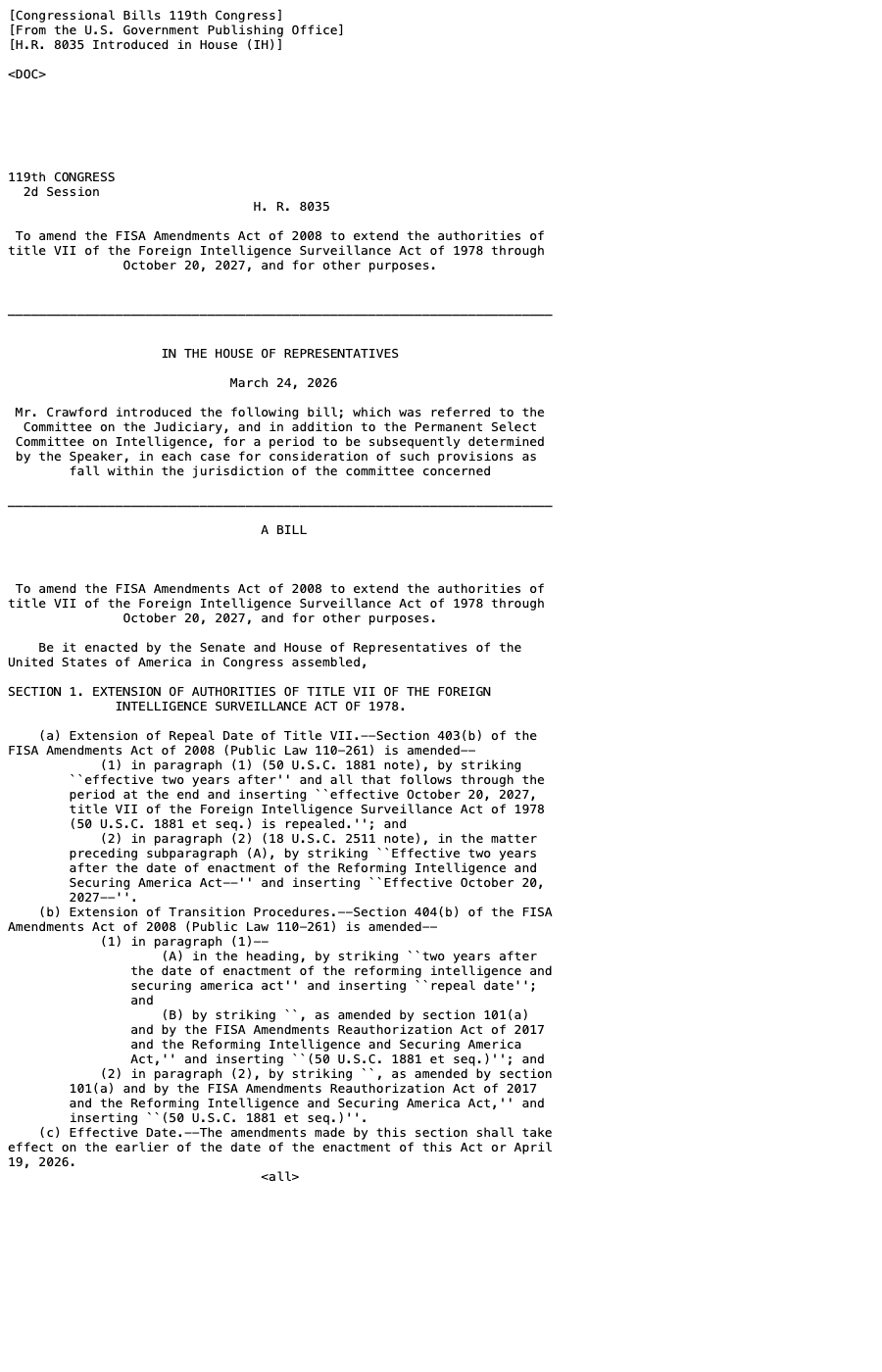
The House of Representatives, in the early hours of April 17, 2026, rejected the rule that would have allowed floor consideration of H.R. 8035, the Trump administration's preferred clean 18-month extension of Section 702 of the Foreign Intelligence Surveillance Act. With the rule defeated, the bill did not receive a vote. The surveillance authority — which had been reauthorized by the 2024 Reforming Intelligence and Securing America Act and was scheduled to sunset on April 20, 2026 — was kept alive instead by a separately introduced 10-day extension, H.R. 8322, which Congress cleared and the president signed the following day. Section 702 now sunsets on April 30, 2026, giving Congress seven days from today to assemble a longer reauthorization.
What H.R. 8035 actually said
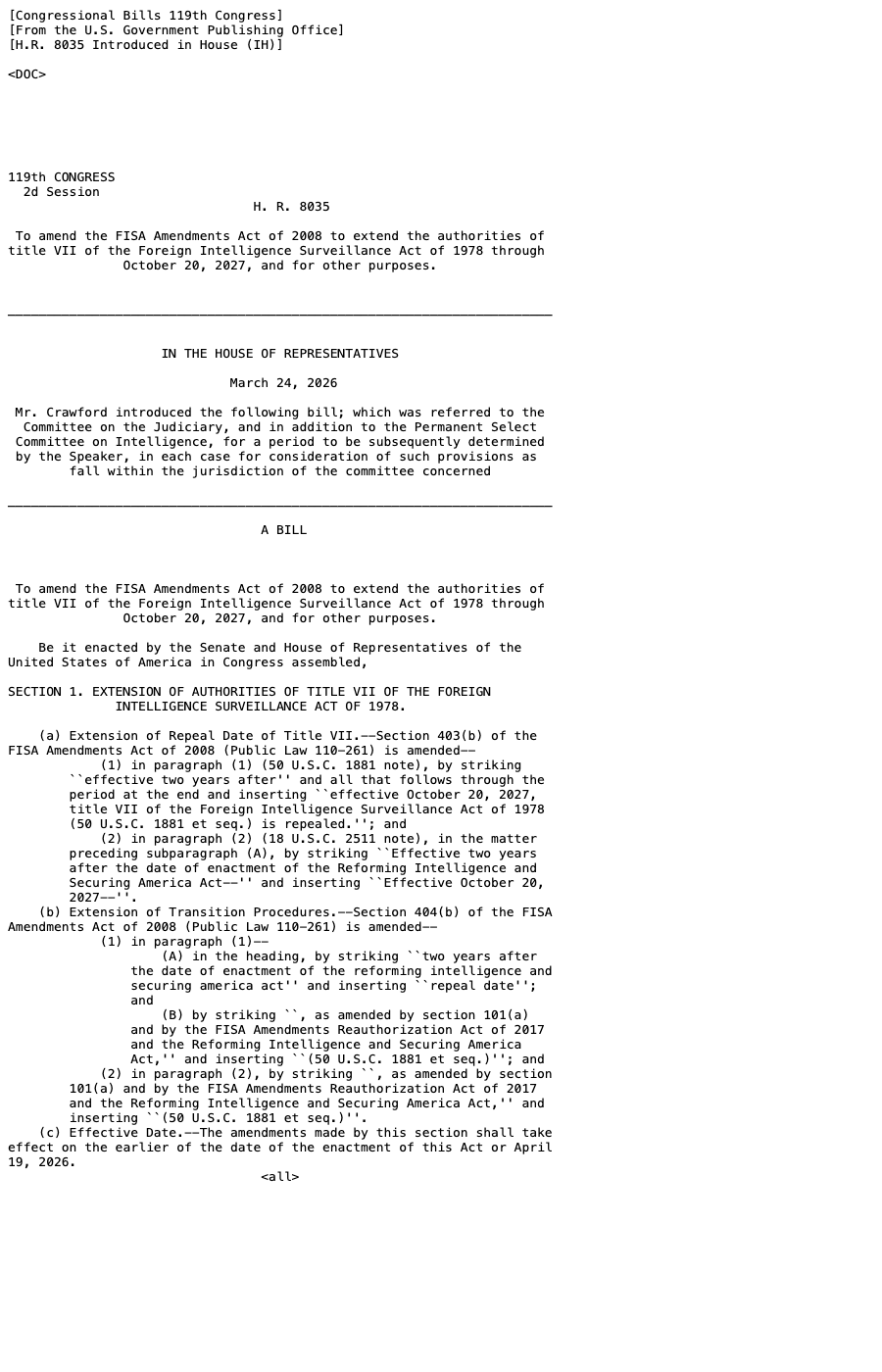
The 18-month clean extension introduced March 24 by Rep. Rick Crawford (R-AR-1) is a three-paragraph bill with no substantive policy changes. Its operative text strikes "effective two years after" the 2024 reauthorization and replaces it with "effective October 20, 2027." It is a date change and nothing else.
The procedural path to a failed vote
- March 24, 2026 — Crawford introduces H.R. 8035. It is referred to the Judiciary and Intelligence committees.
- April 14, 2026 — The House Rules Committee approves H. Res. 1175, a closed rule for H.R. 8035, by a record vote of 6–4. A closed rule bars floor amendments. Rep. Andy Biggs (R-AZ) had sought to attach a warrant requirement for queries of Americans' communications collected under Section 702; the closed rule blocked that amendment. An identical warrant amendment tied 212–212 on the House floor in 2024, failing for lack of a majority.
- April 15, 2026 — The Rules Committee reports H. Res. 1175 to the full House.
- April 17, 2026 — H. Res. 1175 fails passage on the House floor. Without an approved rule, H.R. 8035 cannot be brought up for a floor vote.
What actually became law
With the 702 authority set to expire on April 20, Rep. Austin Scott (R-GA-8) introduced H.R. 8322 on April 16 — a separate bill that extends Section 702 through April 30, 2026, a ten-day bridge. On April 17, the House discharged the bill from both committees by unanimous consent and passed it without objection; the Senate passed it the same day by voice vote. President Trump signed it on April 18. It is now Public Law No. 119-84.
The 10-day bridge, like the 18-month proposal it replaced, contains no privacy reforms — its operative text is also a date change, in this case setting the new sunset at April 30.
What the warrant amendment would have done
Section 702 permits the government, without individualized court approval, to compel electronic-communication providers to turn over the content of targets' messages when the targets are non-U.S. persons located abroad. Americans' communications are "incidentally" collected when they are in contact with those targets. The Biggs amendment, like the 2024 amendment it revives, would have required the government to obtain a warrant or FISA Title I order before querying the 702 database for content using a U.S.-person identifier — the so-called "backdoor search" of Americans' communications by the FBI.
Sponsors of the warrant amendment, and a bloc of House Republicans opposing the leadership's proposals, argue that without such a requirement, the 2024 RISAA reforms — which strengthened penalties and training — do not prevent U.S.-person queries at the query stage. Opponents of the amendment, led by the House Intelligence and Judiciary committee chairs, argue that imposing a warrant standard would degrade the intelligence-collection tool and conflict with its foreign-intelligence purpose.
The seven-day cliff
The 10-day extension expires at the end of day on April 30, 2026. As of this writing, no replacement bill has been formally noticed for floor action. House negotiators are circulating new proposals; the most recent plans reported to be under discussion continue to omit a warrant requirement. If Congress does not pass a further extension or a reauthorization by April 30, the statutory authorities of Title VII of FISA — including Section 702 — lapse.