Iran Executed at Least 1,639 People in 2025, the Most Since 1989
A joint report by Iran Human Rights and ECPM documents a 68% surge in executions over 2024, with nearly half for drug offenses. The regime executed an average of more than four people per day while concealing 93% of hangings from official media.
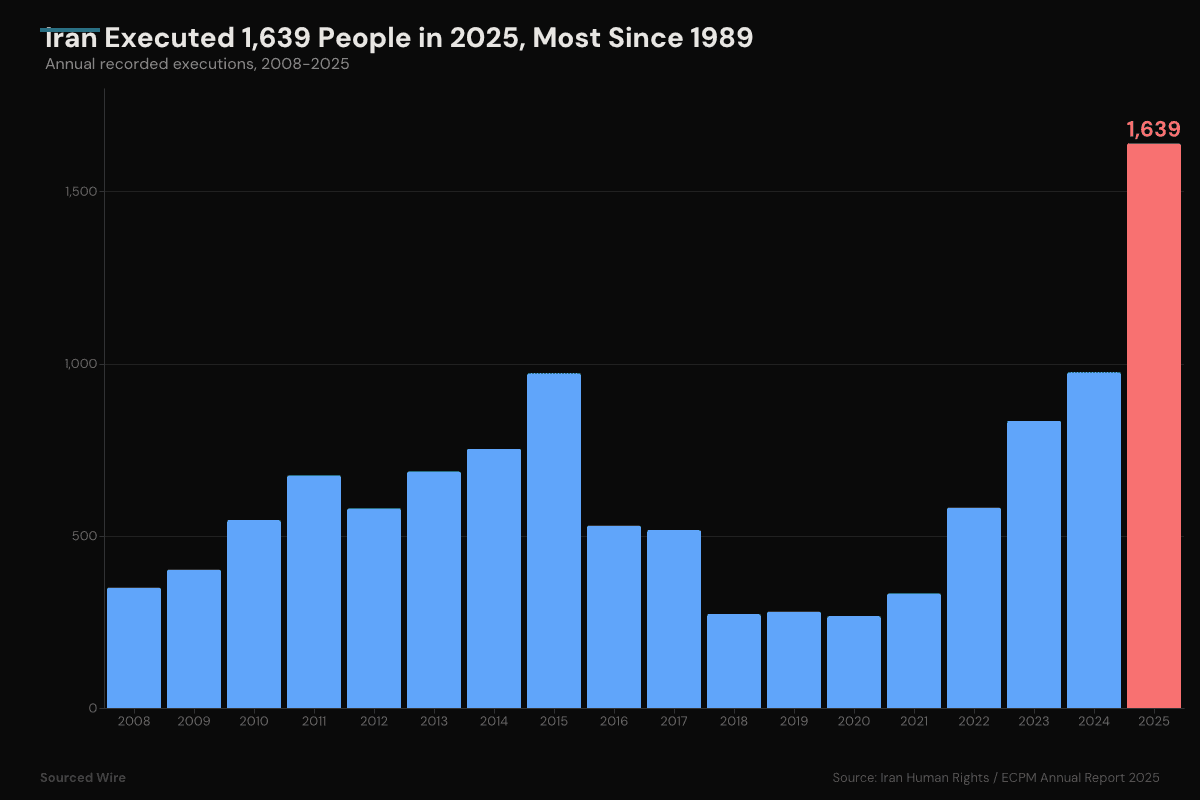
Iranian authorities executed at least 1,639 people in 2025 -- an average of more than four per day -- marking the highest recorded number since 1989 and a 68% increase over the 975 executions documented in 2024.
The figures come from the 18th Annual Report on the Death Penalty in Iran, published jointly by Norway-based Iran Human Rights (IHRNGO) and Paris-based Together Against the Death Penalty (ECPM). The organizations require two independent sources to confirm each execution, meaning the real total is almost certainly higher. They received an additional 553 unconfirmed reports -- more than ten times the number of unconfirmed cases in any of the previous four years.
By the Numbers
| Category | 2025 | 2024 | Change |
|---|---|---|---|
| Total executions | 1,639 | 975 | +68% |
| Drug-related | 795 (48.5%) | 503 | +58% |
| Murder (qisas) | 747 (45.6%) | 419 | +79% |
| Security charges | 57 | -- | -- |
| Rape | 37 | -- | -- |
| Women executed | 48 | 31 | +55% |
| Public executions | 11 |
The security-related executions included two protesters from the 2022 "Woman, Life, Freedom" movement, 18 political prisoners, and 13 people charged with espionage. Six were members of the People's Mojahedin Organization of Iran (PMOI/MEK), which the report identifies as the most disproportionately represented political group on death row.
The Concealment Machine
Perhaps the most striking finding is the regime's increasing effort to hide what it is doing. Only 113 of the 1,639 executions -- under 7% -- were announced through official channels. That transparency rate has collapsed steadily: it was 25% between 2016 and 2021, dropped to 12% in 2022, 15% in 2023, below 10% in 2024, and now sits at 7%. Not a single one of the 795 drug-related executions was officially acknowledged.
The report's methodology relies on official Iranian judiciary websites, state media, local news, and a network of sources inside prisons across all 31 provinces who report through unofficial channels at significant personal risk.
Timing and Politics
The surge accelerated after two key events: the 2022 "Woman, Life, Freedom" nationwide protests and the June 2025 twelve-day war between Iran and Israel. IHRNGO Director Mahmood Amiry-Moghaddam drew a direct connection between executions and regime survival:
"By creating fear through an average of four to five executions per day in 2025, authorities tried to prevent new protests and prolong their crumbling rule. But by the end of the year, people took to the streets again to demand their fundamental rights, demonstrating the failure of the policy of the gallows."
October was the deadliest month, with 222 executions. Even during Ramadan in March -- when executions historically decline -- the numbers remained "unprecedentedly high" at 62.
Who Was Executed
Nearly half of all executions were for drug offenses, many imposed by Revolutionary Courts "after grossly unfair trials and without due process," according to ECPM Executive Director Raphael Chenuil-Hazan. The Kurdish minority in western Iran and the Baluch in the southeast -- both predominantly Sunni in a Shia-governed state -- were disproportionately targeted. Poverty is an underlying factor: those executed overwhelmingly came from Iran's most marginalised communities.
The 48 women executed in 2025 represent the highest number in more than two decades. Twenty-one were convicted of spousal or familial murder.
At least 84 Afghan nationals were also executed, continuing a pattern of targeting foreign nationals that has intensified since 2022.
Internal Resistance
Despite the scale of killing, opposition to the death penalty inside Iran has grown. The "No Death Penalty Tuesdays" movement, which began in a single prison, expanded to 56 prisons nationwide in its third year. In October 2025, more than 1,500 drug-offense death row inmates staged a six-day hunger strike in Ghezelhesar Prison, forcing authorities to halt executions there temporarily.
The report's foreword was written by Nasrin Sotoudeh, Iran's most prominent human rights lawyer, who was arrested at her home on April 1, 2026 -- days before the report's publication. Her whereabouts remain unknown.
In the 18 years since IHRNGO began tracking, Iranian authorities have executed at least 11,196 people.