FinCEN's New Whistleblower Program Excludes the People Most Likely to Find Financial Crimes
A proposed rule published April 1 would pay outsiders 10-30% of penalties for reporting money laundering and sanctions violations. Government employees -- the people with direct access to suspicious activity reports -- are excluded from awards. The comment period closes June 1.
A proposed rule published April 1 would create the first formal whistleblower program at the Financial Crimes Enforcement Network, offering 10 to 30 percent of collected penalties to individuals who report violations of the Bank Secrecy Act, sanctions laws, and anti-money-laundering statutes.
The program is designed to incentivize reporting. But it excludes the people most likely to discover financial crimes: FinCEN's own employees.
The proposed rule identifies government employees as ineligible for awards. The anti-retaliation protections it offers -- reinstatement, back pay -- are employment-level remedies. They do not prevent criminal prosecution for unauthorized disclosure of Suspicious Activity Reports, which remains a federal crime under 31 U.S.C. § 5322.
This exclusion is not theoretical. It has been tested.
The Test Case
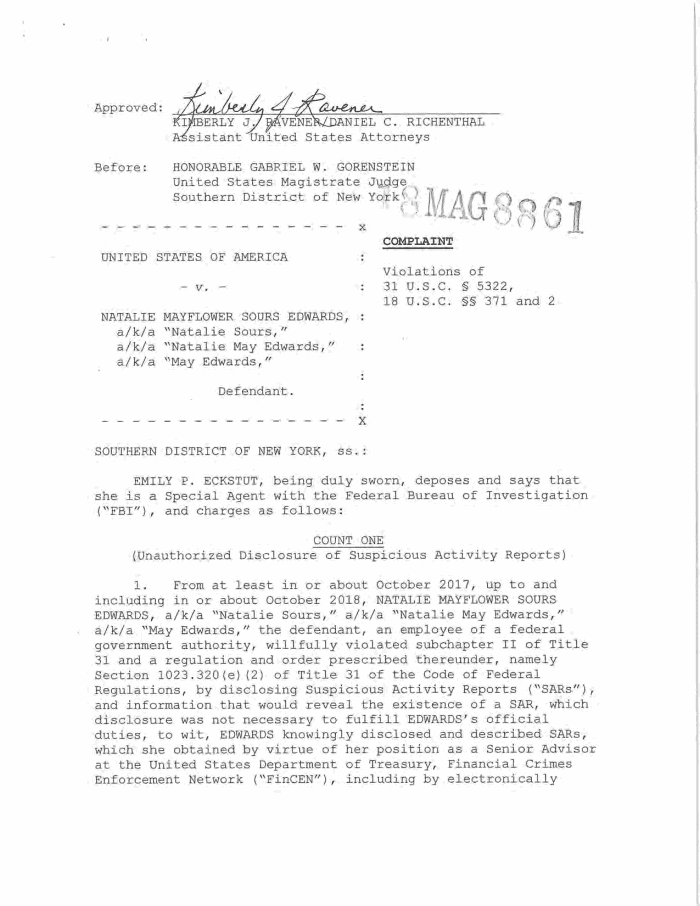
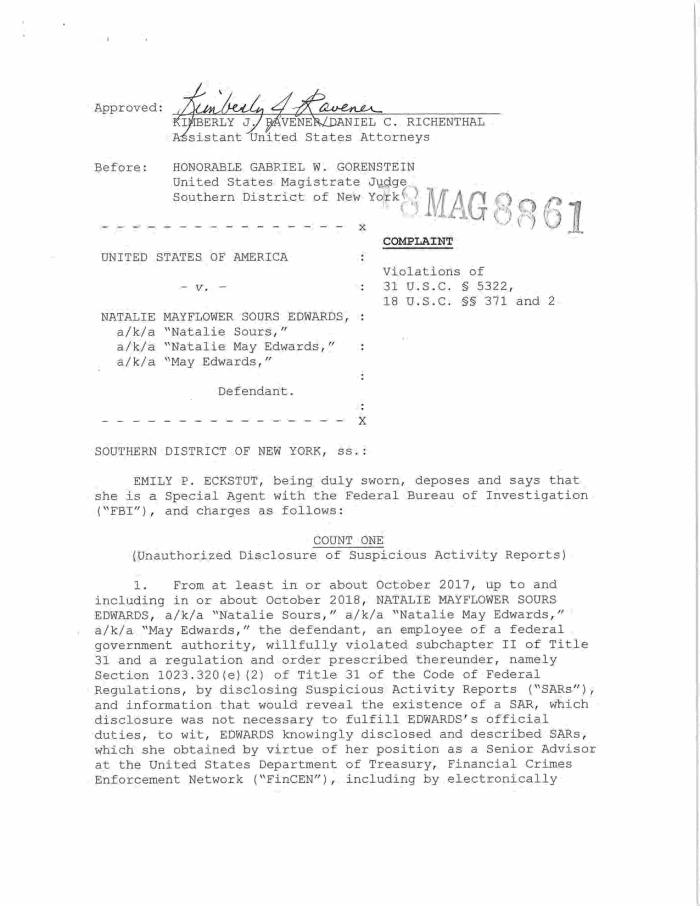
In October 2018, the FBI arrested Natalie Mayflower Sours Edwards, a Senior Advisor at FinCEN, and charged her with unauthorized disclosure of approximately 2,100 Suspicious Activity Reports to journalist Jason Leopold at BuzzFeed News.
The SARs she disclosed revealed the scale of a system designed to document suspicious money and then do nothing about it. Between 1999 and 2017, banks had filed reports flagging over $2 trillion in suspicious transactions. JPMorgan Chase alone flagged $514 billion. Deutsche Bank moved $2.6 billion through a single shell company. HSBC continued processing suspect transactions while on probation for a prior money laundering settlement.
Filing a SAR satisfies a bank's legal obligation under the Bank Secrecy Act. It does not stop the transaction. The bank flags the money, the money moves, FinCEN receives the report. No one is required to act on it.
Edwards's disclosures included SARs on Paul Manafort, the former Trump campaign chairman later convicted of financial crimes. JPMorgan had filed at least eight SARs on Manafort's accounts by December 2013, flagging over $10 million. In 2017, the bank filed another report on $300 million in wire transfers through Manafort-connected shell companies in Cyprus. Banks continued processing his transactions for 14 months after he resigned from the campaign amid money laundering allegations.
Edwards told the court she had exhausted internal whistleblower channels before going to the press. Her attorney said she disclosed information only after experiencing retaliation and concluding that FinCEN was not providing complete information to Congress about the SARs related to Russian electoral interference in 2016.
In June 2021, Federal Judge Gregory Woods sentenced Edwards to six months in prison. "She abused a position of trust and broke a law that was designed to stop criminals," Woods said.
What the Leak Produced
The documents Edwards disclosed became the foundation of the FinCEN Files investigation, a collaboration between BuzzFeed News, the International Consortium of Investigative Journalists, and 108 media partners. The investigation documented how major global banks knowingly profited from suspicious transactions and how regulators received the evidence and failed to act.
The consequences were legislative, not administrative. Congress passed the Corporate Transparency Act -- the largest anti-money-laundering policy revision in decades. Authorities in the United Kingdom, Liberia, Seychelles, and Thailand launched inquiries. The European Parliament demanded stronger banking reforms.
Congress also passed the Anti-Money Laundering Act of 2020, which mandated the whistleblower program FinCEN is now proposing -- six years after the law required it.
What the Program Does and Doesn't Do
The proposed rule creates a formal channel for reporting BSA, IEEPA, and sanctions violations. Awards of 10 to 30 percent of collected monetary sanctions would be paid from the Financial Integrity Fund. When penalties are $15 million or less, a 30 percent award is presumed.
The program targets bank compliance officers, financial industry employees, and outside tipsters who witness or discover violations. These are valuable sources. But the highest-value information in anti-money-laundering enforcement sits inside FinCEN itself -- in the SARs database that tracks what banks report and what the government does with those reports.
The proposed rule's exclusion of government employees from awards, combined with the continued criminalization of SAR disclosure, means the program incentivizes reporting from the people who see part of the picture while excluding the people who see all of it.
The Timeline
| Date | Event |
|---|---|
| 2012 | Banks begin filing SARs on Paul Manafort's accounts |
| October 2017 | Edwards begins disclosing SARs to BuzzFeed News |
| October 2018 | Edwards arrested; criminal complaint filed in SDNY |
| September 2020 | BuzzFeed News and ICIJ publish the FinCEN Files |
| January 2021 | Anti-Money Laundering Act of 2020 mandates whistleblower program |
| June 2021 | Edwards sentenced to six months in prison |
| April 1, 2026 | FinCEN publishes proposed whistleblower program rule |
| June 1, 2026 | Comment period closes (docket FINCEN-2026-0067) |
Public comments on the proposed rule are open through June 1 at regulations.gov under docket FINCEN-2026-0067.