Peru Votes Sunday With Record 35 Candidates, No Frontrunner Above 16%
A record-breaking presidential field, a June runoff almost everyone already expects, and more than half the electorate blank or undecided as electoral silence began Monday.
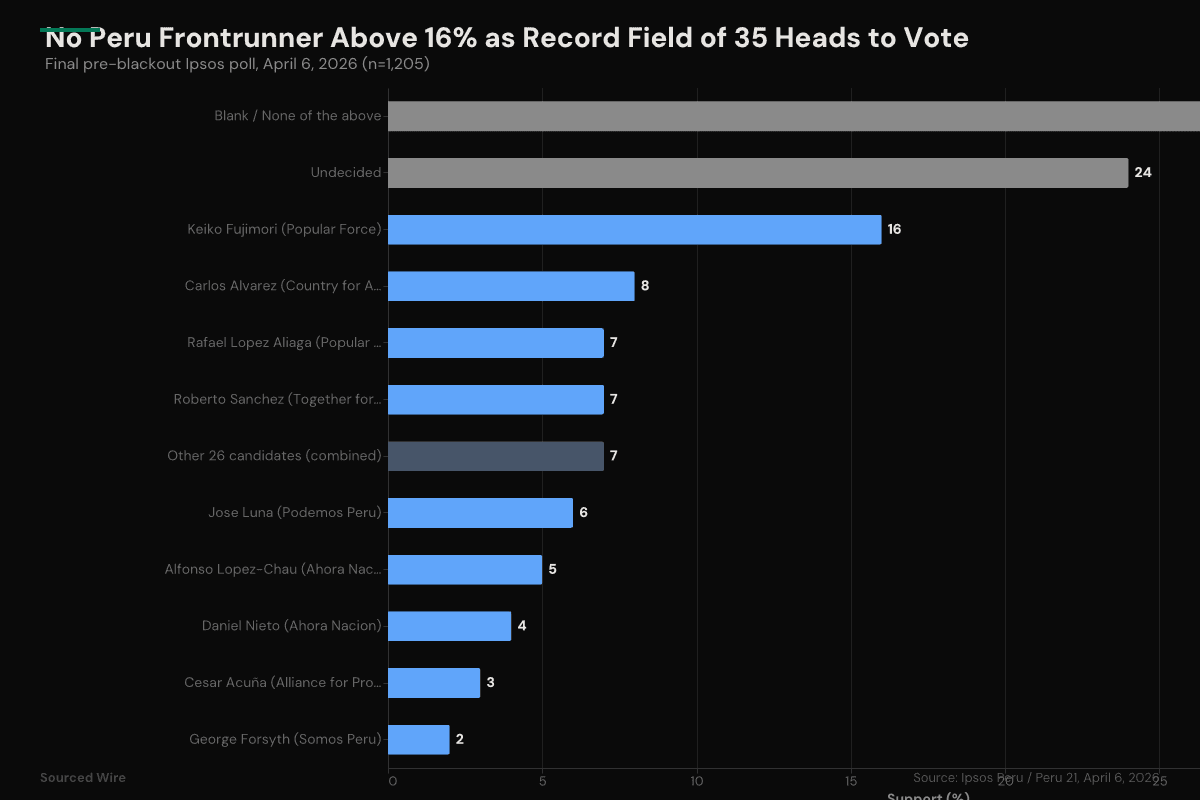
Peru holds first-round voting on Sunday, April 12, with a record field of 35 candidates on the presidential ballot. The final pre-blackout poll from Ipsos, published April 6, put Keiko Fujimori on top at 16% — nowhere near the 50% threshold needed to avoid a runoff, and well within margin of the candidates behind her.
The Jurado Nacional de Elecciones, Peru's electoral authority, lists all registered candidates on its Voto Informado platform. Under Peruvian electoral law, all public opinion polling had to stop by Monday, April 6. The Ipsos Peru / Perú 21 survey released that day is the last snapshot voters — or reporters — will have until polls close.
A field split more than a dozen ways
After Fujimori at 16%, the Ipsos poll shows comedian Carlos Álvarez (Country for All) and former Lima mayor Rafael López Aliaga (Popular Renewal) tied with single-digit support, followed by a cluster of candidates all polling between 2% and 8%. The combined share of the top nine candidates is roughly 58%. The remaining ~26 candidates — enough to fill a long tail the JNE split into six days of three-at-a-time debates — poll individually below 2%.
The more striking number is what voters aren't saying. In the same Ipsos poll, 29% of respondents said they would cast a blank ballot or vote for none of the above, and 24% were undecided. That is 53% of the electorate without a committed choice as of a week before the vote — a fragmentation number that more or less guarantees whoever advances to the runoff will do so with well under a quarter of the first-round vote.
Why the ballot is this long
Peru has had six presidents in the last five years. Pedro Castillo was removed after an attempted self-coup in December 2022. His vice president, Dina Boluarte, served through mass protests and multiple crises. José Jerí then took over before being removed in February 2026, leaving José María Balcázar — elected by Congress — as the caretaker who will hand power to whoever wins in June.
That churn, combined with a registration process that left 43 parties on the books at the Registro de Organizaciones Políticas, produced a ballot that ran out of vertical space. The JNE lists 38 rows covering 35 parties and 3 alliances. Popular Action, a historic party, had its primary annulled over what the electoral authority called "substantial procedural irregularities."
What's on the ballot besides the presidency
Sunday's vote is also the first under Peru's reconstituted bicameral legislature. Voters will elect 130 members of the new Chamber of Deputies and 60 members of a new Senate alongside the president and two vice presidents. Peru abolished its upper house in 1993 and voted in 2018 to keep a unicameral Congress; a 2024 constitutional reform reversed that decision, and the 2026 election is the first under the new structure.
With no candidate expected anywhere near 50%, the runoff is set for June 7. The two top finishers Sunday face off head-to-head, and the winner takes office on July 28.