Sanders Forces Senate Votes on $447 Million in Emergency Arms Transfers to Israel
Two joint resolutions of disapproval will come to the Senate floor Wednesday, targeting 12,000 one-thousand-pound bomb bodies and Caterpillar military bulldozers that Secretary of State Rubio authorized without congressional review during the war with Iran.
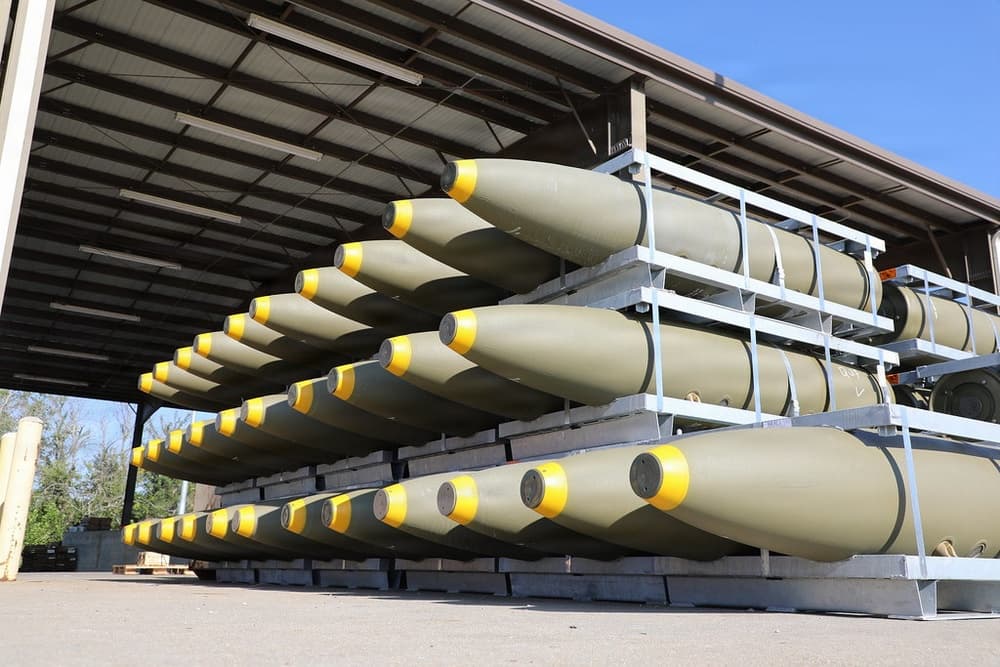
Senator Bernie Sanders announced Monday he will use a parliamentary procedure to force the full Senate to vote Wednesday on two joint resolutions targeting $447 million in emergency arms transfers to Israel -- transfers that Secretary of State Marco Rubio authorized without the standard congressional review.
The two resolutions are S.J.Res.138, which would block a $151.8 million sale of 12,000 BLU-110A/B general-purpose 1,000-pound bomb bodies, and S.J.Res.32, which would block a $295 million sale of Caterpillar D9R and D9T armored bulldozers. Both were approved under emergency determinations that waived the 15-day congressional review period required under Section 36(b) of the Arms Export Control Act.
The bomb sale was authorized on March 6 -- six days after the US and Israel began military operations against Iran. The State Department said an emergency "requires the immediate sale" of the munitions. Part of the BLU-110 requirement will be transferred from existing US stockpiles. The principal contractor is Repkon USA of Garland, Texas.
The bulldozer package includes spare parts, corrosion protection, technical documentation, and support services, with deliveries estimated to begin in 2027.
How the Vote Works
Under the Arms Export Control Act, Congress can block a foreign military sale by passing a joint resolution of disapproval. A procedural feature of these resolutions allows Sanders to bring them to the floor without approval from Senate leadership, forcing every senator to cast a recorded vote.
The resolutions are expected to fail -- all previous rounds of Israel arms sales votes have been defeated by Republican support combined with enough Democratic votes. But the forced votes have produced a visible shift: each successive round has drawn more Democrats to vote against the transfers.
Growing Democratic Opposition
| Date | Sale targeted | Democrats voting to block |
|---|---|---|
| November 2024 | Various arms packages | 19 |
| April 2025 | $8.8B in heavy bombs | 15 |
| July 2025 | $676M in rifles and bombs | 27 |
| April 16, 2026 | $447M in bombs and bulldozers | -- |
The July 2025 vote marked a threshold: for the first time, a majority of the Democratic caucus voted to block arms sales to Israel, with 27 senators supporting one resolution and 24 the other. Wednesday's vote will be the first since the war expanded to include Iran, testing whether the broader conflict increases or decreases Democratic willingness to oppose the transfers.
The Emergency Bypass
Rubio's use of the emergency provision drew criticism when announced in March. Representative Gregory Meeks, the ranking Democrat on the House Foreign Affairs Committee, called the emergency determination evidence of a "lack of preparation for the war with Iran."
The emergency clause allows the Secretary of State to skip the normal congressional notification period when circumstances "require the immediate sale" of defense articles. This was the first time the second Trump administration formally invoked this statutory emergency authority for Israel, though it had previously bypassed the informal congressional pre-notification process on three prior occasions.
Sanders argued that both sales violate the Foreign Assistance Act and the Arms Export Control Act, calling the 1,000-pound bombs responsible for "excessive civilian casualties in densely populated areas" and describing the D9 bulldozers as "primary tools for demolishing Palestinian homes and constructing settler infrastructure."