Southport Inquiry: Attack on Children's Dance Class 'Could Have Been and Should Have Been Prevented'
A 763-page UK public inquiry found that five systemic failures across police, counter-terrorism, and social services left a known violent individual free to carry out the July 2024 mass stabbing that killed three children.
The attack on a Taylor Swift-themed children's dance class in Southport, England that killed three girls and wounded ten others could have been prevented, a public inquiry concluded on April 13.
"I have no doubt that if appropriate procedures had been in place and if sensible steps had been taken by the agencies and AR's parents, this dreadful event would not have happened," wrote Sir Adrian Fulford, the retired Lord Justice of Appeal who chaired the inquiry.
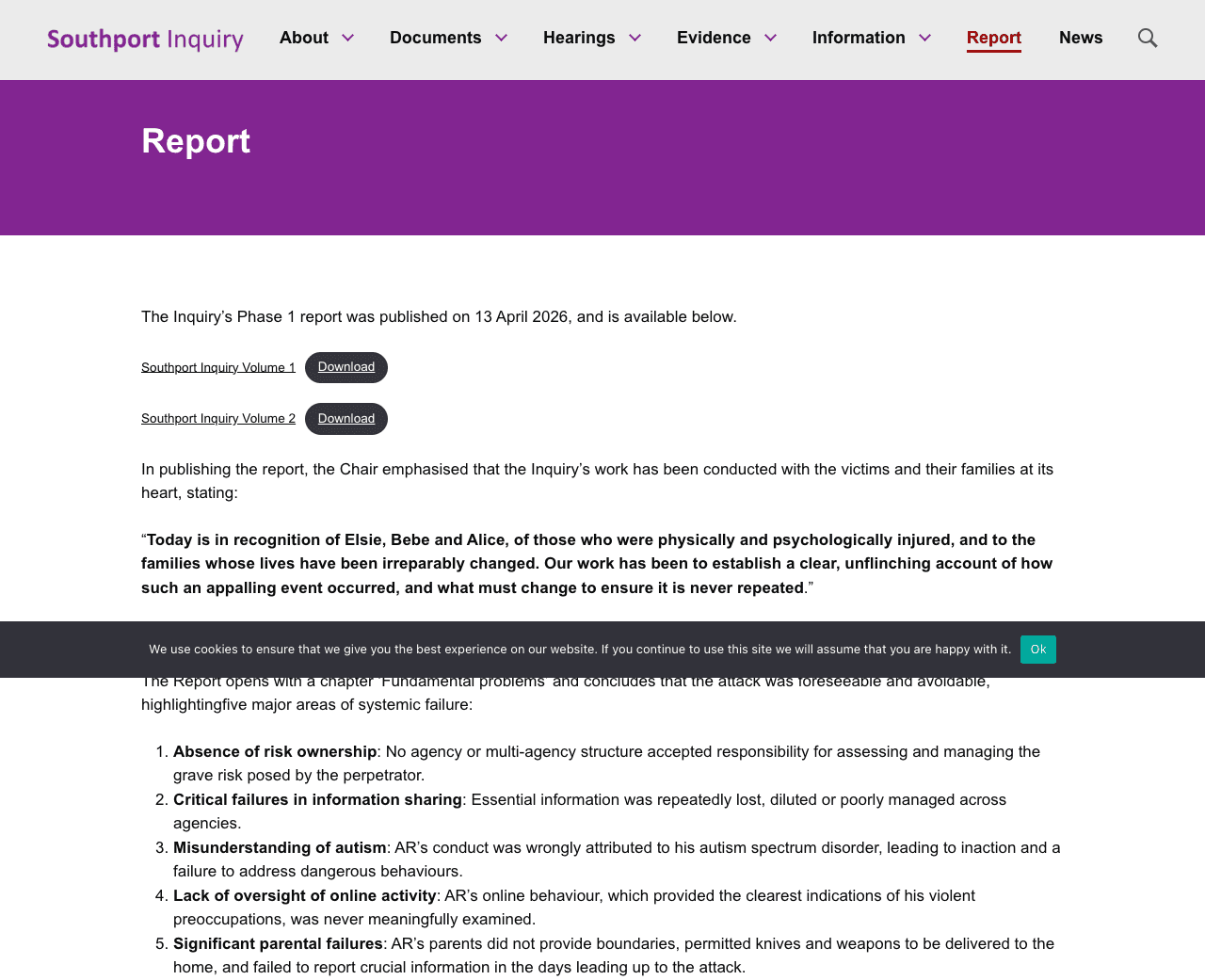
The Phase 1 report, spanning two volumes and 763 pages, identifies five systemic failures and makes 67 recommendations. The word "fail" and its variants appear 295 times.
What the Inquiry Found
The attacker, Axel Rudakubana, had a documented history of violence stretching back to December 2019, when he attacked students at Range High School with a kitchen knife and hockey stick. Fulford called this a "watershed event" that should have triggered high-harm conclusions.
Between 2019 and the July 2024 attack:
- He was referred to the Prevent counter-terrorism programme three times. All three referrals were closed without progression to the Channel programme, the active intervention tier, because assessors determined he had no fixed ideological motivation.
- Police responded to his home address five times.
- He was involved in a separate incident possessing a knife in public.
- He was convicted of violent assault and referred to a youth offending team.
- He purchased three machetes and ricin precursor ingredients online.
- He downloaded Al-Qaeda manuals, Nazi history material, and poison-making guides -- none of which was ever examined by any agency.
Five Systemic Failures
1. No risk ownership. Fulford called this "the single most important" failure. No agency accepted responsibility for assessing and managing the risk Rudakubana posed. The result was "an inappropriate merry-go-round of referrals, assessments, case-closures and hand-offs." As Fulford put it: "Because it belonged to everyone, it belonged to no one."
2. Information sharing breakdown. Critical intelligence was repeatedly lost, weakened, or siloed between organizations. No single agency had a complete picture of the threat.
3. Autism misattribution. Rudakubana's autism spectrum disorder diagnosis was repeatedly used to excuse and explain away dangerous behavior, rather than recognized as a factor that required more careful risk assessment.
4. Online activity never examined. His internet usage -- which included Al-Qaeda manuals, violent and misogynistic material, and poison-making guides -- was never reviewed by any agency. Fulford said the material "fed his already unhealthy fascination with violence."
5. Parental failures. His parents "created significant obstructions," imposed no restrictions on their son, permitted weapons to be delivered to the home, and withheld vital information from authorities. Fulford stated: "If AR's parents had done what they morally ought to have done, AR would not have been at liberty to conduct the attack."
Government Response
Home Secretary Shabana Mahmood accepted all 67 recommendations in an oral statement to the House of Commons on April 13. Announced measures include a review of Prevent counter-terrorism thresholds, a new Prevention Assessment Framework, the appointment of Tim Jacques as the first Prevent Commissioner, enforcement under the Online Safety Act, tightened weapons purchase controls, and new legislation to criminalize planning of non-ideological mass violence.
The last measure addresses a gap the case exposed: Rudakubana did not fit existing terrorism statutes because he lacked a fixed ideological motivation, despite downloading terrorist manuals and purchasing weapons.
A Phase 2 of the inquiry will examine broader questions including the state's capacity to monitor high-risk individuals' online activity.
The Attack
On July 29, 2024, Rudakubana entered a holiday dance class for children aged six to eleven at a community center in Southport, Merseyside. He stabbed multiple people with a kitchen knife, killing three girls -- Bebe King, age 6, Elsie Dot Stancombe, age 7, and Alice Dasilva Aguiar, age 9 -- and wounding ten others, including eight children and two adults who tried to shield them.
The attack triggered riots across England fueled by false rumors about the attacker's identity and background, leading to arson attacks on mosques and asylum seeker housing.
Fulford's conclusion was unequivocal: "It could have been and it should have been prevented."