Federal Judge Halts Arizona's Criminal Case Against Prediction Market Kalshi
A federal judge issued a temporary restraining order blocking Arizona from prosecuting Kalshi on 20 misdemeanor gambling charges, halting the first criminal case ever brought against a federally regulated prediction market.
A federal judge in Phoenix halted Arizona's criminal prosecution of Kalshi on April 10, canceling the prediction market operator's arraignment and temporarily blocking the state from enforcing its gambling laws against any CFTC-regulated exchange.
The temporary restraining order, issued by U.S. District Judge Michael Liburdi, came eight days after the Department of Justice and the Commodity Futures Trading Commission sued Arizona, arguing that the state's gambling statutes are preempted by federal law when applied to exchanges the CFTC regulates.
The Charges
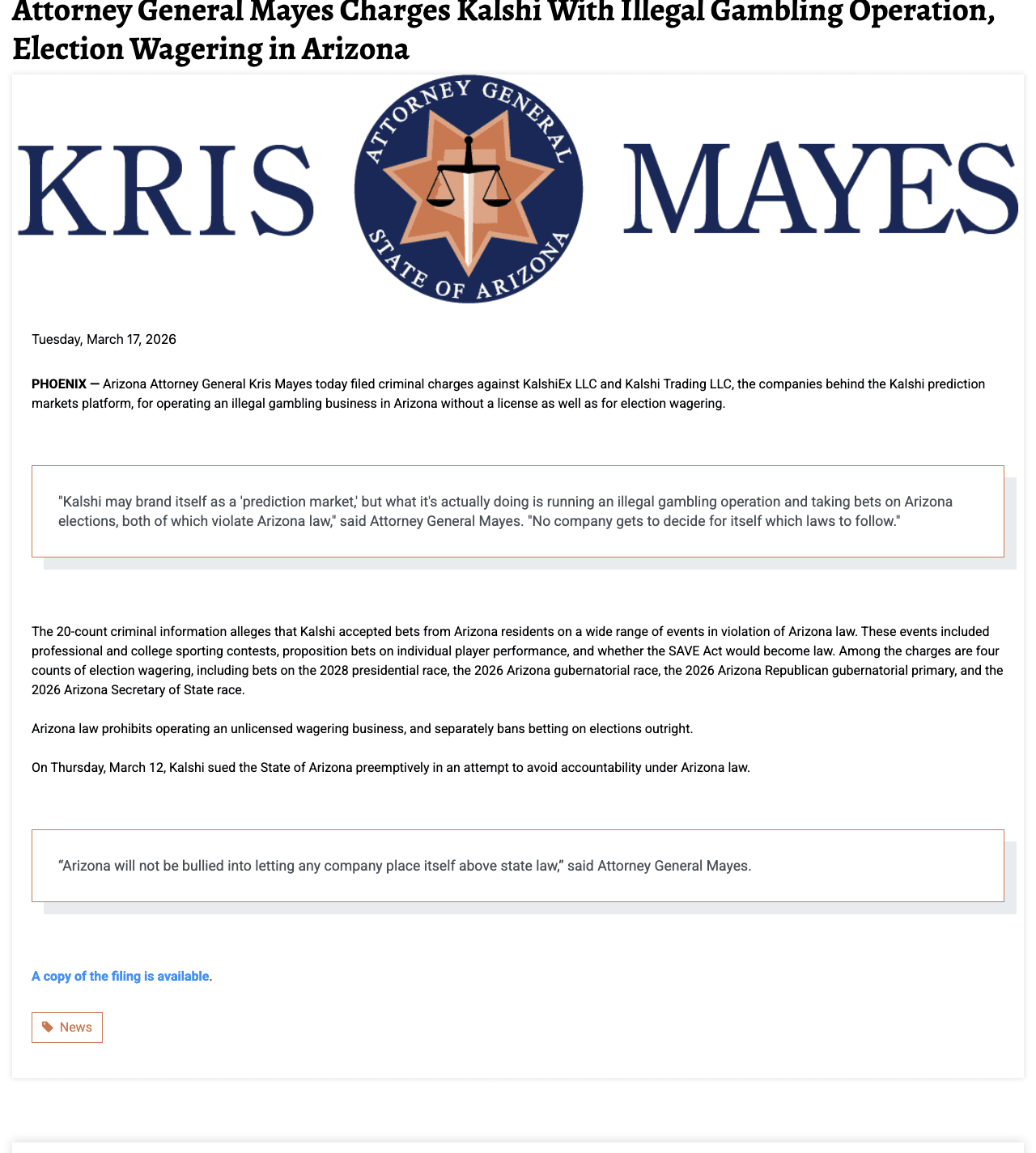
Arizona Attorney General Kris Mayes filed 20 misdemeanor counts against KalshiEX LLC and Kalshi Trading LLC on March 16 in Maricopa County Superior Court -- the first criminal prosecution ever brought against a CFTC-registered designated contract market.
Sixteen counts allege violations of Arizona's betting and wagering statute (A.R.S. § 13-3305), covering contracts on college and professional sports -- including whether Devin Booker would score more than 25 points in a Suns-Pacers game and the outcome of an ASU-Arizona women's basketball game. Four counts target election wagering under A.R.S. § 16-1015, covering contracts on the 2028 presidential race, the 2026 Arizona governor's race, and the 2026 Arizona secretary of state race.
"Kalshi may brand itself as a 'prediction market,' but what it's actually doing is running an illegal gambling operation," Mayes said.
The Federal Intervention
The DOJ and CFTC filed suit against Arizona on April 2, alongside parallel suits against Connecticut and Illinois. The federal government's argument: the Commodity Exchange Act gives the CFTC "exclusive jurisdiction" over swaps traded on federally regulated exchanges, and prediction market contracts qualify as swaps under the law. Arizona's criminal prosecution of a CFTC-regulated exchange therefore violates the Supremacy Clause.
Judge Liburdi found the CFTC had "clearly shown" it was likely to succeed on the merits. The TRO blocks Arizona from enforcing its gambling laws against any designated contract market -- not just Kalshi -- through April 24, when the court will consider converting it to a preliminary injunction.
The ruling had an unusual procedural twist: two days before issuing the TRO, Liburdi had denied Kalshi's own request for a preliminary injunction in a separate case the company filed preemptively, citing the Anti-Injunction Act as a bar to federal interference. The federal government's suit sidesteps that restriction -- the Anti-Injunction Act doesn't apply the same way when the United States is the plaintiff.
Who's Affected
The TRO's scope extends beyond Kalshi. By blocking enforcement against all CFTC-designated contract markets, it effectively creates a temporary safe harbor for any federally regulated prediction market operating in Arizona.
The broader battle spans roughly 20 federal and state actions across at least 14 states. Arizona stands alone in pursuing criminal charges; other states -- Nevada, Massachusetts, Michigan, Washington -- have taken civil enforcement actions. Federal courts have split: Tennessee sided with Kalshi on preemption; Massachusetts ruled against it. The Third Circuit allowed Kalshi to operate pending appeal.
What's Next
The TRO expires April 24. Arizona can challenge it at a preliminary injunction hearing or appeal to the Ninth Circuit. The DOJ's parallel suits against Connecticut and Illinois raise the same preemption question, setting up a potential circuit split that could ultimately reach the Supreme Court.
Kalshi CEO Tarek Mansour called the criminal charges a "total overstep." Arizona AG Mayes responded: "Arizona will not be bullied into letting any company place itself above state law."
The case turns on a question Congress has not directly answered: are prediction market contracts "swaps" under federal commodity law, or "wagers" under state gambling law? The answer will likely determine whether prediction markets -- now a multi-billion dollar industry -- are regulated from Washington or state by state.