The UN's 40-Member Scientific Panel on AI Has Started Work on Its First Report, Due in Geneva in July
The Independent International Scientific Panel on AI, established by UN General Assembly resolution in August 2025 and seated with 40 experts in February, held its inaugural in-person summit this week. Its first evidence-based assessment of AI opportunities, risks, and impacts is due at the Global Dialogue on AI Governance in Geneva on July 6-7.
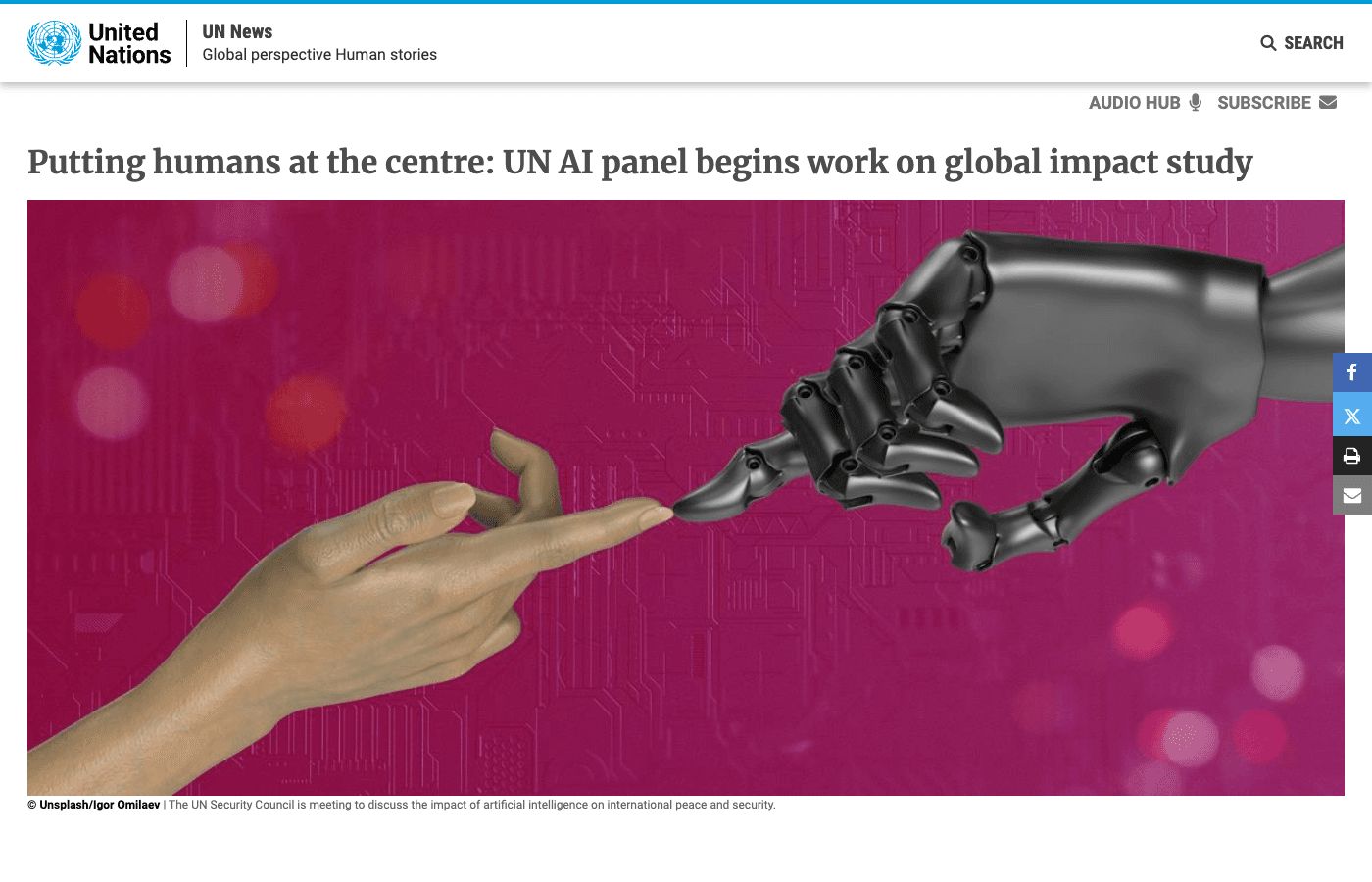
The United Nations' Independent International Scientific Panel on Artificial Intelligence — the first global scientific body on AI — has convened its inaugural in-person summit and is beginning work on the landmark global impact study it is mandated to deliver before its first public report in July, according to a UN News dispatch published Saturday by correspondents Conor Lennon and Khaled Mohamed.
The panel's first annual report will be presented at the UN Global Dialogue on AI Governance in Geneva on 6–7 July 2026, giving the 40 members roughly three months to compile their initial assessment.
What this body is, exactly
The panel is the product of UN General Assembly resolution A/RES/79/325, adopted on 26 August 2025. It was formally seated on 12 February 2026, when the General Assembly appointed 40 experts chosen from more than 2,600 candidates following independent review by the International Telecommunication Union, UNESCO, and the UN Office for Digital and Emerging Technologies.
Members serve three-year terms in their personal capacity and are drawn from academia, the private sector, civil society, government and international organizations, and the technical community. Their backgrounds span core technical AI, applied AI/safety/infrastructure, and AI policy, ethics, and impact.
The panel's mandate, as summarized in the UN News piece, is narrow and deliberately non-binding: it is required to produce an annual evidence-based scientific assessment of AI's "opportunities, risks and impacts," which is then presented at the Global Dialogue on AI Governance. The panel is explicitly not a regulatory body. It will not set rules, enforce standards, or prescribe policy. Its sole output is analysis.
That framing — a scientific advisory body with no enforcement power — is a direct echo of the way the Intergovernmental Panel on Climate Change (IPCC) is structured relative to UNFCCC negotiations. The IPCC does the science; national governments decide what to do with it. The panel on AI is built to play the same role for the emerging UN AI governance architecture.
What the summit is working on
The UN News article quotes Menna El-Assady, an assistant professor at ETH Zurich and a founding panel member, describing the scope:
"We are not just focusing on AI as a mathematical or algorithmic field: we are also looking at ensuring that humans are central to decision-making."
El-Assady, an Egyptian national, is identified in the UN News piece as a founding member recommended to serve by the UN Secretary-General. She told UN News the panel is working on four specific questions:
- When human expertise is necessary and when automation is acceptable. "We are trying to work out when we need to rely on humans and their expertise, and when things can be automated."
- The co-adaptation loop between AI and humans. El-Assady said the panel wants to "understand the link between AI and human models... and the evolution that occurs whenever humans receive new information, or when AI does."
- Public digital infrastructure. She is advocating that the panel's report address how to build "public digital infrastructure, so that everyone who wants to develop AI has the resources they need."
- AI watermarking. She named watermarking — the technical practice of tagging AI-generated content so it is distinguishable from human-authored content — as a candidate topic for the first report.
El-Assady is also known for her work at ETH Zurich on "augmented intelligence," a framing in which AI enhances rather than replaces human capabilities.
Why this panel exists
The UN News piece traces the panel's political origin to two recent statements from UN leadership. In September 2025, at a Security Council session, Secretary-General António Guterres told members that "humanity's fate cannot be left to an algorithm." In February 2026, UN High Commissioner for Human Rights Volker Türk said AI developers building models without grounding in "fundamental social and ethical principles" risk creating "Frankenstein's monster."
Both statements bracket the panel's launch and help explain why a specifically scientific body — rather than a regulatory one — was created. The UN's diagnosis in 2025 was that the international system lacked trustworthy, independent, apolitical assessment of what AI is actually doing to economies and societies. Without that, negotiators had nothing to negotiate from. The Independent Panel is the attempt to build that evidence base.
Deadlines that matter
- Now: First in-person summit underway (dates not disclosed in the UN News piece).
- 6–7 July 2026: First annual report presented at the Global Dialogue on AI Governance, Geneva.
- Annual thereafter: Panel delivers a report per year for the duration of the three-year initial mandate (through early 2029).
The panel's permanent web presence at un.org/independent-international-scientific-panel-ai lists the 40 members and describes the governance structure.