Trump's April 3 College Sports Executive Order Uses Federal Contractor Leverage to Force NCAA Rule Changes by August 1
The order directs federal agencies that fund university research to treat violations of NCAA rules on NIL, transfers, and eligibility as a responsibility question for contracting and debarment. It also sets a five-year eligibility cap, bans federal money from NIL and coaching compensation, and tells the Attorney General to sue state NIL laws that conflict with the NCAA framework.
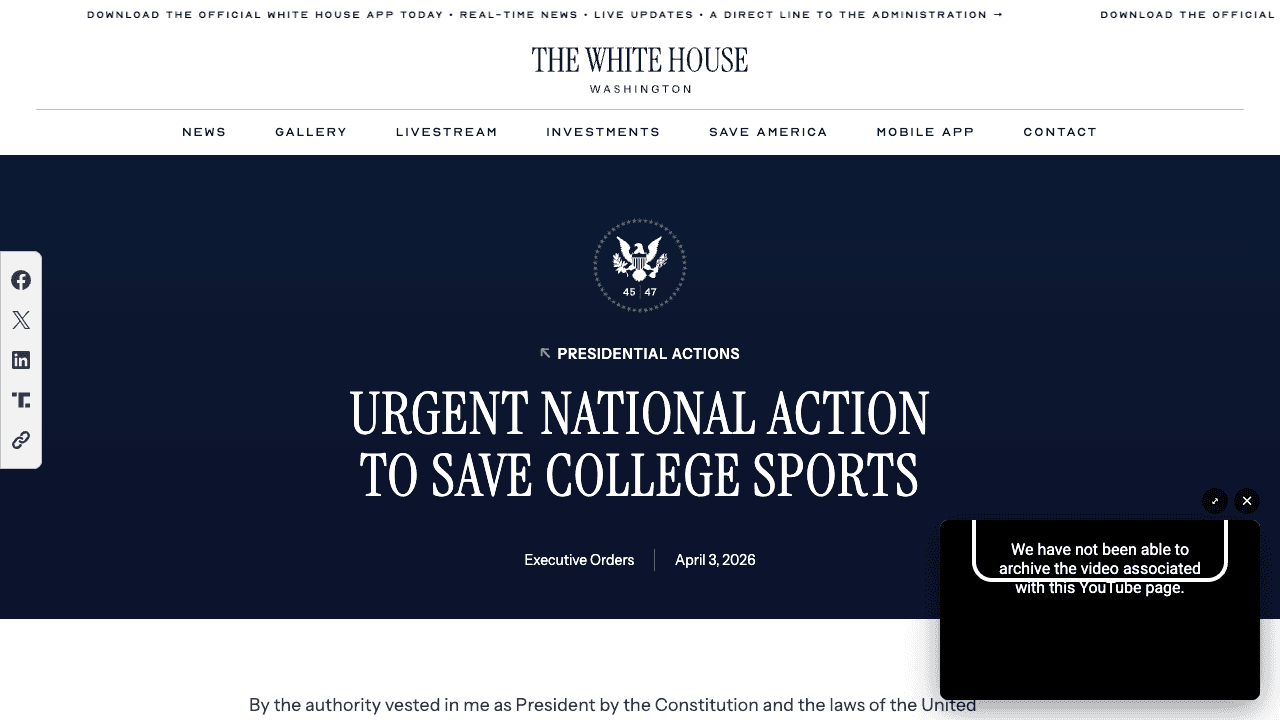
President Trump signed an executive order titled "Urgent National Action to Save College Sports" on April 3, 2026. Its operative provisions take effect on August 1, 2026. It is the second college-sports executive order of the administration, following a July 2025 order cited in the new order's own preamble, and it moves substantially further than the first — using federal contracting and grantmaking as leverage to force the NCAA to adopt a specific set of rules by the August effective date.
What the order actually does
The order's mechanism is indirect but forceful. It does not set NCAA rules directly. Instead, Section 4(a) directs every federal agency that contracts with or provides grants to higher education institutions — Defense, HHS, NSF, and the other research-sponsoring agencies — to "evaluate violations" of the NCAA's rules on:
- eligibility limits,
- transfers between institutions,
- revenue-sharing between institutions and student-athletes, and
- "permissible and improper financial activities"
...and then determine whether those violations are "so serious or compelling in nature to affect the present responsibility of the recipient" as a federal contractor. Present responsibility is the formal standard for federal suspension and debarment. The Office of Management and Budget is directed, in consultation with GSA, to "issue guidance to contracting and grantmaking agencies" enforcing that link.
The direct translation: a major research university that the NCAA finds has violated its NIL rules could — under this order — be deemed insufficiently responsible to hold federal research grants. The universities affected are those reporting $20 million or more in annual intercollegiate athletics revenue, which captures essentially every power-conference football program.
The specific rules the NCAA is directed to adopt
Section 4(b) of the order lists the rule changes the "interstate intercollegiate athletic governing body" — the NCAA is not named directly, but the definition matches no other entity — is urged to adopt before August 1, 2026:
- Age-based eligibility limits: "no more than a five-year period" of college athletic participation, with exceptions limited to military service, missionary service, and "other periods of absence from participation that are in the public interest."
- Professional re-entry ban: "professional athletes cannot return to college athletics."
- Transfer rules: one transfer during the five-year period with immediate playing eligibility, and one additional such transfer if the student-athlete obtains a four-year degree.
- Medical care continuity: medical care for athletics-related injuries during enrollment "and for a reasonable period of time thereafter."
- Women's and Olympic sports protection: revenue-sharing rules must "preserve or expand" scholarships and athletic opportunities in women's and Olympic sports.
- Federal funds ban: "a prohibition on the use of Federal funds by higher education institutions for NIL or revenue-sharing payments or coaching or athletic compensation."
- Collectives ban: prohibition on "improper financial activities regarding student-athletes, including collectives or other entities or methods used to facilitate third-party, pay-for-play payments."
- National agent registry: a "national student-athlete agent registry and reasonable protections for student-athletes from excessive agent commissions."
The order's Section 3 defines a "fraudulent NIL scheme" as "a scheme to pay for goods or services, including NIL services, above the actual fair market value of those goods or services in connection with a student-athlete's participation in intercollegiate athletics, including through the use of collectives or similar entities." Revenue sharing and arms-length third-party NIL deals that are not tied to athletic participation are explicitly carved out.
Preempting state NIL laws
Section 5 directs the Attorney General to "take appropriate measures to further meritorious actions to invalidate State laws that conflict with interstate intercollegiate athletic governing body rules" on three constitutional theories:
- Commerce Clause — state laws that "discriminate against out-of-state commerce or unduly burden or impede interstate commerce" (Article I, Section 8, Clause 3).
- Contract Clause — state laws that "impair a contractual relationship" (Article I, Section 10, Clause 1).
- "Otherwise invalid under Federal law."
At least 40 states have passed NIL-related legislation since the Supreme Court's 2021 NCAA v. Alston decision. This section directs DOJ to sue the ones that conflict with the post-August NCAA framework.
The administration's stated rationale
The order's preamble cites two specific financial numbers. "Already, one major athletic program closed fiscal year 2025 with $535 million in athletics-related debt, and another has $437 million in such debt, while others face enormous annual athletics-related deficits." The preamble does not name the programs. It argues that without federal intervention, the "escalating financial demands to succeed in football and basketball" will force "curtailment of women's and Olympics sports." It also argues the crisis threatens universities' capabilities "as Federal contractors and grantees" for the Department of War (the current administration name for the Department of Defense), HHS, and NSF.
The preamble also frames the order as a stopgap for congressional action: "The Congress is strongly encouraged to expeditiously pass legislation that satisfactorily addresses these issues. But further delay is not an option given what is at stake — the 500,000 annual educational, athletic, and leadership-development opportunities that provide almost $4 billion in scholarships."
What comes between now and August 1
Under Section 2, Sections 3–6 of the order are effective August 1, 2026. Agencies are directed to "immediately begin work to ensure that appropriate regulatory or policymaking measures will be in place by the effective date." Section 4(d) directs the Secretary of Education to consider rulemaking requiring universities to regularly report (i) total varsity roster spots by team as of the first game, and (ii) total athletic aid spending separately for men's and women's teams. Section 4(e) directs the FTC chairman to enforce existing consumer-protection statutes — 15 U.S.C. 45 and 15 U.S.C. 7801–7807 — against student-athlete agents.
The order contains the standard severability clause and the standard disclaimer that it creates no private right of action. Costs of publication are assigned to the Department of Education.