Army and Navy Pull Off a Third Successful Joint Dark Eagle / CPS Hypersonic Test From Cape Canaveral
A March 26 launch from Cape Canaveral Space Force Station was the third successful end-to-end flight test of the Army-Navy common hypersonic missile in just over 18 months. The April 2 Department of War release frames the shared booster as a cost-saving program for both the Army's Dark Eagle ground-launched system and the Navy's sea-based Conventional Prompt Strike weapon.
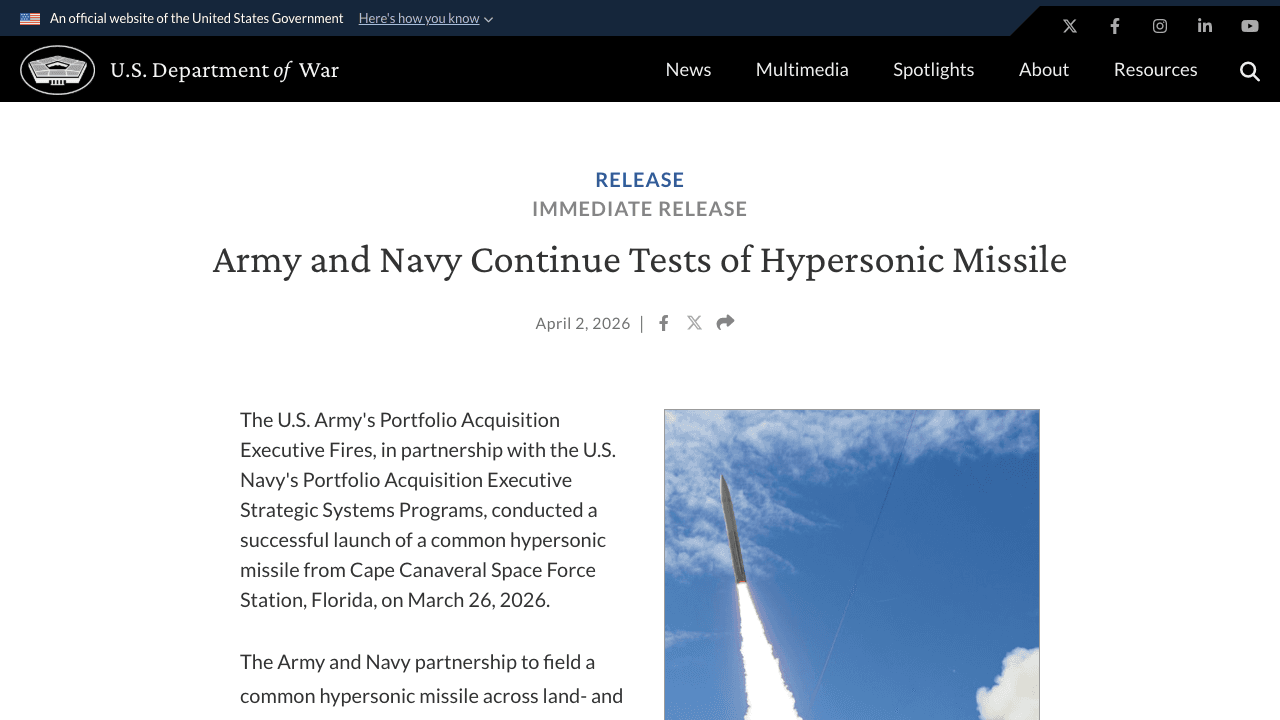
The Department of War announced on April 2, 2026 that the U.S. Army's Portfolio Acquisition Executive Fires, working with the Navy's Portfolio Acquisition Executive Strategic Systems Programs, conducted a successful launch of a "common hypersonic missile" from Cape Canaveral Space Force Station, Florida, on March 26, 2026. The release calls the Army-Navy partnership "a highly survivable capability to defeat time-sensitive, heavily defended, and high-value targets at speeds exceeding Mach 5."
The DoW release is brief — three short paragraphs — but the program it describes is not. The "common hypersonic missile" is the shared two-stage booster used by both the Army's ground-launched Long-Range Hypersonic Weapon (LRHW), formally designated Dark Eagle in April 2025, and the Navy's ship- and submarine-launched Conventional Prompt Strike (CPS) system. When the booster is mated with the Common Hypersonic Glide Body (C-HGB) built by Dynetics, the combined vehicle is called the All Up Round plus Canister (AUR+C).
The program, as described in open-source primary materials
The Congressional Research Service's In Focus report IF11991, last updated June 12, 2025, by analyst Andrew Feickert, provides the clearest public baseline for the program:
- Reported range: 1,725 miles.
- Missile primes: Lockheed Martin and Northrop Grumman.
- C-HGB prime: Dynetics (a subsidiary of Leidos), under contract to produce glide-body prototypes for both services.
- C-HGB origin: Derived from the Alternate Re-Entry System developed by the Army and Sandia National Laboratories.
- Battery composition: 4 Transporter Erector Launchers (TELs) on modified M870A4 trailers, each carrying two AUR+Cs (eight missiles per battery), plus a Battery Operations Center and a support vehicle.
- First unit: 5th Battalion, 3rd Field Artillery Regiment at Joint Base Lewis-McChord, Washington, part of the Army's 1st Multi-Domain Task Force in I Corps.
What the Dark Eagle test record looks like after March 26
The March 26, 2026 launch is the program's third successful end-to-end test in roughly 18 months, following two failed tests and two scrubs earlier in the program. The CRS report catalogs the sequence:
| Date | Site | Result |
|---|---|---|
| October 21, 2021 | (not disclosed) | Failed — booster carrying C-HGB failed; characterized as "no test" |
| June 2022 | (not disclosed) | Failed — full LRHW missile test |
| March 5, 2023 | Cape Canaveral | Scrubbed pre-flight |
| September 2023 | Cape Canaveral | Did not occur — pre-flight checks |
| June 28, 2024 | Pacific Missile Range Facility, Kauai, HI | Successful end-to-end flight; ~2,000+ miles to Marshall Islands |
| December 12, 2024 | Cape Canaveral | Successful end-to-end flight; first live-fire using a Battery Operations Center and TEL |
| March 26, 2026 | Cape Canaveral | per April 2 DoW release |
The December 2024 test was notable because it was the first live-fire event using the full fielded configuration — BOC, TEL, and AUR+C. The March 2026 test, as described, continues that success pattern from the same range.
Cost and fielding
The Army's FY2025 budget request included $744 million for "the production of LRHW Battery 3 Ground Support Equipment and the basic load of eight All-Up Round + Canister missiles," per the CRS report. A January 2023 CBO study estimated comparable intermediate-range hypersonic boost-glide missiles at $41 million per missile in 2023 dollars; the Army has told CRS that current per-missile cost exceeds that figure, with the caveat that costs could decline at higher order quantities.
The GAO's June 11, 2025 Weapons System Annual Assessment reported that the estimated cost of fielding the first LRHW battery had grown by $150 million over the prior year, which the Army attributed to "increases in the cost of the missiles and testing issues that resulted in investigations and retests." GAO also reported that the second battery is scheduled to be fielded in the fourth quarter of FY2026 as part of the Middle Tier Acquisition rapid-fielding effort, and that the third battery's ground-support-equipment award slipped from Q1 FY2024 to Q3 FY2025 due to funding delays.
What the April 2 release does not say
The DoW release does not disclose the specific test configuration (ground-stand vs. TEL), the target range achieved, whether it was an Army LRHW, a Navy CPS, or a common-booster validation flight, or the battery currently undergoing operational testing. It characterizes the flight as "successful" without further technical detail. The accompanying photograph on the release page is labeled as an Army/Navy image from the March 26 test but does not caption the configuration.
For the Army, the fielded Dark Eagle battery represents the first US ground-launched hypersonic capability since the 1991 Intermediate-Range Nuclear Forces Treaty withdrawal from intermediate-range ground-launched missile development — and, since the US withdrew from the INF Treaty in 2019, the program is no longer constrained by range limits on ground-launched missiles. For the Navy, CPS is planned for fielding on Zumwalt-class destroyers and, subsequently, Virginia-class Block V submarines.