FAA Has Quietly Granted Hermeus a Special Flight Authorization to Fly Its Quarterhorse Mk 2.1 Past Mach 1 Over White Sands
A Federal Register notice scheduled for publication Monday discloses that the FAA granted Atlanta-based hypersonic startup Hermeus Corporation authorization to conduct up to seven supersonic test flights of its Quarterhorse Mk 2.1 uncrewed aircraft inside White Sands Missile Range restricted airspace by December 31, 2026. The authorization became effective April 9.
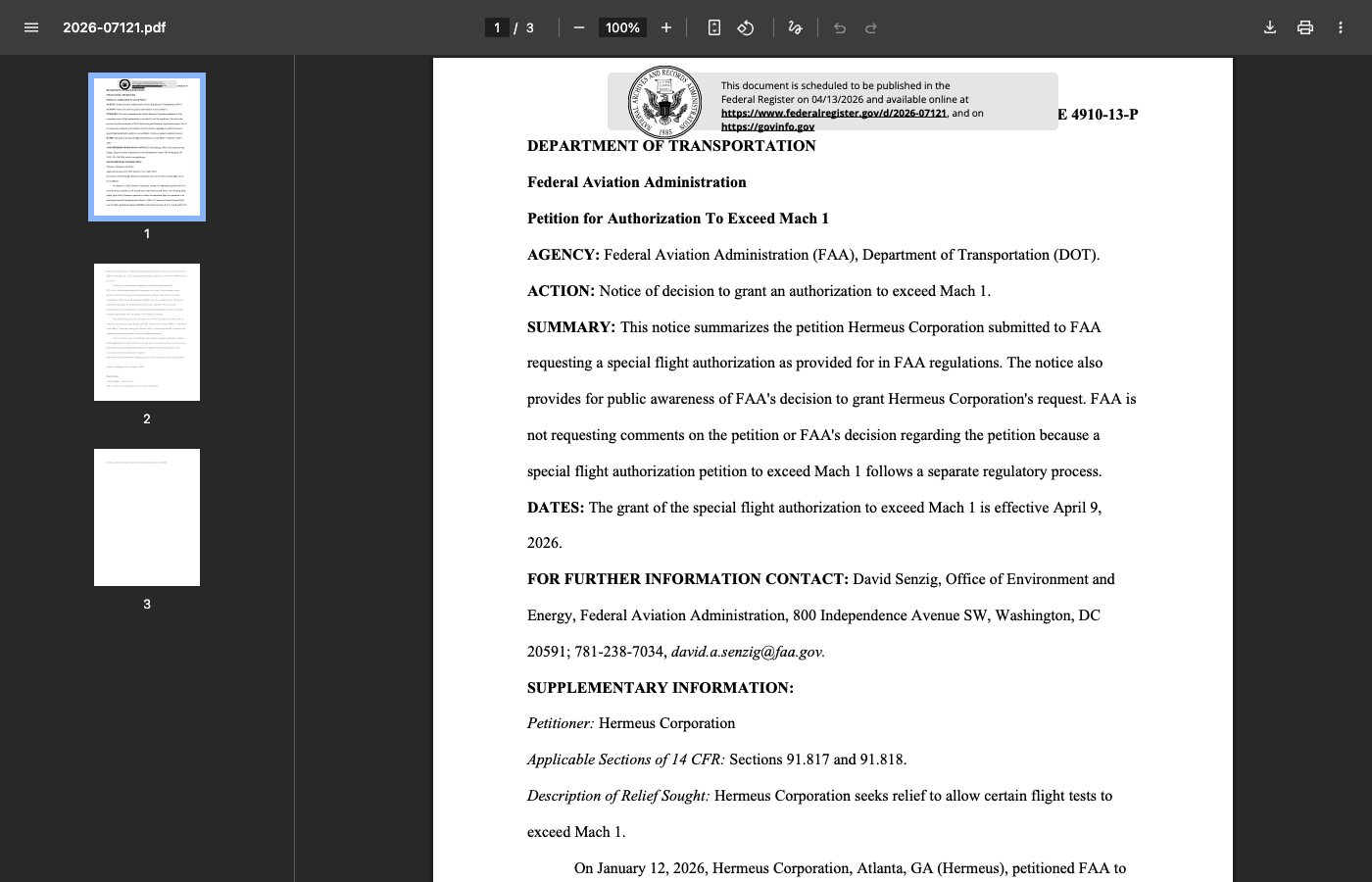
The Federal Aviation Administration has granted Atlanta-based hypersonic aircraft startup Hermeus Corporation a Special Flight Authorization under 14 CFR § 91.818 to conduct supersonic developmental flight testing of its Quarterhorse Mark 2.1 uncrewed aircraft, according to a Federal Register notice currently on public inspection and scheduled for formal publication on April 13. The authorization took effect April 9, 2026.
Federal Register document 2026-07121 is signed by David Senzig, Acting Manager of the FAA's Office of Environment and Energy Noise Division (AEE-100), and describes the petition history and FAA's decision to grant.
What Hermeus is allowed to do
The petition, filed by Hermeus on January 12, 2026, sought authorization to operate a civil aircraft expected to exceed Mach 1 during flight testing of the Quarterhorse Mk 2.1 Unmanned Aircraft System. According to the Federal Register notice:
- Test site: White Sands Missile Range (WSMR), New Mexico, inside Restricted Areas R-5111 A & B and R-5107 B.
- Altitude floor: at or above 30,000 feet mean sea level.
- Number of flights authorized: up to seven supersonic test flights.
- Deadline: by December 31, 2026.
- Effective date of authorization: April 9, 2026.
The FAA concluded that Hermeus's request is "well within the intent of 14 CFR 91.818" — the regulation under which the agency issues Special Flight Authorizations to exceed Mach 1 in US airspace. Operation above Mach 1 in civil flight is otherwise prohibited by 14 CFR § 91.817, a regulation dating to 1973 that was adopted in response to concerns about sonic booms over populated areas and that effectively ended civilian supersonic commercial operations in the contiguous United States for half a century.
Environmental review
One unusual detail in the grant: the FAA did not prepare a new environmental review for the Hermeus test flights. Instead, in a decision dated March 27, 2026, FAA "relied on and adopted the Department of the Army's Environmental Impact Statement for Development and Implementation of Range-Wide Mission and Major Capabilities at White Sands Missile Range, March 2010," which the notice describes as "the foundational document for the Department of the Army's Record of Environmental Consideration for the proposed action." On that basis FAA determined the flights "would not significantly affect the quality of the human environment." Piggybacking a civil aircraft special flight authorization on a 16-year-old Army range-wide EIS is unusual; it is also the kind of administrative move that becomes available when the test article is scheduled to fly entirely inside DoD restricted airspace at a joint DoD-civil test range.
What Quarterhorse Mk 2.1 is
Quarterhorse is Hermeus's flagship technology demonstrator program, a series of progressively larger and faster uncrewed test vehicles intended to validate hypersonic airframe design, turbine-based combined cycle propulsion, and hypersonic flight characteristics. Mark 1 was a subsonic runway-handling demonstrator. Mark 2 was the first in the line designed to go supersonic. The April 9 authorization covers the Mk 2.1 specifically — Hermeus's iteration of the Mk 2 aircraft — and limits operations to the conditions in the special flight authorization. The FAA has not publicly published the full content of the authorization itself; both the grant and the relevant environmental review are posted to the FAA's supersonic SFA page.
This is the second FAA supersonic SFA in two years
The most recent previous Special Flight Authorization under § 91.818 was granted to Boom Supersonic in April 2024 for flight testing of its XB-1 subscale demonstrator, which broke the sound barrier over California's Mojave Desert in January 2025. Hermeus is now the second company in two years to receive an SFA to exceed Mach 1 in US civil airspace — and the first to do so inside WSMR rather than in Edwards/Mojave airspace.
That pace is a shift. Between the 1973 adoption of 14 CFR § 91.817 and 2024, US civil supersonic flight authorizations were rare and largely confined to military-adjacent test aircraft. The Hermeus grant, combined with the Boom XB-1 grant, indicates that the FAA is processing civil hypersonic and supersonic test-aircraft petitions under a standing framework, rather than case-by-case rulemaking. The regulatory text of § 91.818 — not of § 91.817 — is now the controlling document for the industry.
What the Federal Register notice does not say
The FAA notice does not disclose the target Mach number the Mk 2.1 is authorized to achieve, the specific test objectives, propulsion system configuration, or the mass/dimensions of the aircraft. It also does not disclose how many of the seven permitted flights Hermeus plans to conduct in 2026 versus reserving for later months, though the December 31, 2026 outer deadline caps the program year. Those operational details sit inside the grant document posted on the FAA's supersonic SFA page rather than in the public notice.