Georgia Issues First Mandatory Burn Ban in State Forestry History as Wildfires Tear Through 91 Counties
Gov. Brian Kemp declared a 30-day state of emergency and State Forester Johnny Sabo signed the first-ever mandatory burn ban in the 100-year history of the Georgia Forestry Commission. 98% of Georgia is now in drought; the Highway 82 Fire in Brantley County alone has destroyed 53 homes and threatens roughly 1,000 more. Florida is simultaneously battling 130+ wildfires in what its agriculture commissioner calls the worst fire season in 40 years.
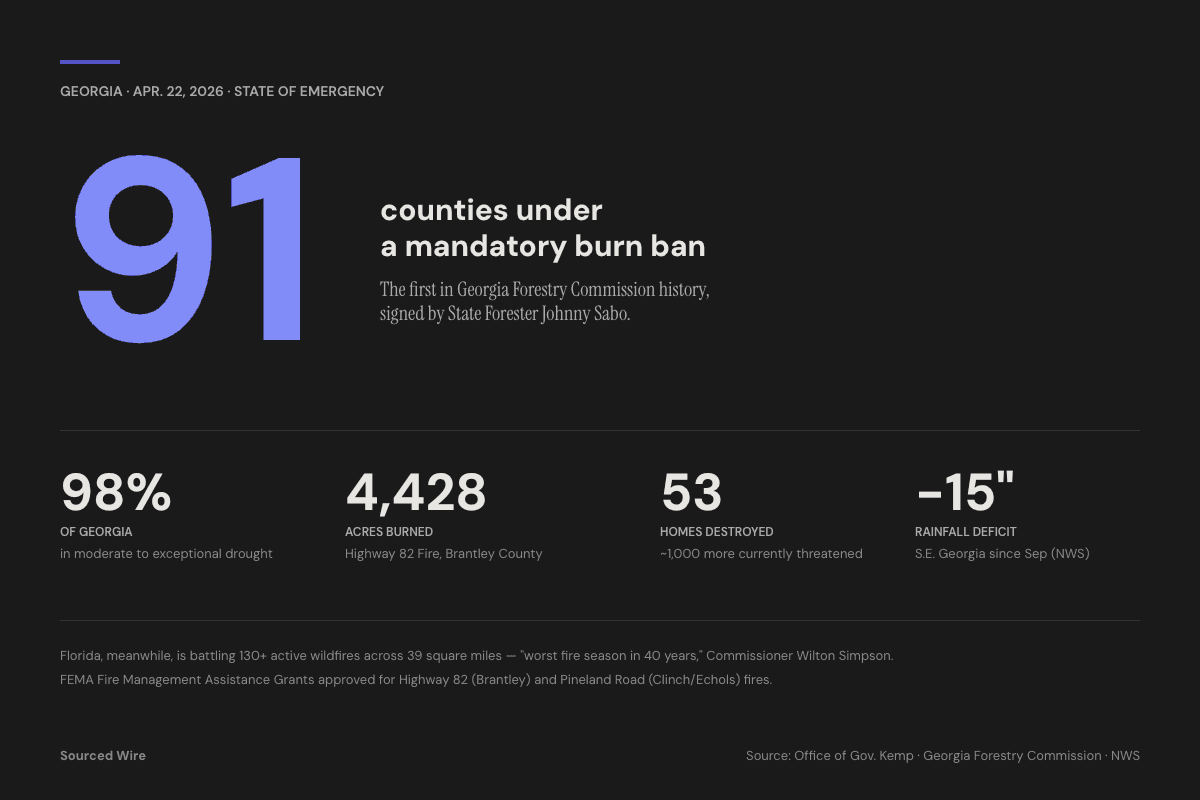
Georgia's State Forester signed the first-ever mandatory outdoor-burning ban in the Georgia Forestry Commission's history on April 22, 2026, covering 91 counties across the southern half of the state. The same day, Governor Brian Kemp declared a 30-day State of Emergency for the same 91 counties and activated the Georgia National Guard in response to fast-moving wildfires across South Georgia.
"GFC's wildland firefighters are responding daily to a near-record number of wildfires," said State Forester Johnny Sabo. "It's critical to remember that just one spark or ember can ignite a life-threatening wildfire." The ban prohibits prescribed burns, yard-debris burning, and agricultural burning for at least 30 days.
The fires on the ground
Two South Georgia blazes were large enough to trigger Federal Emergency Management Agency Fire Management Assistance Grant declarations:
- Highway 82 Fire (Brantley County): 4,428 acres, 15% contained, fire behavior described by the GFC as "extreme, with wind-driven runs, spotting, and group torching." 53 homes have been lost; roughly 1,000 more are currently threatened.
- Pineland Road Fire (Clinch and Echols Counties): also operating under a federal FMAG declaration.
Georgia's two largest active fires together have burned more than 53 square miles (137 km²), and state crews responded to 34 additional new ignitions in a single day, the Forestry Commission said.
Under the Governor's emergency order, the Georgia Department of Natural Resources has deployed three helicopters, a D6 bulldozer, two Type-2 water engines, and 10 game wardens. The Georgia State Patrol contributed three more helicopters. The Georgia National Guard activated air assets and troops. The order also prohibits price gouging on goods and services needed for wildfire preparation, response, and recovery.
The drought underneath the fires
The trigger for all of this is an extreme precipitation deficit that has been building since early fall. According to the National Weather Service, southeastern Georgia has received only 11 inches of rain since September 1 — roughly 15 inches below normal. The Georgia Forestry Commission reports that 98% of Georgia's total land area is currently in moderate to exceptional drought.
Kemp's statement put it plainly: "With much of Georgia remaining in extreme drought conditions, wildfires have already surpassed the state's 5-year average and continue to spread."
Florida, simultaneously
Across the state line, Florida firefighters are battling more than 130 active wildfires that have burned roughly 39 square miles (101 km²), mostly in the state's northern half. Florida Commissioner of Agriculture Wilton Simpson told reporters this week that it is the state's worst fire season in nearly 40 years.
What to watch next
The burn ban is effective for 30 days unless extended. With no meaningful rain in the short-term forecast and 98% of the state already in drought, further containment of the Highway 82 and Pineland Road fires will depend on wind conditions and the success of the FEMA-supported response. Georgia has now crossed several thresholds the Forestry Commission had never previously reached — a structural shift, not just a seasonal one.