WHO Validates Algeria as 29th Country to Eliminate Trachoma, Leaving 30 Still Endemic
The World Health Organization on April 23, 2026 certified Algeria as the 29th country globally — and the 10th in WHO's Africa Region — to eliminate trachoma as a public health problem. 30 countries remain endemic; 1.9 million people worldwide are still blind or visually impaired from the bacterial infection.
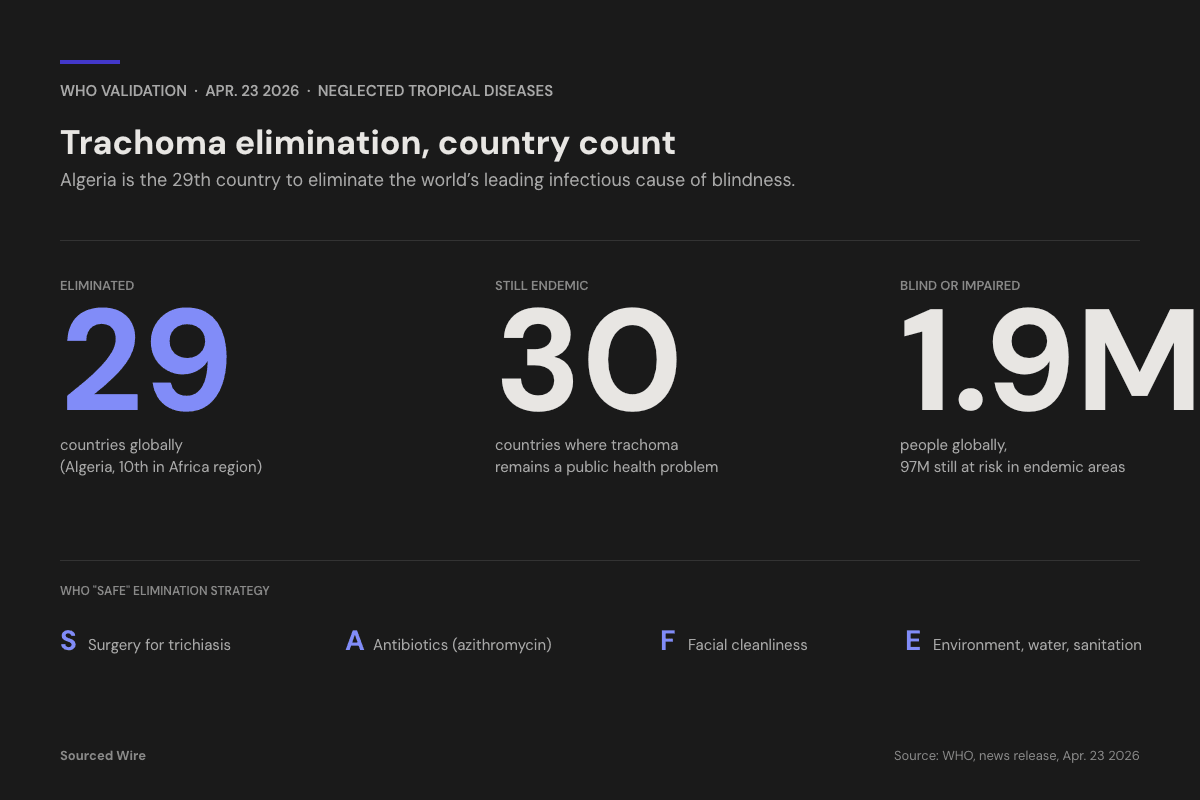
The World Health Organization on April 23, 2026 validated Algeria's elimination of trachoma as a public health problem, making it the 29th country globally — and the 10th in WHO's Africa Region — to cross that threshold for the world's leading infectious cause of blindness.
Trachoma is a bacterial infection caused by Chlamydia trachomatis. Transmitted through contact with infected eye discharge via hands, clothing, or flies, repeated infections scar the upper eyelid and turn the eyelashes inward — a condition called trichiasis that grinds against the cornea until sight is lost. Globally, the disease remains endemic in 30 countries and is responsible for blindness or visual impairment in roughly 1.9 million people, with another 97 million living in endemic areas at risk of infection.
A century-long campaign
Algeria's fight against trachoma began with the founding of the Pasteur Institute of Algeria in 1909 and continued through independence, when domestic physicians — led by Prof. Mohamed Aouchiche — took over the work. The country layered on a free universal healthcare system in 1974, a dedicated three-year acceleration strategy (2013–2015) targeting its 12 southern provinces, and a series of WHO-compliant population surveys in 2022 that confirmed the elimination thresholds had been met. The Ministry of Health submitted its validation dossier to WHO in December 2025.
The SAFE strategy
All 29 eliminating countries have used the same WHO-recommended protocol, known by its acronym:
- Surgery to reverse trichiasis and prevent further corneal damage
- Antibiotics — particularly mass administration of azithromycin — to clear active infection
- Facial cleanliness, promoted through public-awareness campaigns
- Environmental improvement, especially access to clean water and sanitation
WHO Director-General Dr. Tedros Adhanom Ghebreyesus said in a statement that the milestone "proves that with sustained political will and on-the-ground leadership from committed health professionals, we can eliminate neglected tropical diseases." Dr. Mohamed Janabi, WHO Regional Director for Africa, called it "a major achievement that transforms the health and well-being of children, women and entire families."
Where the count stands
With Algeria, the full list of countries WHO has validated for trachoma elimination now reads: Benin, Burundi, Cambodia, China, Egypt, Fiji, The Gambia, Ghana, India, Iraq, Iran, Lao PDR, Libya, Malawi, Mali, Mauritania, Mexico, Morocco, Myanmar, Nepal, Oman, Pakistan, Papua New Guinea, Saudi Arabia, Senegal, Togo, Vanuatu, Viet Nam — and Algeria.
Algeria is also WHO's 62nd country globally and 23rd in Africa to have eliminated at least one neglected tropical disease. Trachoma is Algeria's first NTD elimination.
The structural picture: 29 eliminated, 30 endemic. The global ledger on trachoma now sits just past the halfway point — with the harder half, concentrated in the Sahel, the Horn of Africa, and parts of the western Pacific, ahead.