Four Candidates Take Questions on UN WebTV as Race to Succeed Guterres Opens
Michelle Bachelet, Rafael Grossi, Rebeca Grynspan, and Macky Sall sat through three-hour televised interactive dialogues with UN Member States on April 21–22 — the General Assembly's structured audition process for the next Secretary-General, whose term begins January 1, 2027.
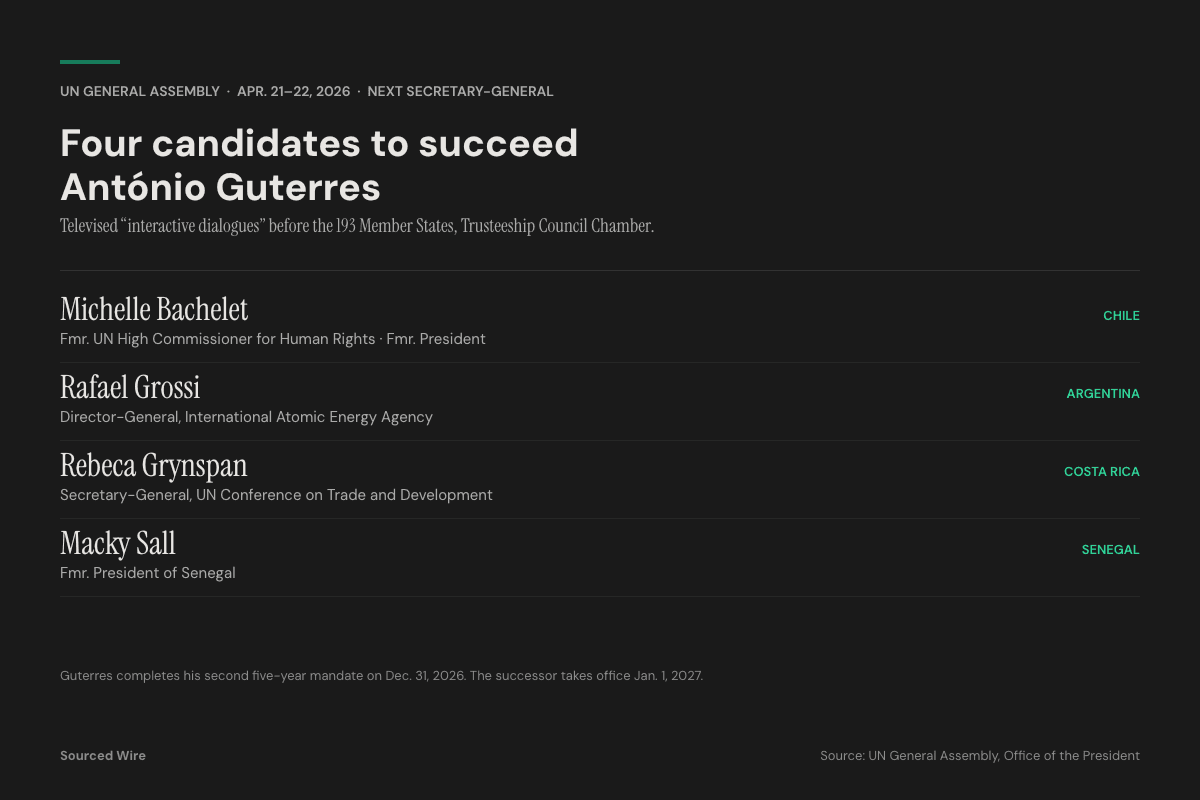
The race to succeed António Guterres as Secretary-General of the United Nations moved into public view this week. Over two days in the Trusteeship Council Chamber at UN Headquarters in New York, four declared candidates sat through three-hour "interactive dialogues" broadcast live on UN WebTV, taking questions from the 193 Member States of the General Assembly and from civil society representatives.
The dialogues were convened by the President of the General Assembly, Annalena Baerbock, under the process established by General Assembly resolution 69/321 in 2015 and reaffirmed at the start of each selection cycle. "The selection of the Secretary-General has widespread consequences that resonate far beyond this building," Baerbock told delegates.
The candidates
Four candidates have formally declared and submitted vision statements:
- Michelle Bachelet Jeria (Chile) — former UN High Commissioner for Human Rights and two-term President of Chile. Dialogue: Tuesday 10 a.m.–1 p.m.
- Rafael Mariano Grossi (Argentina) — Director-General of the International Atomic Energy Agency since 2019; lead interlocutor with Iran and Russia on nuclear safeguards. Dialogue: Tuesday 3 p.m.–6 p.m.
- Rebeca Grynspan Mayufis (Costa Rica) — Secretary-General of the UN Conference on Trade and Development (UNCTAD); former Vice-President of Costa Rica and head of the UN Development Programme for Latin America and the Caribbean. Dialogue: Wednesday 10 a.m.–1 p.m.
- Macky Sall (Senegal) — President of Senegal from 2012 to 2024; chair of the African Union in 2022. Dialogue: Wednesday 3 p.m.–6 p.m.
How the dialogue was structured
Each candidate opened with a statement of up to 10 minutes, then fielded questions for roughly two and a half hours across two thematic segments:
- Leadership, experience, and fitness for the role, including the "UN80" reform initiative;
- The three UN pillars — peace and security, development, and human rights.
In-person questions were capped at 60 seconds each and enforced by automatic microphone cut-offs. Civil society participation was organized by lottery, with pre-recorded video questions submitted from outside New York. All four sessions were broadcast in the six official UN languages.
What comes next
The interactive dialogues are advisory. The formal decision sits with the Security Council, which holds a series of straw polls to narrow the field before recommending a single candidate to the General Assembly. The General Assembly then appoints the Secretary-General by acclamation. Under resolution 69/321 the five permanent members of the Council — China, France, Russia, the United Kingdom, and the United States — retain their veto over the recommendation, so informal vetting by the P5 effectively determines the shortlist.
Guterres took office on January 1, 2017 and completes his second five-year mandate on December 31, 2026. He is not eligible for a third term. The successor selected through this process will begin a five-year term on January 1, 2027, leading a Secretariat that under the UN80 reform track is simultaneously being restructured for the first time in decades.