WHO Certifies Bahamas as 12th Country in the Americas to Eliminate Mother-to-Child HIV Transmission
The World Health Organization on April 22 certified the Bahamas for eliminating mother-to-child transmission of HIV, making it the third Caribbean nation — after Cuba and Brazil — and the 12th country or territory in the Americas to meet the thresholds: a transmission rate below 2%, fewer than 5 pediatric infections per 1,000 live births, and 95%-plus coverage for antenatal care, HIV testing, and treatment.
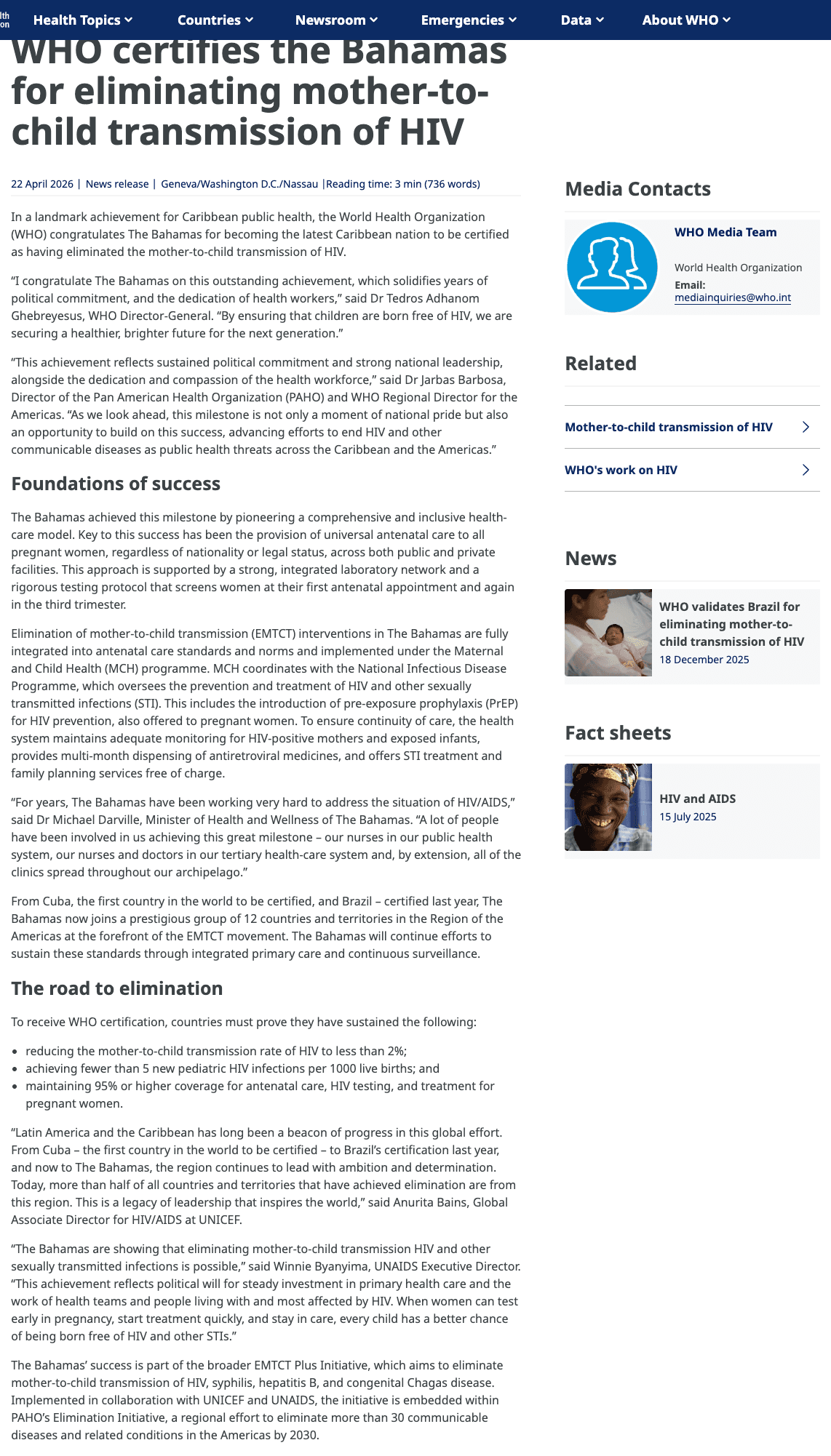
The World Health Organization on April 22, 2026 certified the Bahamas as having eliminated mother-to-child transmission of HIV, the third Caribbean nation to reach the threshold after Cuba — the first country in the world to be certified, in 2015 — and Brazil, which was certified in 2025.
To qualify, a country has to sustain three measures simultaneously:
- a mother-to-child HIV transmission rate below 2 percent,
- fewer than 5 new pediatric HIV infections per 1,000 live births, and
- 95 percent or higher coverage for antenatal care, HIV testing, and treatment among pregnant women.
The Bahamas is now the 12th country or territory in the WHO Region of the Americas to be certified. PAHO, WHO's regional office for the Americas, has driven more mother-to-child-transmission (EMTCT) certifications than any other WHO region.
How the Bahamas got there
WHO and PAHO credited three policy choices in the certifying announcement:
- Universal antenatal care regardless of legal status. All pregnant women in the Bahamas, including those without citizenship or residency, receive antenatal care across both public and private facilities.
- Integration into standard maternal and child health services. EMTCT interventions are delivered inside the Maternal and Child Health programme rather than as a parallel vertical HIV program, coordinated with the National Infectious Disease Programme.
- Pre-exposure prophylaxis during pregnancy. PrEP is offered to pregnant women at risk of acquiring HIV, closing a window in which new maternal infections during pregnancy can still seed vertical transmission even in systems with high overall testing coverage.
Dr. Michael Darville, the Bahamian Minister of Health and Wellness, in a statement released by WHO: "A lot of people have been involved in us achieving this great milestone — our nurses in our public health system, our nurses and doctors in our tertiary health-care system and, by extension, all of the clinics spread throughout our archipelago."
Dr. Tedros Adhanom Ghebreyesus, the WHO Director-General: "By ensuring that children are born free of HIV, we are securing a healthier, brighter future for the next generation."
What certification does and does not mean
WHO certification does not mean that zero children are born with HIV in the certifying country. It certifies that a country has sustained the three population-level threshold metrics — transmission rate, case rate per 1,000 live births, and coverage — long enough that the elimination-as-a-public-health-problem standard holds.
Countries must continue to report on the indicators to maintain certification. A country whose transmission rate or coverage falls back below the thresholds can lose it.
PAHO, which coordinates the certification process in the region, said the Bahamas model — particularly the delivery of antenatal care to all pregnant women regardless of nationality or residency status — is the pattern it is pushing other Caribbean countries to adopt as they work toward certification.