FERC Fast-Tracks Bath County's Relicense: 2,484 MW of Pumped Storage Up for a No-Significant-Impact Environmental Assessment
Federal Energy Regulatory Commission staff issued a Notice of Intent on April 7 to prepare an environmental assessment — not a full impact statement — for Dominion Energy's relicense application for the Bath County Pumped Storage Project. The world's most powerful pumped storage station is on track for a draft EA by November 20, 2026.
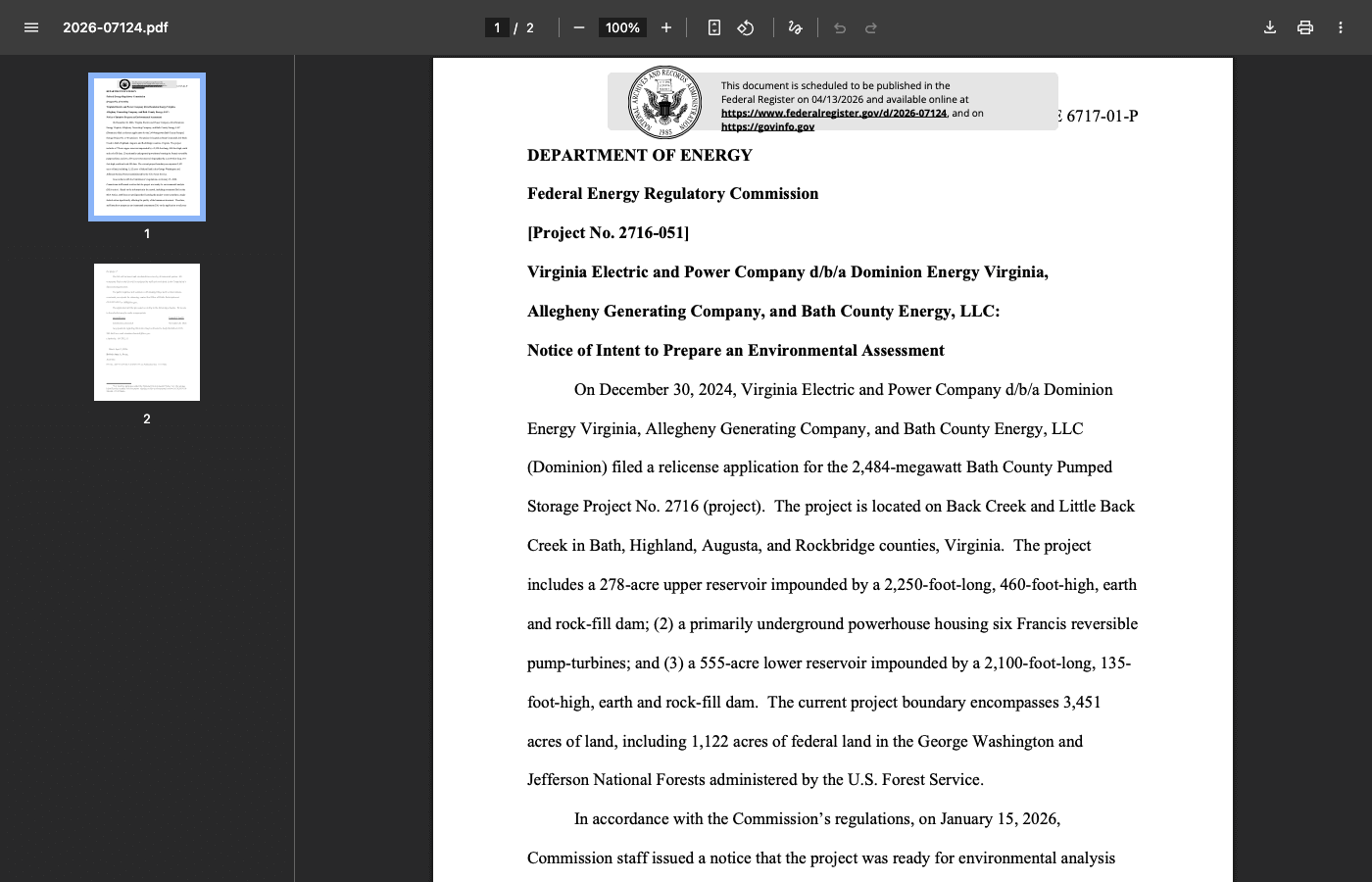
Federal Energy Regulatory Commission staff on April 7, 2026 issued a Notice of Intent to prepare an Environmental Assessment for the relicense of Project No. 2716, the Bath County Pumped Storage Project — the world's most powerful pumped storage generating station and the largest single piece of grid-scale energy storage in the United States. The notice is scheduled for formal publication in the Federal Register on Monday, April 13.
The filing is Notice of Intent, not a final license decision, and it is significant for what FERC staff said they would not do. Under the National Environmental Policy Act (NEPA), federal agencies must prepare either a full Environmental Impact Statement (for projects that constitute a "major federal action significantly affecting the quality of the human environment") or a lighter-weight Environmental Assessment for projects that do not meet that threshold. FERC staff wrote in the notice that, "Based on the information in the record, including comments filed on the REA Notice, staff does not anticipate that licensing the project would constitute a major federal action significantly affecting the quality of the human environment." That preliminary determination routes Bath County onto the EA track.
The applicant and the project
The joint relicense application was filed on December 30, 2024 by Virginia Electric and Power Company (doing business as Dominion Energy Virginia), Allegheny Generating Company, and Bath County Energy, LLC — referenced collectively in the FERC notice as "Dominion." On January 15, 2026, FERC staff issued a separate notice (the "Ready for Environmental Analysis" or REA notice) declaring the application complete for environmental review.
The notice describes the project as follows:
- Nameplate: 2,484 megawatts (the notice's figure; Dominion publishes a maximum generation capacity of approximately 3,003 MW and an average of 2,772 MW)
- Location: Back Creek and Little Back Creek, in Bath, Highland, Augusta, and Rockbridge counties, Virginia
- Upper reservoir: 278 acres, impounded by a 2,250-foot-long, 460-foot-high earth-and-rock-fill dam
- Powerhouse: Primarily underground, housing six Francis reversible pump-turbines
- Lower reservoir: 555 acres, impounded by a 2,100-foot-long, 135-foot-high earth-and-rock-fill dam
- Project boundary: 3,451 acres total, including 1,122 acres of federal land in the George Washington and Jefferson National Forests, administered by the U.S. Forest Service
The facility has been operating since 1985. Its original 50-year FERC license will expire in 2035, which is why Dominion filed its relicense application more than 10 years in advance — FERC's relicense process typically runs 5–10 years from application to decision.
The schedule
FERC staff published only one firm milestone in the Notice of Intent:
| Milestone | Target date |
|---|---|
| Commission issues EA | November 20, 2026 |
The notice adds that "revisions to the schedule may be made as appropriate." The EA, once issued, will be circulated for public comment; comments will be analyzed and considered in FERC's final licensing decision. No date is set for that final decision.
The FERC staff contact on the environmental review is Andy Bernick (202-502-8660, andrew.bernick@ferc.gov), and the notice is signed by Debbie-Anne A. Reese as Secretary of the Commission. The NEPA tracking identifier for this environmental review is EAXX-01920-000-1774339686.
Why this relicense matters
Bath County is not just a large power plant — at roughly 24,000 megawatt-hours of storage capacity according to Dominion, it is the single largest piece of grid-scale energy storage in the United States by a wide margin. A relicense proceeding determines the operational constraints the facility will run under for the next 30 to 50 years: minimum stream flows, reservoir elevation targets, recreation access, fish and wildlife mitigation obligations, and the scope of any required capital upgrades. Each of those operational constraints translates directly into megawatt-hours available to the PJM grid at peak demand.
For the PJM Interconnection — the regional transmission operator serving 13 states from New Jersey through Illinois — Bath County provides a significant share of the available pumped storage capacity that backs up variable renewable generation and covers demand peaks. A full Environmental Impact Statement process (which the NOI signals FERC is not pursuing) can attach new operational constraints that reduce dispatchable capacity; an Environmental Assessment process typically produces fewer and lighter constraints. That procedural choice is the substantive news in the NOI.