A New Paper Says the Corporate Bond 'Factor Zoo' Is a Replication Crisis: Most Factors Fail Once You Fix the Data
Alexander Dickerson, Cesare Robotti, and Giulio Rossetti argue that 108 documented corporate bond factors across nine thematic clusters mostly disappear once you correct for two specific methodological flaws: errors-in-variables bias from TRACE transaction prices, and ex-post return filtering that embeds future information in factor construction.
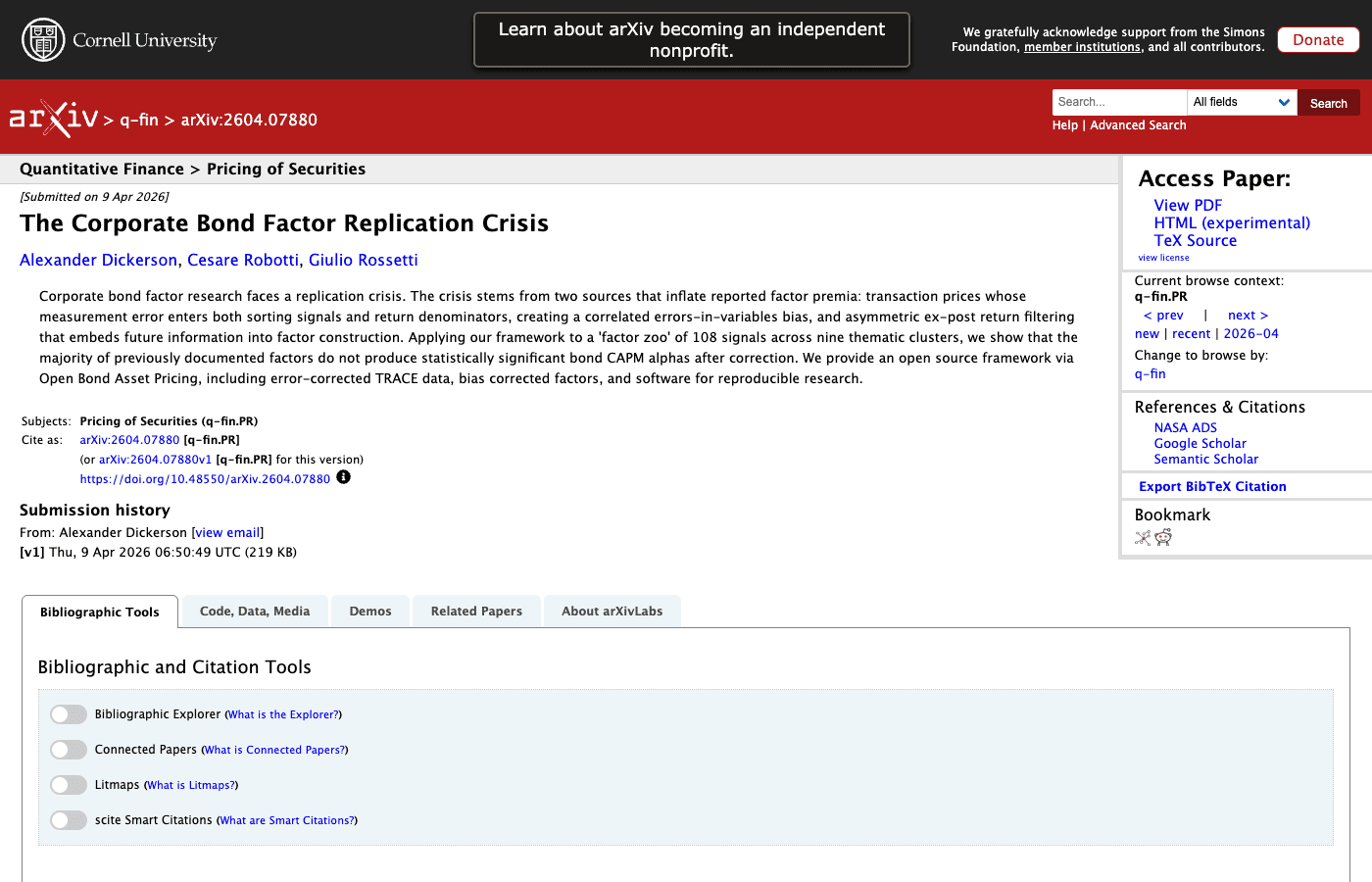
A preprint posted to arXiv on April 9, 2026, argues that nearly a decade of academic work on corporate bond "factors" — the systematic sources of excess return that underpin much of the actively managed corporate bond strategy universe — is in a replication crisis. The paper, "The Corporate Bond Factor Replication Crisis" by Alexander Dickerson, Cesare Robotti, and Giulio Rossetti, tests a "factor zoo" of 108 previously published signals across nine thematic clusters and finds that the majority stop producing statistically significant bond-CAPM alphas once two specific biases are corrected.
The two flaws
The authors identify two mechanisms that systematically inflate reported factor premia in corporate bond research:
1. Correlated errors-in-variables from TRACE prices. Corporate bond researchers use transaction prices from TRACE (FINRA's Trade Reporting and Compliance Engine) to construct both sorting signals and the returns those signals are supposed to predict. The problem: TRACE prices contain measurement error. Because the same noisy price enters both the signal and the return denominator, errors in the two quantities are correlated, and standard factor tests mistake that correlation for premium. The paper calls this a "correlated errors-in-variables bias."
2. Asymmetric ex-post return filtering. Several widely cited factor constructions filter bond returns after the fact — dropping observations that are extreme, illiquid, or otherwise inconvenient. Because the filter is applied with knowledge of which observations will later prove problematic, it effectively embeds future information into the factor, producing look-ahead bias that boosts backtested performance.
What happens when you fix it
The paper applies a corrected test to 108 published signals organized into nine thematic clusters — value, momentum, profitability, issuance, volatility, liquidity, default risk, carry, and accruals-style groupings. The headline result, from the abstract: "the majority of previously documented factors do not produce statistically significant bond CAPM alphas after correction."
The paper does not name which individual factors survive and which do not in the abstract, but the claim is sweeping — this is not an argument about one or two problematic papers, but about the statistical plumbing shared across the field.
An open-source replacement
Alongside the critique, the authors release what they call the Open Bond Asset Pricing framework — hosted at openbondassetpricing.com — containing error-corrected TRACE data, bias-corrected factor series, and software intended to let other researchers reproduce and audit their own work. That move matters because it transforms the paper from a critique into a public utility: any practitioner running corporate bond factor strategies can now test their book against the corrected data and see how much of their historical alpha survives.
Why it matters outside academia
Corporate bond factor research is the intellectual scaffolding under a large share of the systematic credit business — the set of funds, ETFs, and separately managed accounts that claim to harvest systematic risk premia in investment-grade and high-yield debt. If the majority of documented factors vanish once the data is cleaned up, two things follow: the reported historical performance of factor-based credit strategies has been overstated, and the academic literature practitioners rely on for signal discovery has been generating false positives at scale. The paper's authors have been building toward this argument for several years; earlier work in the same group includes "Priced Risk in Corporate Bonds" and the 2023 "Common pitfalls in the evaluation of corporate bond strategies" SSRN working paper.
Cesare Robotti is a finance professor at Warwick Business School. Alexander Dickerson and Giulio Rossetti are co-authors on earlier papers in the group.
The paper is a preprint and has not yet been peer-reviewed. Its findings apply specifically to the US corporate bond factor literature; equity factor research is a separate debate with its own replication history.