Europe Records Its First Imported Human Case of Avian Influenza A(H9N2) in an Italian Traveler Returning From Senegal
WHO published Disease Outbreak News 597 on Friday describing an adult male in Lombardy who tested positive for H9N2 after spending more than six months in Senegal. The case is the first human H9N2 infection ever reported in the WHO European Region. WHO assesses the risk to the general public as low.
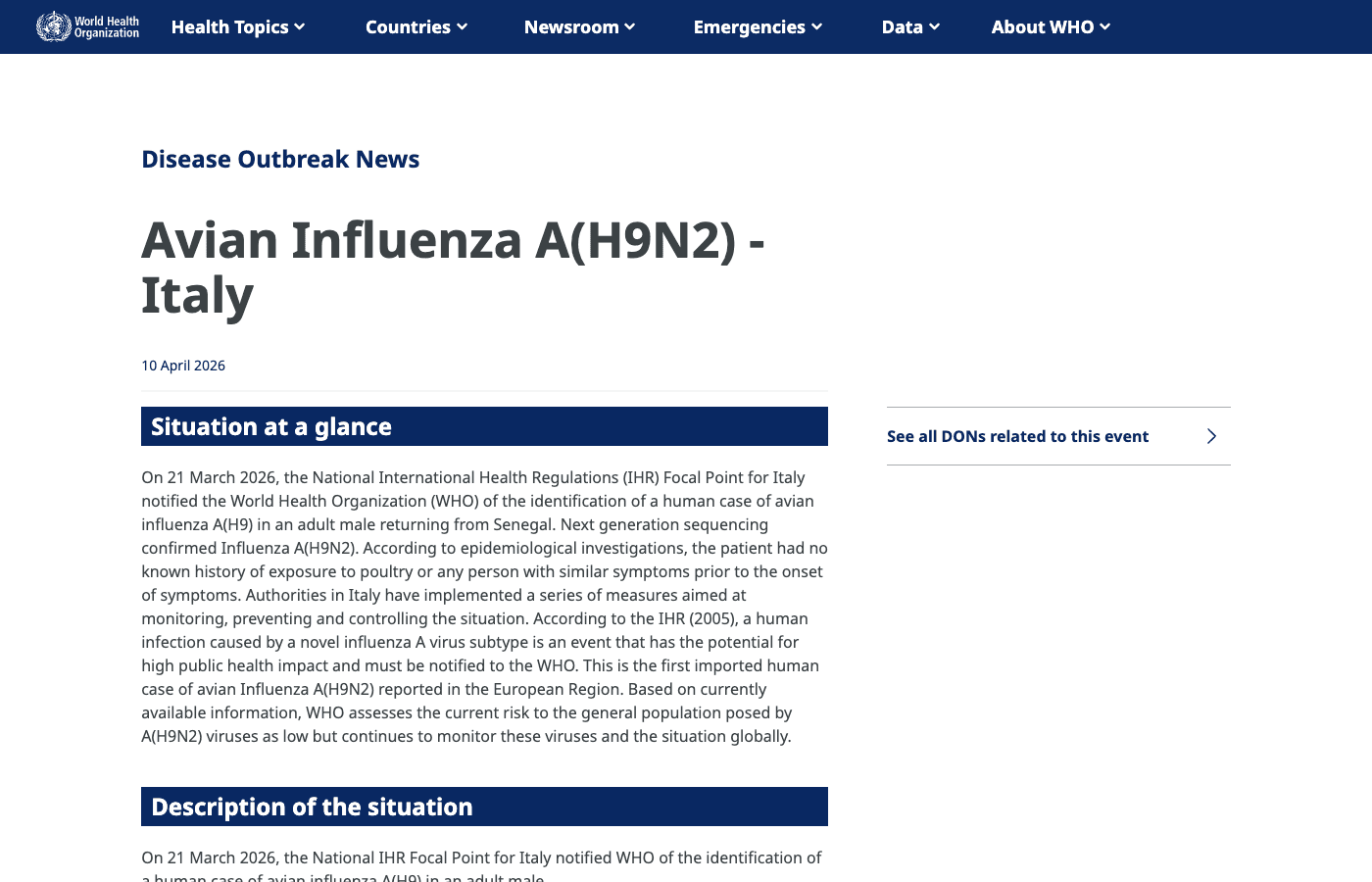
The World Health Organization on Friday published Disease Outbreak News 597 describing an adult male patient in Italy who has tested positive for avian influenza A(H9N2) after returning from a six-month stay in Senegal. It is the first imported human case of H9N2 ever reported in the WHO European Region. Italy's National International Health Regulations Focal Point formally notified WHO on 21 March 2026.
The clinical timeline
- Mid-March 2026. The patient travels from Senegal to Italy after more than six months in the country. On arrival he presents to a hospital emergency department with fever and a persistent cough.
- 16 March. A bronchoalveolar lavage sample is collected. It returns positive for Mycobacterium tuberculosis AND for an un-subtypeable influenza A virus. The patient is placed in a negative-pressure isolation room on airborne precautions and started on antitubercular medication plus the antiviral oseltamivir.
- 20 March. A regional reference laboratory identifies the influenza A as subtype H9.
- 21 March. Next-generation sequencing at Italy's National Influenza Center confirms the subtype as A(H9N2), with "close genetic similarity to strains previously identified in poultry in Senegal," per WHO. Italy notifies WHO under IHR Article 6, which requires immediate notification for any lab-confirmed human case of a novel influenza A subtype.
- 9 April. The patient's condition is described by WHO as "stable and improving."
- 10 April. WHO publishes DON597.
WHO reports that the patient had no known contact with poultry, wildlife, rural environments, or symptomatic human cases prior to symptom onset. Contact tracing in both Italy and Senegal is ongoing; Senegalese contacts were asymptomatic, and all identified Italian contacts tested negative for influenza, completed active monitoring and quarantine, and received oseltamivir as post-exposure prophylaxis.
What H9N2 is, and why Europe hasn't seen this before
Influenza A(H9N2) is a low-pathogenicity avian influenza that is enzootic in poultry across much of Asia and parts of Africa. Human cases have been documented almost exclusively in China and, more recently, in West and Central African countries that share its poultry reservoirs. Senegal reported its first human case of A(H9N2) in 2020, and environmental sampling at Senegalese live-bird markets has repeatedly detected the virus. The European Region — 53 member states from Iceland to Tajikistan under WHO's regional definition — had never reported a human H9N2 case until now.
WHO's risk assessment
WHO's public risk assessment in DON597 is explicit and narrow:
"Current epidemiological and virological evidence indicates that none of the characterized influenza A(H9N2) viruses thus far have acquired the ability for sustained transmission among humans. Thus, the likelihood of sustained human-to-human spread is low at this time."
WHO classifies the risk to the general population from A(H9N2) viruses as low, and explicitly advises against any travel or trade restrictions based on the current information. The statement notes that "infected individuals traveling internationally from affected areas may be identified in another country during or after arrival," but that community-level spread would be considered unlikely even if further imported cases are detected.
That framing is deliberate. The public-health concern with H9N2 is not the current case — it's what would happen if the virus acquired the genetic changes needed to transmit between humans, which would constitute an emerging pandemic threat. WHO's Global Influenza Programme tracks the subtype precisely because of that possibility, and publishes a Monthly Risk Assessment Summary at the human-animal interface.
Coordinated response
Italy's Ministry of Health published its own statement on the case identifying the region as Lombardy and describing "routine surveillance and prevention procedures activated." The Italian MoH press release is the national-authority primary source. The European Centre for Disease Prevention and Control also issued a statement characterizing the case as the first imported human H9N2 infection in the EU.
WHO's advice in DON597 is unchanged from its standing guidance: avoid contact with live animal markets, farms, or surfaces potentially contaminated by poultry feces; practice hand hygiene; and in occupational or backyard-farming settings, wear respiratory protection when handling live or dead poultry. WHO does not recommend any additional measures for travelers.