Judge Blocks $6.2B Nexstar-Tegna Merger That Would Have Reached 80% of US TV Households
A federal judge froze the largest broadcast deal in history after 8 state attorneys general sued, ruling the merger is 'presumed likely to violate antitrust laws' -- even though both the DOJ and FCC had approved it.
Chief U.S. District Judge Troy Nunley issued a preliminary injunction on April 17 blocking Nexstar Media's $6.2 billion acquisition of Tegna, finding that the deal to combine the nation's largest and third-largest television station groups is "presumed likely to violate antitrust laws."
The injunction takes effect April 21. Tegna must operate independently with information barriers, and no current or recent Nexstar employees may serve in Tegna leadership while the case proceeds.
The Deal
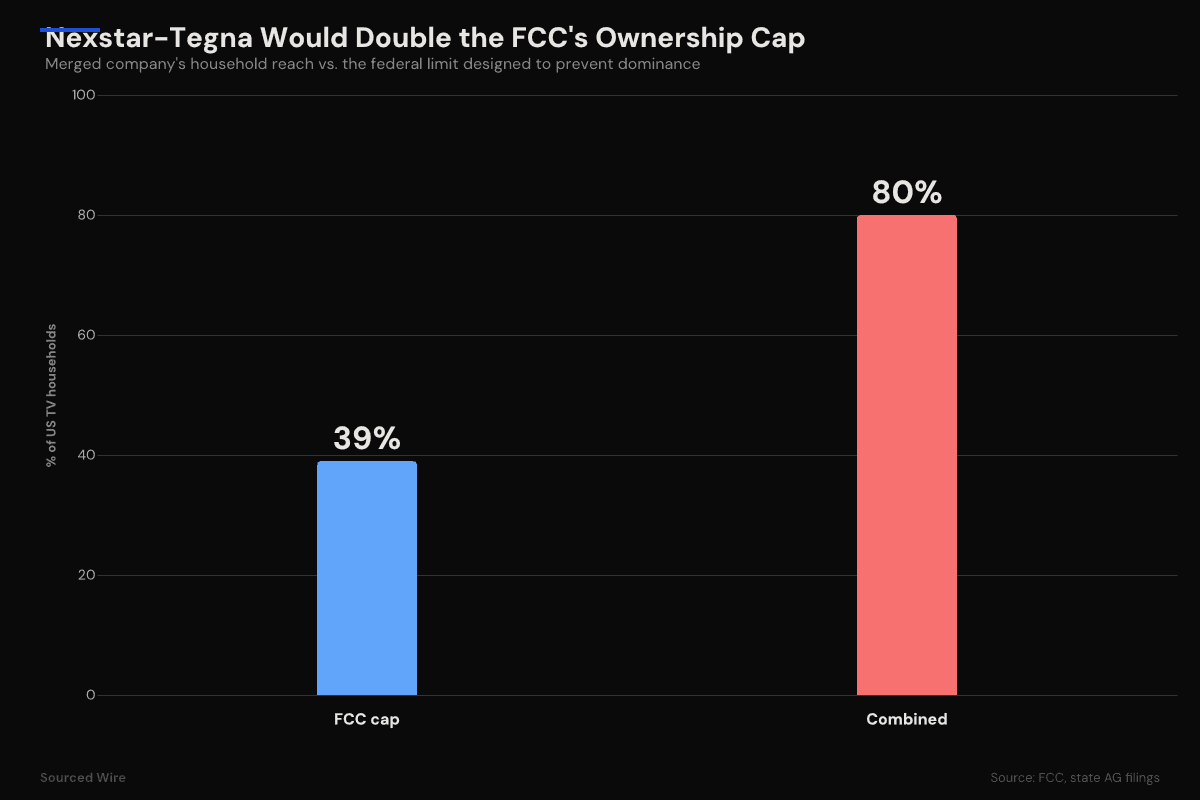
Nexstar announced its acquisition of Tegna in March 2026, and the deal closed on March 19 -- before courts could intervene. The combined company would control over 250 local TV stations affiliated with ABC, CBS, Fox, and NBC, reaching approximately 80 percent of U.S. television households.
That 80 percent figure far exceeds the FCC's national audience cap of 39 percent, which exists to prevent any single company from dominating local broadcast markets. FCC Chairman Brendan Carr -- a Trump appointee -- waived the cap to allow the deal. The Department of Justice also approved it.
State AGs Stepped In
Eight state attorneys general, led by California's Rob Bonta, filed suit on March 19 to block the merger -- the same day Nexstar announced the deal had closed.
"This merger is illegal, plain and simple," Bonta said. "The federal government may have thrown in the towel, but we'll keep fighting for consumers, for workers, for affordability, and for our local news."
The coalition includes California, New York, Colorado, Connecticut, Illinois, North Carolina, Oregon, and Virginia. DirecTV also joined as a co-plaintiff, arguing the combined company would have coercive bargaining power over retransmission fees -- the payments TV distributors make to carry local stations.
The Ruling
Judge Nunley found the plaintiffs would likely succeed on their antitrust claims and that allowing the merger to proceed would cause "irreparable harm" to DirecTV and the plaintiff states. He rejected Nexstar's argument that its competitive landscape includes streaming and digital services, siding with DirecTV's contention that consumers "do not consider them to be reasonable substitutes" for local broadcast television.
The ruling is a preliminary injunction, not a final judgment. It freezes the merger while the full antitrust case proceeds.
What's at Stake
In specific markets, the concentration is particularly stark. In Sacramento-Stockton-Modesto, the merged company would own half of all Big Four network affiliates. The same is true in San Diego, Denver, and Buffalo. States alleged the merger would lead to:
- Higher cable bills through increased retransmission fees
- Job cuts at local stations (Nexstar had already fired journalists in Los Angeles, Chicago, and New York before the injunction)
- Reduced competition in local news
What's Next
Nexstar said it will appeal to the Ninth Circuit Court of Appeals. "We will appeal today's decision and look forward to presenting our case on its merits," the company said.
The underlying antitrust trial will determine whether the merger is permanently blocked or allowed to proceed. In the meantime, the two companies must operate as separate entities.
The case marks a notable moment in federalism: the federal government -- through both the FCC and DOJ -- approved the deal, but a coalition of state attorneys general successfully argued it violates the same federal antitrust laws the DOJ chose not to enforce.