4% of Accounts Generated 23% of the Chappell Roan Backlash, Research Shows
Analytics firm GUDEA found that bot accounts drove nearly a quarter of the social media posts attacking Chappell Roan over a hotel security incident she had nothing to do with. The security guard took full responsibility, and the accuser walked back his claims.
When Brazilian footballer Jorginho accused Chappell Roan's security of berating his 11-year-old stepdaughter at a São Paulo hotel in March, the internet responded with overwhelming force: over 100,000 posts in 48 hours, calls for boycotts, and personal attacks on the Grammy-winning singer.
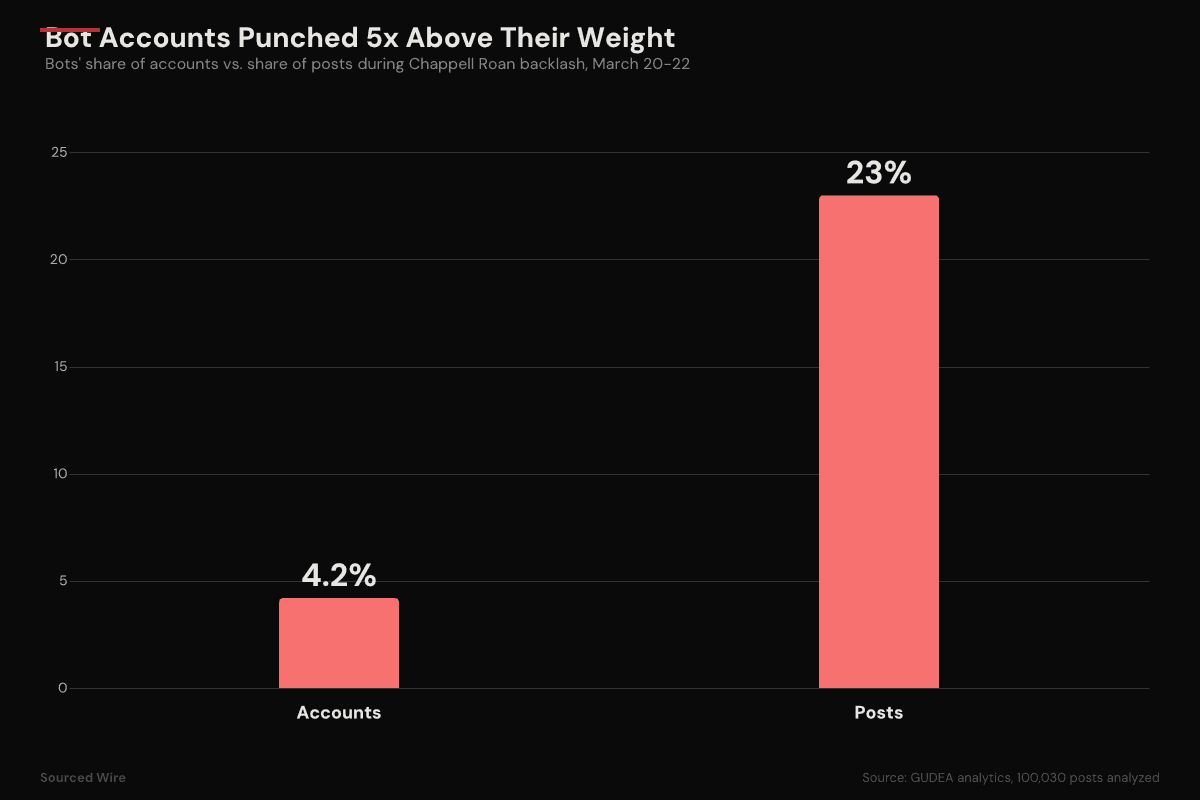
But analytics firm GUDEA found something in the data that the discourse missed. Of the 54,334 accounts that posted about the controversy between March 20 and 22, 4.2 percent -- roughly 2,300 accounts -- showed patterns consistent with automated bot behavior. Those accounts generated 23 percent of all posts, amplifying the backlash far beyond what organic conversation would have produced.
The backlash also outran the facts. The security guard who confronted the child wasn't Roan's. And Jorginho himself later said he regretted the impact on the singer.
What Actually Happened
On March 21, Jorginho posted on Instagram that his stepdaughter Ada -- Jude Law's 11-year-old daughter -- had been reduced to tears by a security guard at their São Paulo hotel during Lollapalooza weekend. According to Jorginho, Ada had walked past Roan's table to confirm it was her, smiled, and returned to her own table. A guard then approached Ada and her mother "in an extremely aggressive manner," threatening to file a complaint with the hotel.
Roan responded the same day on Instagram Stories: "I'm just going to tell my half of the story. No one came up to me, no one bothered me. I did not ask the security guard to go up and talk to this mother and child. I did not."
She apologized to the family: "I'm sorry to the mother and child that someone was assuming something. If you felt uncomfortable, that makes me really sad. You did not deserve that."
The Guard Speaks
Four days later, security guard Pascal Duvier posted his own statement on Instagram, ending the ambiguity. "I take full responsibility for the interactions on March 21st," he wrote. "I was at the hotel on behalf of another individual, and I was not part of the personal security team of Chappell Roan."
Duvier said he "made a judgment call based on information we obtained from the hotel, events I had witnessed in the days prior, and the heightened overall security risk of our location." He described his interaction with Ada's mother as "calm and with good intentions" and called the outcome "regretful."
He was emphatic that Roan had no involvement: "The actions I took were not on behalf of Chappell Roan, her personal security team, her management, or any other individuals."
The Accuser Walks It Back
In April, Jorginho issued a statement saying he "regrets the impact" of the situation. He confirmed that Roan had reached out privately to his wife, and that it "became clear that she had no knowledge of what took place at breakfast and had not asked anyone to approach them."
The Bots
GUDEA's analysis of the 100,030 posts from the peak backlash period identified the bot accounts through behavioral patterns -- posting frequency, account age, engagement ratios, and coordination signals. The firm noted that the controversy generated "intense personal attacks on Chappell Roan, calls for boycotts, and significant misinformation, including satirical and fictional embellishment spreading as fact."
The research didn't identify who operated the bot accounts or their motivations. But the math is clear: a small cluster of automated accounts exerted roughly five times their proportional influence on a conversation that cost a 27-year-old singer a month of public life.
The Return
Roan made her first public appearance since the incident at Coachella on April 12, attending the festival in a gold-and-black pirate-themed outfit. She was spotted in the front row during Addison Rae's main stage set.