DOJ Loses Fifth Straight Voter Data Case as Trump-Appointed Judge Calls Lawsuit a 'Fishing Expedition'
A Trump-appointed federal judge dismissed the DOJ's demand for Rhode Island's unredacted voter rolls -- the fifth consecutive loss for a legal campaign that has sued 30 states and DC for their residents' Social Security numbers and driver's license data.
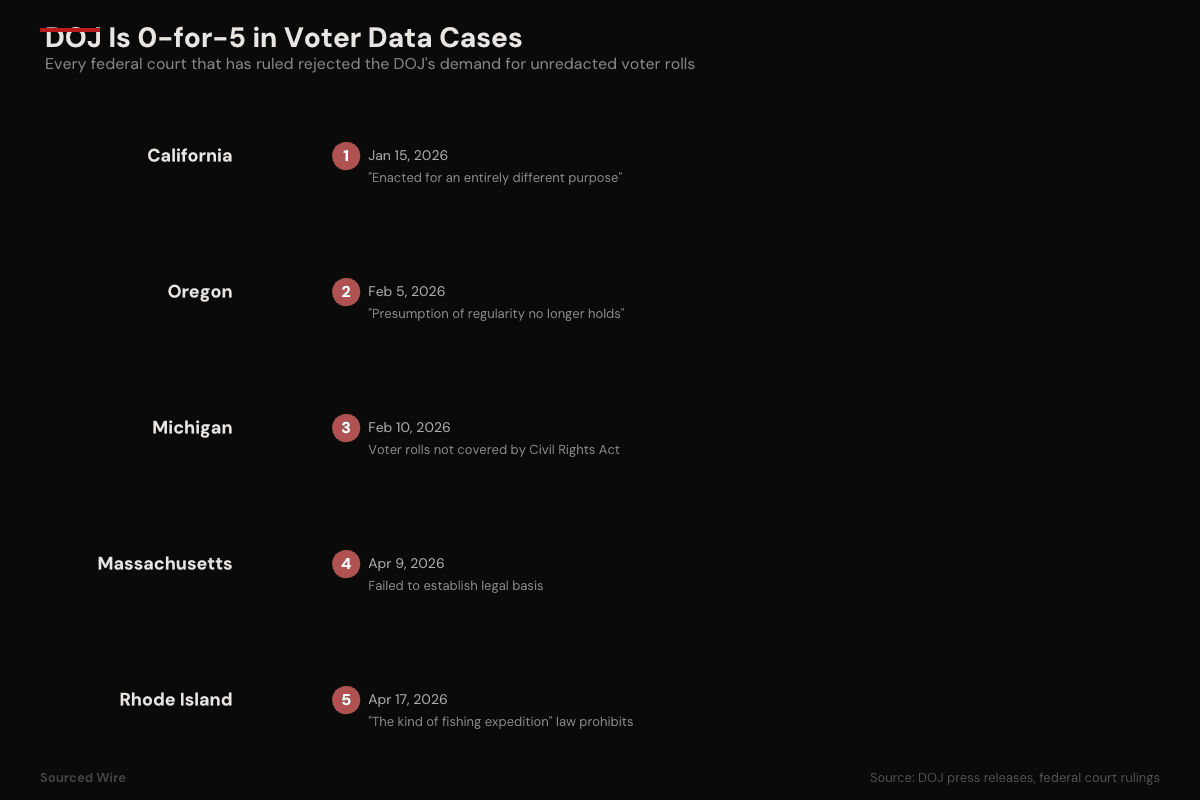
A federal judge appointed by President Trump dismissed the Justice Department's lawsuit demanding Rhode Island's unredacted voter registration data on April 17, calling the effort "the kind of fishing expedition" not permitted under federal election law.
The ruling in United States v. Amore makes the DOJ 0-for-5 in courts that have decided the question on the merits. Every federal judge to issue a ruling has rejected the department's legal theory -- including two judges Trump himself appointed.
What the DOJ Wants
Since September 2025, the Justice Department has sued 30 states and Washington, D.C., demanding they hand over complete, unredacted voter registration files. The data sought includes:
- Full names and addresses
- Dates of birth
- Driver's license numbers
- Last four digits of Social Security numbers
The department claims it needs this information to verify states are complying with federal voter roll maintenance requirements under the National Voter Registration Act (NVRA) and the Help America Vote Act (HAVA). It has also cited the Civil Rights Act of 1960 as authority to compel the records.
The Rulings
Five federal courts have now dismissed the DOJ's claims on the merits:
| Date | State | Key Finding |
|---|---|---|
| Jan. 15, 2026 | California | DOJ using "civil rights legislation enacted for an entirely different purpose" to amass voter data |
| Feb. 5, 2026 | Oregon | "Presumption of regularity no longer holds" for DOJ; court cited "ulterior motives" |
| Feb. 10, 2026 | Michigan | Voter rolls are not records covered by the Civil Rights Act |
| Apr. 9, 2026 | Massachusetts | DOJ failed to establish legal basis for demands |
| Apr. 17, 2026 | Rhode Island | "Fishing expedition" lacking any factual basis |
A sixth case in Georgia was dismissed in January on procedural grounds -- the DOJ filed in the wrong district -- and has been refiled.
Two of these judges were appointed by Trump himself: Judge Mary S. McElroy in Rhode Island and Judge Hala Jarbou in Michigan. Both rejected the DOJ's arguments.
The Rhode Island Ruling
Judge McElroy's decision was particularly pointed. She wrote that the DOJ's demand was "absent any factual allegations suggesting that Rhode Island may be violating the list maintenance requirements" of federal law.
The department's stated purpose -- ensuring compliance with the NVRA and HAVA -- "does not plausibly relate to individual voting rights," McElroy wrote. She rejected the DOJ's attempt to file supplemental "curing letters" to shore up the legal basis, a tactic it has attempted in 13 states after courts began questioning the original demands.
Rhode Island Secretary of State Gregg Amore said the ruling demonstrated "the power of our democratic republic, built on three, coequal branches of government."
Who Complied
While courts have uniformly rejected the DOJ's theory, not every state fought back. Twelve states -- Alaska, Arkansas, Indiana, Louisiana, Mississippi, Nebraska, Ohio, South Dakota, Tennessee, Texas, and Wyoming -- provided or agreed to provide the data. Oklahoma settled its case in March 2026, agreeing to turn over its voter files in exchange for the lawsuit being dropped.
All twelve states that complied voluntarily have Republican governors.
What's Next
The DOJ has appealed the California, Oregon, and Michigan dismissals to federal circuit courts. It is expected to appeal the Massachusetts and Rhode Island decisions as well.
Despite the losing streak, the department continues expanding its campaign. On April 1, it sued Idaho -- bringing the total to 30 states plus DC. Twenty-four cases remain pending across the country, with hearings scheduled through the summer.
The appeals will test whether circuit courts agree with the unanimous district court conclusion: that the Civil Rights Act of 1960, enacted to combat racial discrimination in voting, does not authorize the federal government to demand every state's complete voter files.