Lutnick Tells Congress Trump's 'Gold Card' Visa Has Approved One Applicant — Thirteen Months After Claiming He Sold 1,000 in a Day
Commerce Secretary Howard Lutnick told a House appropriations subcommittee on Thursday that the administration's $1 million Gold Card visa has been approved for one person since applications opened in December. In March 2025, he told the All-In podcast he had 'sold 1,000' of the cards at $5 million each — a claim valued at the time at $5 billion in a single day.
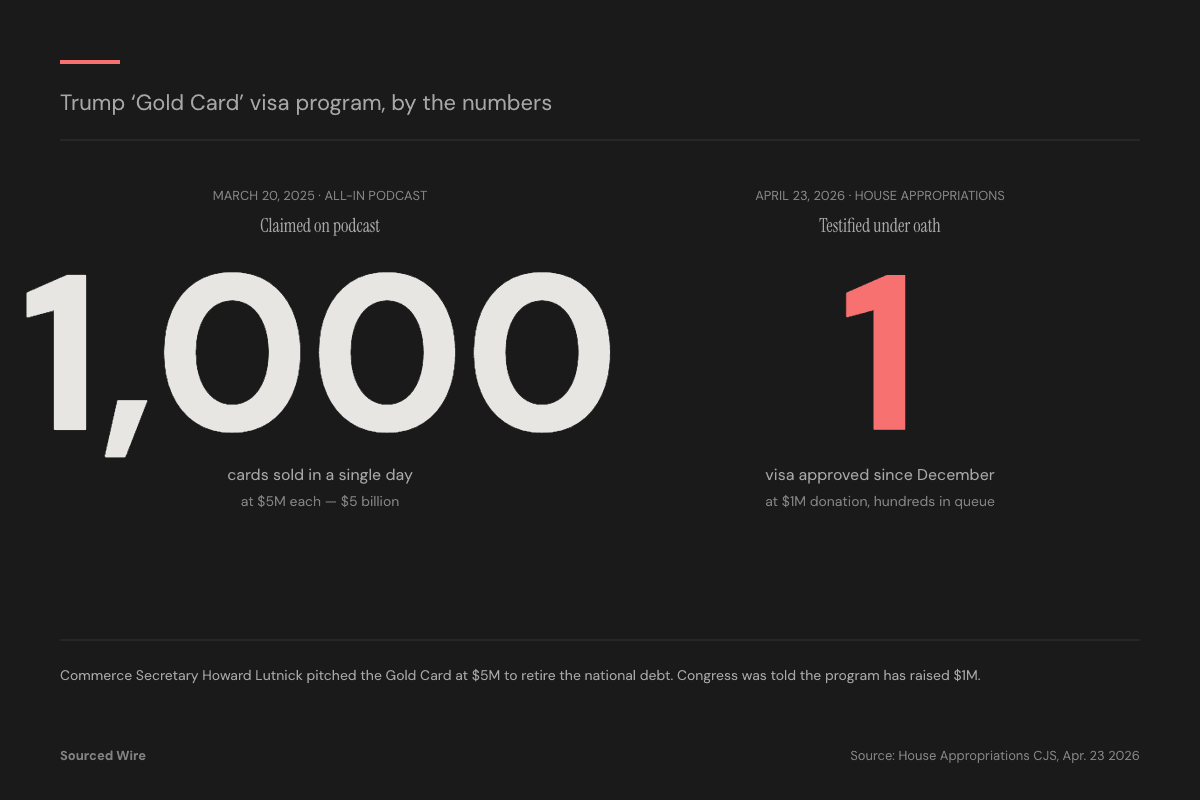
Commerce Secretary Howard Lutnick told the House Appropriations Subcommittee on Commerce, Justice, Science, and Related Agencies on Thursday that President Trump's Gold Card visa program — pitched fourteen months ago as a vehicle to retire the national debt — has produced one approval.
"They have approved, recently, one person, and there are hundreds in the queue," Lutnick said under oath, responding to questions from Rep. Grace Meng (D-NY) about the program's revenue and how the funds would be used. Applications opened in December, making it roughly five months of operation. The applicant pays a $15,000 processing fee to the Department of Homeland Security and, if approved, makes a $1 million "donation" to the U.S. government. Lutnick said the vetting process is "the most serious ... in the history of government," and that proceeds would go toward "the betterment" of the United States.
The prior claim
On March 20, 2025, Lutnick told the All-In podcast — a popular venture capital show hosted by Chamath Palihapitiya, Jason Calacanis, David Sacks, and David Friedberg — that he had already sold 1,000 Gold Cards at $5 million each in a single day.
At the price Lutnick named on the podcast, 1,000 cards in one day amounted to $5 billion. The framing on the show extended further: Trump had said that 200,000 Gold Cards could retire $1 trillion in debt, that 1 million cards could raise $5 trillion, and that 10 million could retire the entire national debt — roughly $50 trillion.
What the program actually looks like
The program Lutnick described to Congress on Thursday differs from the one he described on the podcast in three respects:
- Price. The card Trump announced in February 2025 and that Lutnick pitched on All-In was priced at $5 million. The program that opened for applications in December is a $1 million donation plus a $15,000 DHS processing fee. It grants an EB-1 or EB-2 visa — existing employment-based categories — rather than a new residency tier.
- Volume. The "1,000 in a day" figure Lutnick offered last March has not translated into approvals. One has been approved over roughly five months; Lutnick said "hundreds" are waiting.
- Revenue. The cumulative gross from Gold Card donations, per Lutnick's testimony, is $1 million — the single approved applicant's gift. That figure is 0.00002% of the $5 trillion Trump had forecast if the program sold one million cards.
Lutnick did not disclose the identity of the person approved.
The hearing
The broader hearing was over the Commerce Department's fiscal year 2027 budget request, which would cut discretionary spending at the department by 12.2% — a $1.3 billion reduction — while raising funding for trade enforcement and export controls. Democratic members used the forum to press Lutnick on tariff policy, Bureau of Labor Statistics jobs data, and cuts to the Minority Business Development Agency and the Manufacturing Extension Partnership. Meng's question on the Gold Card was part of that accountability framing: a program the administration had described as a multi-trillion-dollar debt solution now appears on the ledger as a single transaction.