DOJ Charges Fort Bragg Soldier With Turning $33,034 Into $409,881 on Polymarket Using Classified Intel on the Operation That Captured Maduro
The Justice Department on Thursday unsealed a five-count indictment against Army soldier Gannon Ken Van Dyke, alleging he used classified knowledge of Operation Absolute Resolve—the military mission that captured Nicolas Maduro in Caracas on January 3—to win binary event contracts on Polymarket, then tried to erase his account and move the proceeds through a foreign crypto vault.
The Justice Department on Thursday unsealed an indictment in the Southern District of New York charging Gannon Ken Van Dyke, a 38-year-old active-duty Army soldier stationed at Fort Bragg, with using classified knowledge of a U.S. military operation to generate more than $400,000 in profit on Polymarket. The operation in question was Operation Absolute Resolve—the mission that resulted in the predawn capture of Venezuelan President Nicolas Maduro in Caracas on January 3, 2026.
According to the indictment, Van Dyke "participated in the planning and execution" of Operation Absolute Resolve beginning around December 8, 2025, and held access to "sensitive, nonpublic, classified information" about its timing. He had signed nondisclosure agreements promising "never [to] divulge, publish, or reveal by writing, words, conduct, or otherwise . . . any classified or sensitive information" relating to military operations.
The betting pattern
On or about December 26, 2025—roughly a week before the operation—Van Dyke created a Polymarket account and funded it. From December 27 through the evening of January 2, he placed approximately 13 wagers totaling $33,034, all on the "YES" side of four Maduro- and Venezuela-related binary contracts:
- "U.S. Forces in Venezuela . . . by January 31, 2026"
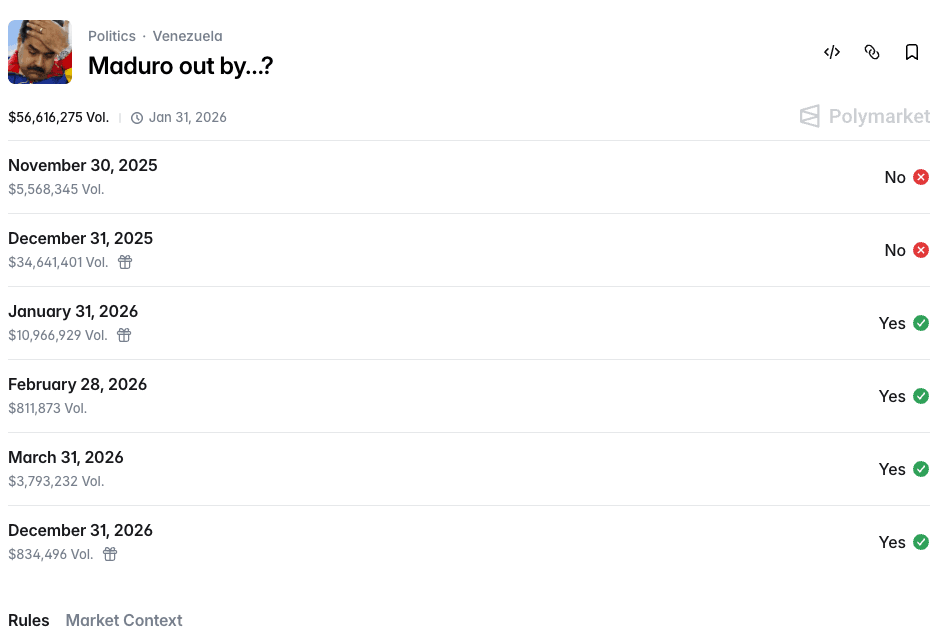
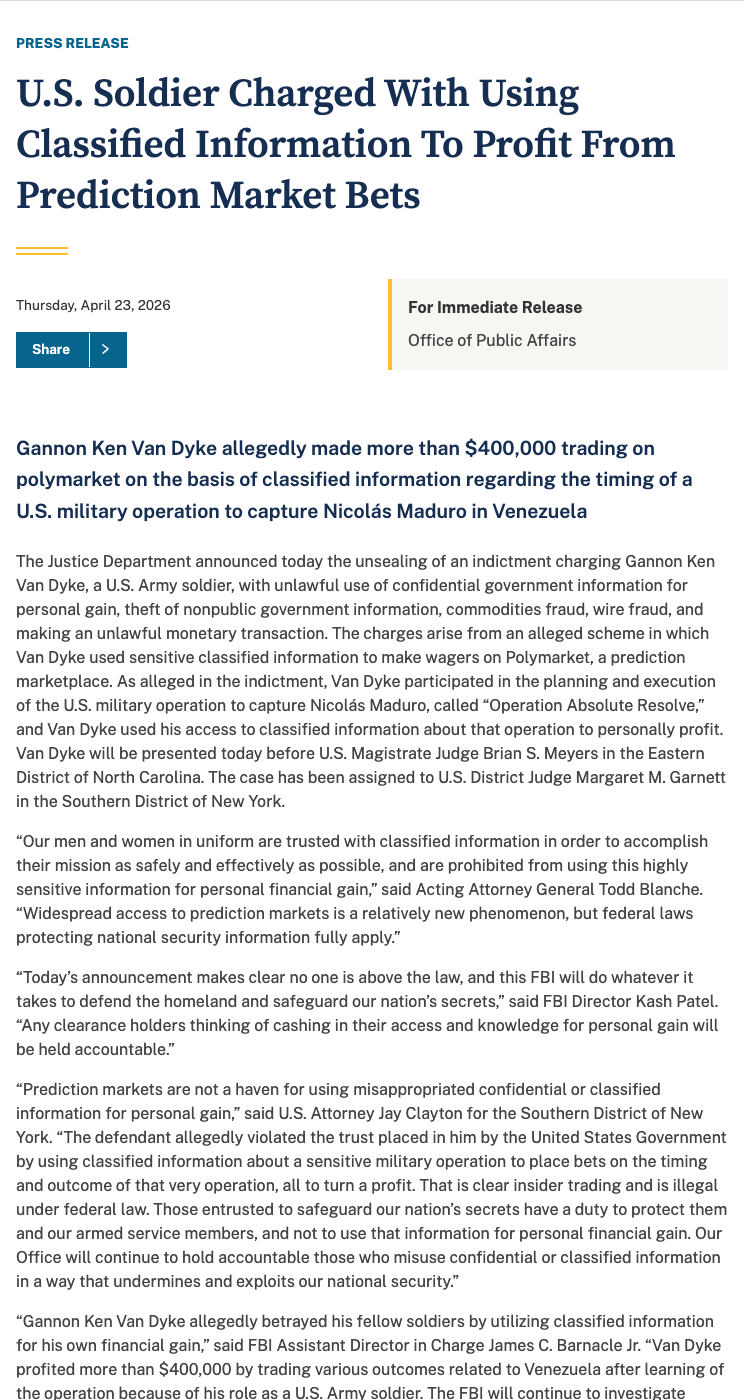
- "Maduro out by . . . January 31, 2026"
- "Will the U.S. invade Venezuela by . . . January 31"
- "Trump invokes War Powers against Venezuela by . . . January 31"
The "Maduro out by . . . January 31, 2026" contract alone drew $10.97 million in traded volume on Polymarket, which is operated by Blockratize Inc. and offers event contracts regulated under the Commodity Exchange Act.
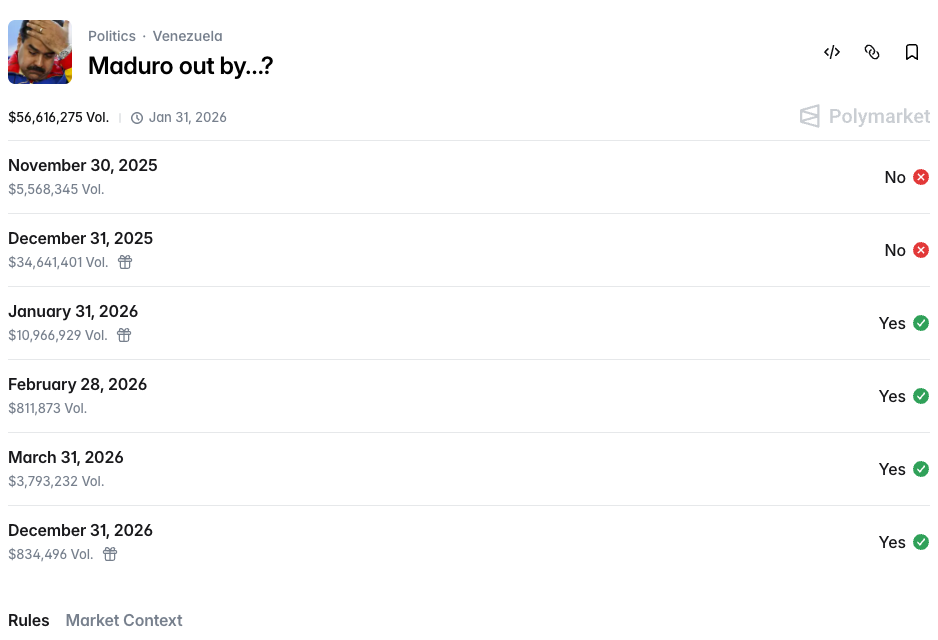
In the predawn hours of January 3, U.S. forces apprehended Maduro and his wife at a residence in Caracas. Hours later, the president publicly announced the successful operation. Polymarket resolved the affected contracts to "YES," and Van Dyke's positions paid out. The indictment states his total profit was approximately $409,881—a return of more than 12x his stake in under a week.
The cover-up allegations
Following the public announcement of Operation Absolute Resolve, unusual trading activity in Maduro-related contracts drew attention in the press and on social media. According to prosecutors, Van Dyke then took steps to conceal his identity as the trader. On January 6, 2026, he asked Polymarket to delete his account, falsely telling the platform he had lost access to the email address linked to it. The same day, he changed the email registered to his cryptocurrency exchange account to an address that was not in his name—an address he had created on or about December 14, 2025, nine days before he began trading.
On the day of the operation, Van Dyke withdrew the majority of the allegedly unlawful proceeds from his Polymarket account, routing "most" of the funds through a foreign cryptocurrency vault before depositing them into a newly created online brokerage account, the indictment alleges.
The charges
Van Dyke is charged with five counts:
| Count | Charge | Max penalty |
|---|---|---|
| 1–3 | Violations of the Commodity Exchange Act | 10 years each |
| 4 | Wire fraud | 20 years |
| 5 | Unlawful monetary transaction | 10 years |
The DOJ also charged him with unlawful use of confidential government information for personal gain, theft of nonpublic government information, and commodities fraud. Maximum sentences are informational; actual sentencing is determined by the judge. Van Dyke was presented Thursday before U.S. Magistrate Judge Brian S. Meyers in the Eastern District of North Carolina; the case has been assigned to U.S. District Judge Margaret M. Garnett in the Southern District of New York.
The officials' framing
Four senior officials issued statements with the indictment. Acting Attorney General Todd Blanche tied the case to a live legal question about how federal securities and commodities law applies to a rapidly growing category of markets: "Widespread access to prediction markets is a relatively new phenomenon, but federal laws protecting national security information fully apply." FBI Director Kash Patel framed it as a warning to clearance holders: "Any clearance holders thinking of cashing in their access and knowledge for personal gain will be held accountable."
U.S. Attorney Jay Clayton for the Southern District of New York—the former SEC chair now leading the office prosecuting the case—went further, explicitly characterizing the conduct as insider trading: "The defendant allegedly violated the trust placed in him by the United States Government by using classified information about a sensitive military operation to place bets on the timing and outcome of that very operation, all to turn a profit. That is clear insider trading and is illegal under federal law." FBI Assistant Director in Charge James C. Barnacle Jr. confirmed the $400,000-plus profit figure and said Van Dyke had "betrayed his fellow soldiers."
The case is being handled by the SDNY Office's Securities and Commodities Fraud Task Force and National Security and International Narcotics Unit, with assistance from the Justice Department's Counterintelligence & Export Control Section.
Context: a first-of-its-kind theory
Congress has never enacted a prediction-market-specific insider trading statute. The indictment instead applies existing commodities and fraud law to a platform—Polymarket—whose contracts are regulated as binary event contracts under the Commodity Exchange Act. Clayton's framing of the trades as "clear insider trading" tests whether the commodities-fraud theory will extend to classified-information cases on prediction markets the same way it has on securities exchanges.
Unusual trading in the Maduro contracts was first flagged by market observers in the days after the capture. On January 6, Rep. Ritchie Torres publicly called for an insider-trading inquiry into the trades. The DOJ indictment unsealed Thursday represents the federal response.