NPR Announces $113M in Gifts, Including $33M From an Anonymous Donor to Replace CPB Infrastructure
Philanthropist Connie Ballmer gave $80 million and an anonymous donor contributed $33 million, nine months after Congress clawed back $1.1 billion in forward appropriations from the Corporation for Public Broadcasting.
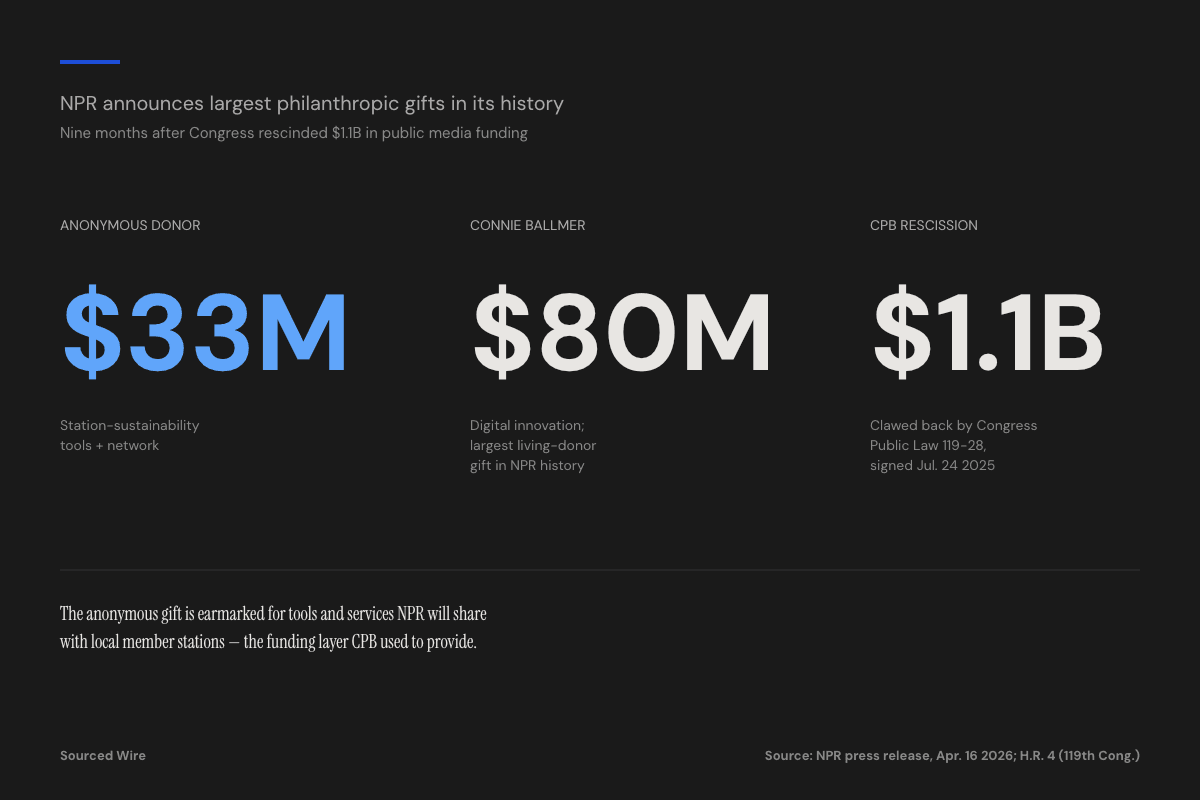
NPR on April 16 announced it has received philanthropic gifts totaling more than $110 million, the largest private commitment in the network's 55-year history. The package is split between an $80 million pledge from Connie Ballmer — the largest single gift from a living donor in NPR's history — and $33 million in gifts from an anonymous donor.
The announcement came nine months after Congress rescinded $1.1 billion in previously approved funding to the Corporation for Public Broadcasting under the Rescissions Act of 2025 (H.R. 4, Public Law 119-28), signed by President Trump on July 24, 2025 after a 51-48 Senate vote. CPB announced it would wind down operations on August 1, 2025 and ceased distributing funds in January 2026.
In the press release, NPR said Ballmer's $80 million will support digital innovation and audience-building work. The anonymous $33 million will go "towards strengthening and increasing the sustainability of the NPR Network, enabling NPR to build and acquire tools and services that will be shared with public media organizations serving communities across the nation."
That distinction matters. NPR's own direct federal funding was roughly 1% of its budget. The CPB appropriation flowed primarily to NPR's 1,000-plus member stations — some rural stations received more than half their revenue from the federal grant — and to shared infrastructure those stations could not afford to build individually. The $33 million anonymous gift is explicitly earmarked for that infrastructure layer: audience analytics, fundraising tools, and digital services built once at NPR headquarters and distributed to member stations.
The donors
Ballmer is the co-founder of the Ballmer Group, a philanthropic organization funded with the Microsoft fortune of her husband, former Microsoft CEO Steve Ballmer. She was quoted in the NPR release saying: "I support NPR because an informed public is the bedrock of our society, and democracy requires strong, independent journalism. My hope is that this commitment provides the stability and the spark NPR needs to innovate boldly and strengthen its national network."
The anonymous donor was not named. NPR did not disclose whether the $33 million is a single gift or a series of pledges, or whether the donor has given to NPR previously.
NPR President and CEO Katherine Maher framed the combined gifts as a strategic turning point: "NPR's mission is unwavering, but our means must evolve. This remarkable investment will enable NPR to continue to deliver the nation's finest public service journalism, meeting audiences where they are today and will be in the years to come."
Scale against what was lost
The $113 million package does not replace what Congress withdrew. CPB's forward appropriation — already enacted, then rescinded — covered public broadcasting through fiscal year 2027. Roughly 70% of CPB's grants went to local television and radio stations. Rescinding the full two-year forward appropriation removed an annual federal funding stream of roughly $535 million from the public media ecosystem, most of it flowing outside NPR's headquarters.
By that comparison, the anonymous donor's $33 million is a small fraction of a single year of the infrastructure funding it aims to replace. NPR has not announced whether additional fundraising is in motion to close the gap for member stations.
A separate federal judge in late 2025 ruled that an executive order directing federal agencies to cut ties with NPR and PBS violated the First Amendment. That ruling did not restore the CPB funding rescinded by Congress.
What's next
NPR said the gifts will fund work over multiple years. Ballmer's pledge is structured as a strategic investment in digital transformation. The anonymous gift is structured as a restricted fund for network tools, with no disclosed matching requirement or sunset date.
Congress has not introduced legislation to restore CPB funding. The FY2026 and FY2027 appropriations for public broadcasting remain at zero.