Senate Confirms Warsh as Federal Reserve Chair, 54-45, in Closest Vote of Modern Era
The Senate voted 54-45 on May 13 to confirm Kevin Warsh as Federal Reserve chairman, with Sen. John Fetterman the only Democrat to cross party lines. The confirmation triggers a 90-day divestiture clock on Warsh's private fund holdings, with the deadline falling around August 11, and sets up the first FOMC meeting of his tenure for June 16-17.
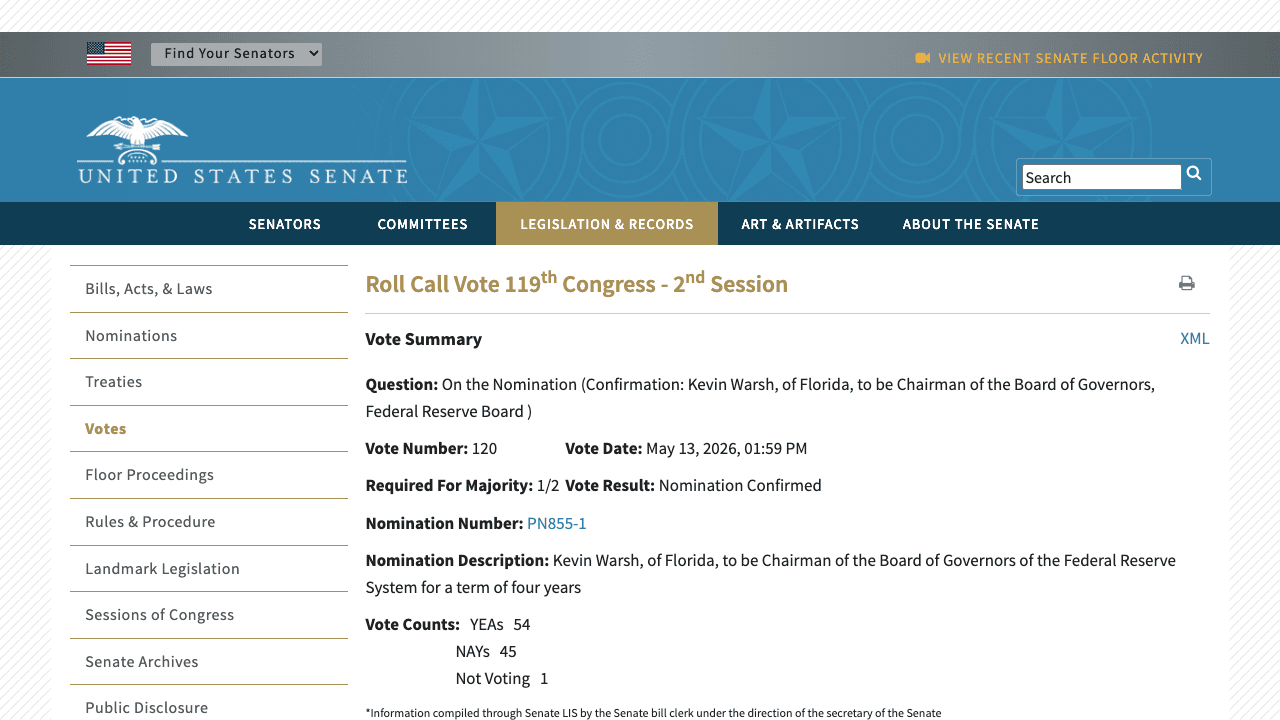
The Senate confirmed Kevin Warsh as chairman of the Federal Reserve on May 13, 2026, by a vote of 54 to 45 — the narrowest confirmation of a Fed chair in modern history — with Sen. John Fetterman of Pennsylvania the only Democrat to cross party lines in support.
Roll Call Vote 120 (PN855-1) logged 54 Yeas and 45 Nays, with one senator not voting. All 53 Republican senators voted to confirm. Forty-three Democrats joined independents Bernie Sanders of Vermont and Angus King of Maine in opposition. Sen. Kirsten Gillibrand of New York did not vote.
The day before, on May 12, the Senate confirmed Warsh to the Fed's Board of Governors on a separate roll call of 51 to 45, filling the 14-year term to which President Trump simultaneously nominated him. Fetterman was again the lone Democratic crossover.
Divestiture clock begins
Warsh's confirmation starts a 90-day ethics countdown. Under his agreement with the Office of Government Ethics, he must divest the following holdings by approximately August 11, 2026:
- DCM Investments 9 LLC, three Bessemer Venture Associates funds (VIII LP, XI LP, XII LP), and 59 THSDFS LLC series.
Three holdings — Juggernaut Fund LP, THSDFS LLC Series 65, and DCM Investments 10 LLC — were required to be divested before Warsh assumed duties as chairman and are not subject to the 90-day window.
The divestiture requirement arises from OGE's partial withholding of certification on Warsh's Form 278e financial disclosure, filed April 10. The office noted the report complies for all entries except dozens of lines where Warsh cited pre-existing confidentiality agreements with fund managers and declined to disclose underlying assets. The holdings implicated in those lines exceed $100 million in total. Full OGE certification requires the divestitures to complete.
The Senate Banking Committee's minority staff previously identified a conflict-of-interest risk specific to Juggernaut Fund LP, which appears to have held financial interests in the parent companies of Berkshire Hills Bancorp and Investar Bank as recently as late 2025 — both institutions subject to Federal Reserve regulatory oversight. The Federal Reserve Act prohibits board members from holding stock in any bank or banking institution.
Transition and first FOMC
Powell's term as Fed chair expired May 15. The Federal Reserve Board named Powell chair pro tempore on May 15, pending Warsh's swearing in while White House paperwork is finalized. The designation follows the Fed's established practice during chair transitions — the same procedure was used in February 2022 when Powell awaited Senate confirmation to a second term. Powell retains his seat as a member of the Board of Governors.
The first Federal Open Market Committee meeting under Warsh's leadership is scheduled for June 16-17, 2026.
Background
Warsh, 56, previously served as a Federal Reserve governor from 2006 to 2011, appointed by President George W. Bush at age 35 — the youngest person ever to serve on the Fed's Board of Governors at the time of appointment. He was nominated by President Trump on January 30, 2026, to succeed Powell, whose term as chair was expiring.
The confirmation process was contentious from the start. The Senate Banking Committee advanced Warsh's nomination on April 29 in a 13-11 vote — the first fully partisan committee vote on a Fed chair nominee in the panel's recorded history. At his April 21 confirmation hearing, Warsh described his approach as requiring "a regime change in the conduct of monetary policy" and declined to commit to maintaining the Fed's current practice of holding a press conference after every FOMC meeting.
The 45 votes against Warsh's chairmanship exceeded the 30 opposing votes cast against Ben Bernanke's 2010 reconfirmation, previously the most contested Fed chair vote in modern history.