Abbott Threatens to Pull $200 Million From Houston, Dallas, and Austin Over Police Limits on ICE Cooperation
Letters from the governor's office gave the three cities until April 20 to repeal or stop enforcing local ordinances limiting how police interact with ICE — or repay the full grant amounts. Houston is already considering a repeal.
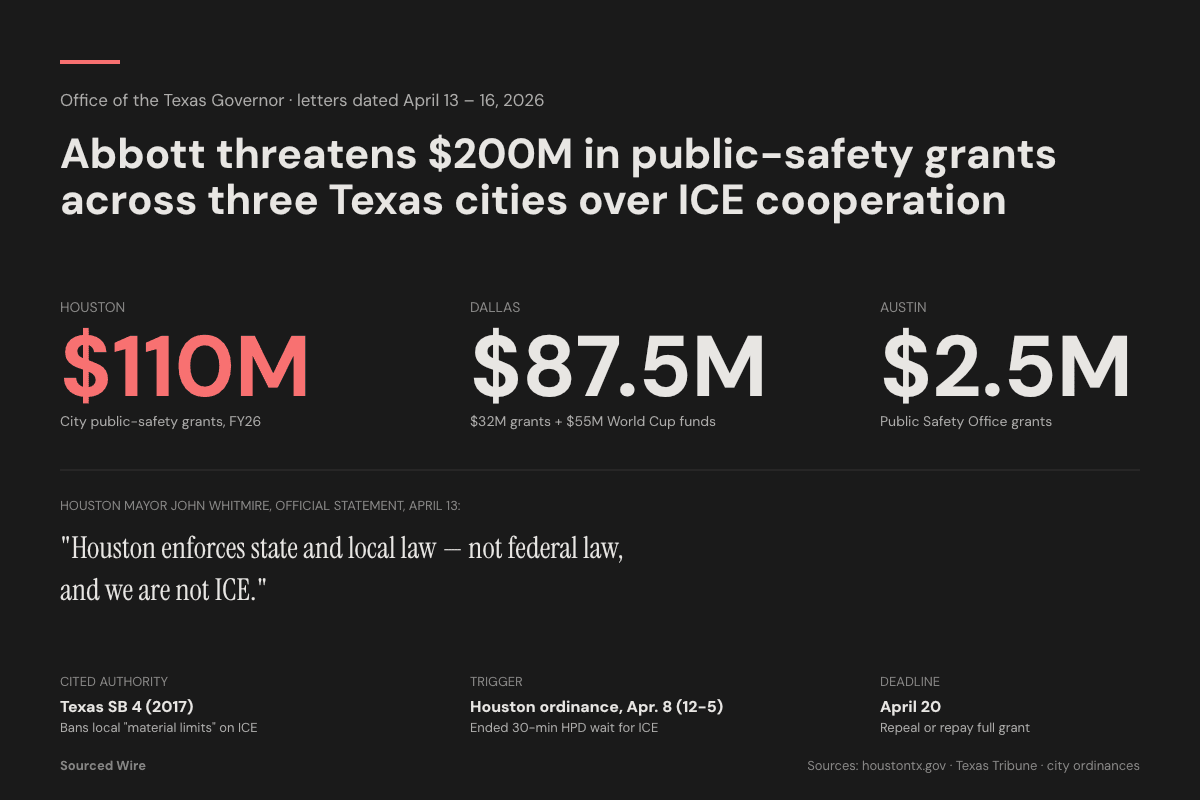
Texas Governor Greg Abbott has threatened to pull roughly $200 million in state public-safety grants from Houston, Dallas, and Austin after each city moved this month to limit local police cooperation with U.S. Immigration and Customs Enforcement, demanding the cities roll back the policies or repay the money in full.
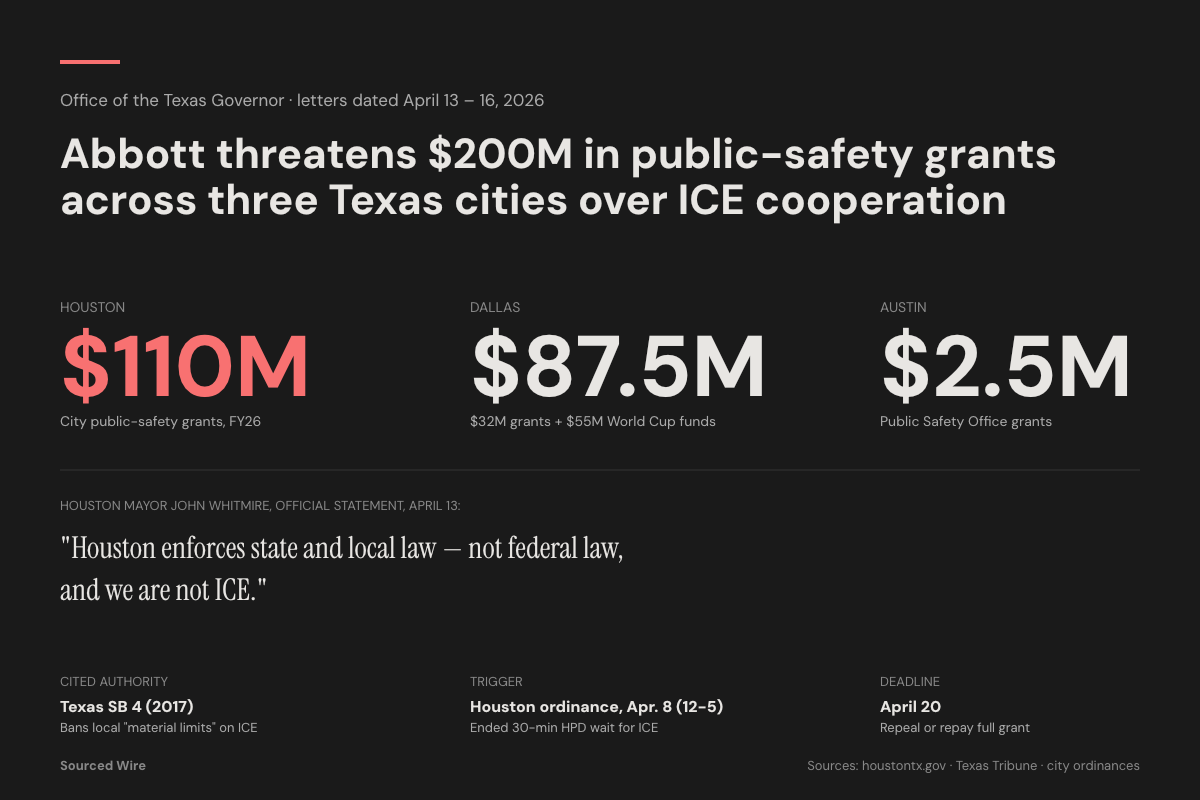
The escalation began on Monday, April 13, when the governor's Public Safety Office sent a letter to Houston Mayor John Whitmire warning that the city must confirm by April 20 that it will not enforce — and will move to repeal — an ordinance the City Council had passed five days earlier, or face the loss of approximately $110 million in Fiscal Year 2026 grants. On Thursday, April 16, the office sent parallel letters to Austin Mayor Kirk Watson and to Dallas, threatening roughly $2.5 million in Austin Public Safety Office grants and more than $32 million in Dallas grants — plus an additional $55 million in public-safety funding tied to the city's hosting of 2026 FIFA World Cup matches.
What the cities did
The Houston ordinance — passed 12-5 on April 8 and sponsored by Council Members Alejandra Salinas, Abbie Kamin, and Edward Pollard — eliminated a prior Houston Police Department directive requiring officers to wait 30 minutes for ICE agents to respond when an immigration warrant was identified during a stop. Under the new policy, an ICE administrative warrant alone — a civil document that does not allege a criminal offense — does not justify continued detention. If no crime is suspected, officers must release the person when the lawful basis for the original stop ends. The ordinance also requires the mayor's administration to file regular reports on local immigration enforcement activity.
Austin's revised police policy bans arrests made solely on civil immigration warrants and prohibits officers from "unreasonably prolonging detention" to contact ICE. Dallas's policy, which Abbott's office cited in its Thursday letter, similarly says officers "may not prolong detention" for immigration investigation and may not stop a person solely to determine immigration status.
None of the three policies bar police from honoring criminal warrants, sharing information about people booked into jail, or cooperating with ICE in cases involving criminal charges.
The legal hook
The governor's office is invoking Texas Senate Bill 4, signed by Abbott in May 2017, which prohibits local governments from "adopt[ing], enforc[ing], or endors[ing] a policy under which [the entity] prohibits or materially limits" the enforcement of federal immigration law. State officials argue that the cities' new policies — and Houston's ordinance in particular — violate certifications mayors signed as a condition of receiving the state grants, in which the cities pledged to fully cooperate with the U.S. Department of Homeland Security and to honor ICE detainer requests.
The "materially limits" provision has its own history: a federal district judge enjoined that exact language in 2017 on vagueness grounds, and the Fifth Circuit later lifted the injunction, allowing the state to enforce it. The constitutional fight over what "materially limits" means is now being relitigated city-by-city through grant-leverage rather than in court.
The response
Mayor Whitmire's official response, posted on the city's website on April 13, did not commit to defending the ordinance. "Houston enforces state and local law — not federal law, and we are not ICE," the statement said, while flagging that the governor's office and Texas Attorney General Ken Paxton had concluded the ordinance violated grant agreements and SB 4. Whitmire identified Salinas, Kamin, and Pollard as sponsors and said he had previously "cautioned" them about "legal and financial risks." The mayor described the situation as a "crisis" affecting the police and fire departments, World Cup preparations, and homeland security operations.
Houston is now reportedly considering a repeal vote. Council Member Salinas has called for the city to mount a legal defense.
Mayor Watson, in Austin, has defended his city's policy as consistent with SB 4, arguing it provides officers clear guidance on what they can and cannot do. Dallas officials said the city is committed to compliance with state and federal law and to public safety. A spokesperson for Abbott, Andrew Mahaleris, said: "Cities in Texas are expected to make the streets safer, not more deadly."
What's at stake
The combined $200 million covers grants used for police equipment, overtime, narcotics enforcement, victim services, and — in Dallas's case — security planning for FIFA World Cup matches the city is hosting in 2026. The April 20 deadline applies first to Houston; the Dallas and Austin letters set similar repeal-or-repay terms. If the cities do not comply, the governor's office has said, the state will terminate the grants and require repayment of the full amounts within 30 days.