Federal judge finds Pentagon violated his March 20 order restoring press access
Judge Paul Friedman ruled April 9 that the Defense Department's replacement credential policy -- which requires escorts for all reporters and relocates the press corps to a basement library in a separate building -- was an attempt to reinstate an unlawful policy under the guise of taking 'new' action.
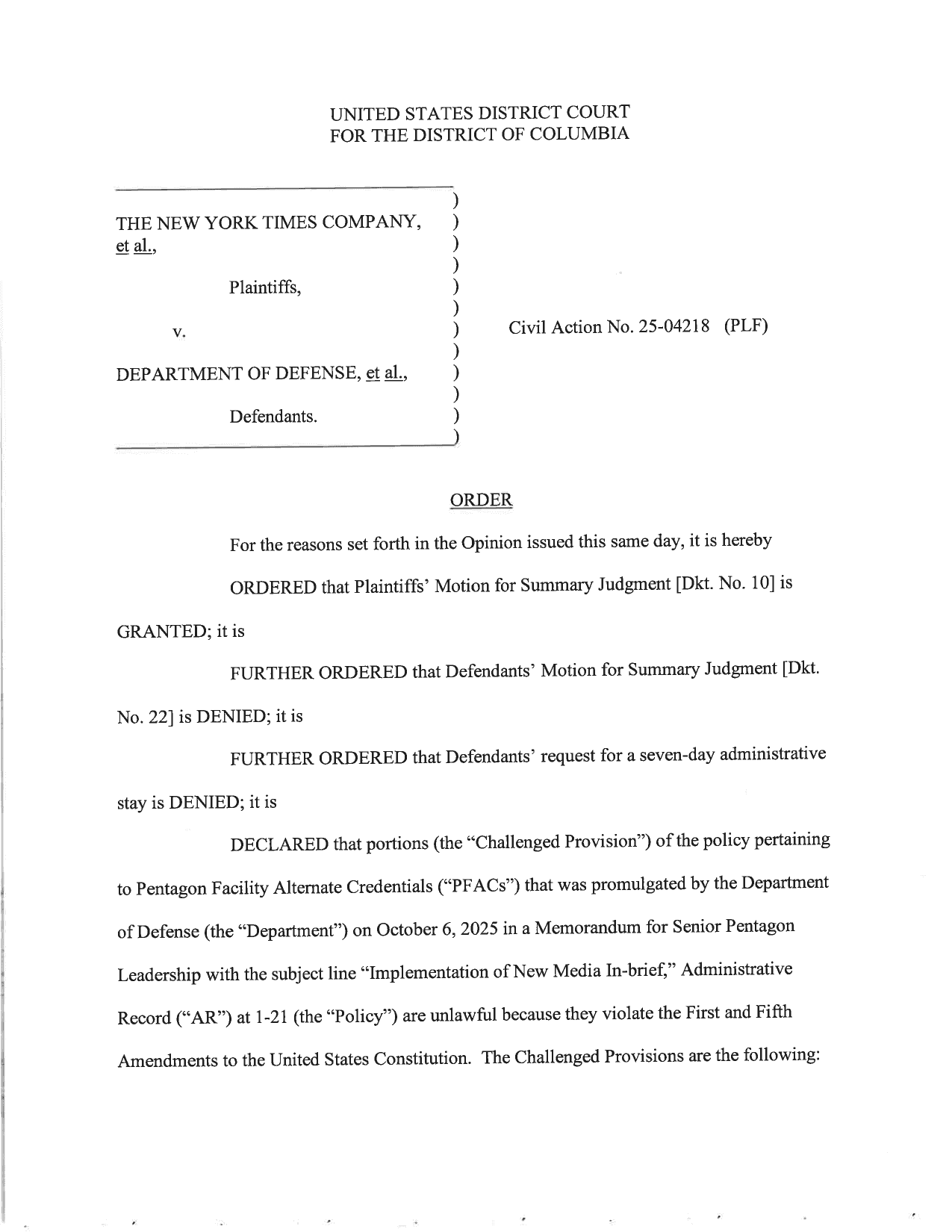
U.S. District Judge Paul L. Friedman ruled on April 9 that the Department of Defense is violating his March 20 order to restore Pentagon press access, siding with The New York Times for the second time in three weeks in New York Times Company v. Department of Defense, Civil Action No. 25-04218 (D.D.C.).
In the April 9 order, Friedman wrote that "the department simply cannot reinstate an unlawful policy under the guise of taking 'new' action and expect the court to look the other way." During the hearing, he likened the Pentagon's replacement rules to "Catch-22" and "Kafka."
The judge ordered the Pentagon to file a sworn declaration by April 16 describing the steps taken to comply with the original order. Defense Department spokesperson Sean Parnell said the department disagrees with the ruling and intends to appeal.
What the March 20 order struck down
The underlying case challenges a Pentagon memorandum promulgated on October 6, 2025 with the subject line "Implementation of New Media In-brief," which established Pentagon Facility Alternate Credentials ("PFACs"). Under that policy, the Pentagon required all accredited journalists to sign a document or lose building access; the entire press corps refused and left rather than sign.
On March 20, 2026, Friedman granted the Times' motion for summary judgment, denied the Pentagon's cross-motion, and denied the defendants' request for a seven-day administrative stay. He found the challenged provisions unlawful because they violate the First and Fifth Amendments, and ordered reinstatement of the seven Times reporters whose PFACs had been revoked -- including the named plaintiff, national security reporter Julian Barnes -- and extended relief to "all regulated parties."
The end-run
Rather than comply, the Pentagon issued a revised policy in late March. According to the Times' motion to enforce:
- All journalists would be required to be accompanied by a government escort anywhere in the building
- Press office workspaces were removed from the main Pentagon
- The press area was relocated to a basement library in a separate building north of the main structure
- Initial access to that library was only possible via Pentagon shuttle bus -- which journalists were prohibited from using
- The key policy term was changed from "solicitation" to "intentional inducement of unauthorized disclosure," with added restrictions on offering source anonymity
The Times argued this was not compliance but a set of new restrictions designed to circumvent the March 20 ruling. Friedman agreed.
The case history
The lawsuit was filed December 4, 2025. Cross-motions for summary judgment were heard on March 6, 2026, with Theodore J. Boutrous Jr. and KatieLynn B. Townsend appearing for the Times. The Pentagon Press Association, the Reporters Committee for Freedom of the Press and 23 other media organizations, and the ACLU all filed amicus briefs in support of the Times in January 2026.
Judge Friedman, appointed by President Clinton in 1994, now has until April 16 to review the Pentagon's declaration of compliance.